By Catherine Pepinster
Artificial intelligence is already changing the world and super-intelligence is coming. The disruption being caused is one of the most significant in human history — and the church has a significant role to play.
That is the view of one of the leading experts on AI and faith who spoke about the need for a Gospel vision in this volatile era.
Matthew Sanders, a Canadian tech entrepreneur who has founded and built several AI systems for the Roman Catholic Church, warned the audience during his lecture at the London Jesuit Centre on Wednesday evening that there could be serious risks to human agency, the way people relate to one another and even social unrest if AI is not managed well.
Last Sunday Pope Leo XIV said: “The digital revolution requires digital literacy, along with humanistic and cultural education.” His first encyclical, due to be published next week, will be about AI.
Mr Sanders said the Catholic church’s social teaching and ethical insights could help offer a way forward.
“If you don’t make preparations, you will be left behind,” he said. “There is the impact on the person and the impact on jobs. But AI is not so good at judgment. AI performs tasks but does not think. Only human beings are moral agents.”
He cited St John Henry Newman, the former Anglican priest and later Catholic cardinal, who said that while the world was good at the surface of things, the church was good at the depths.
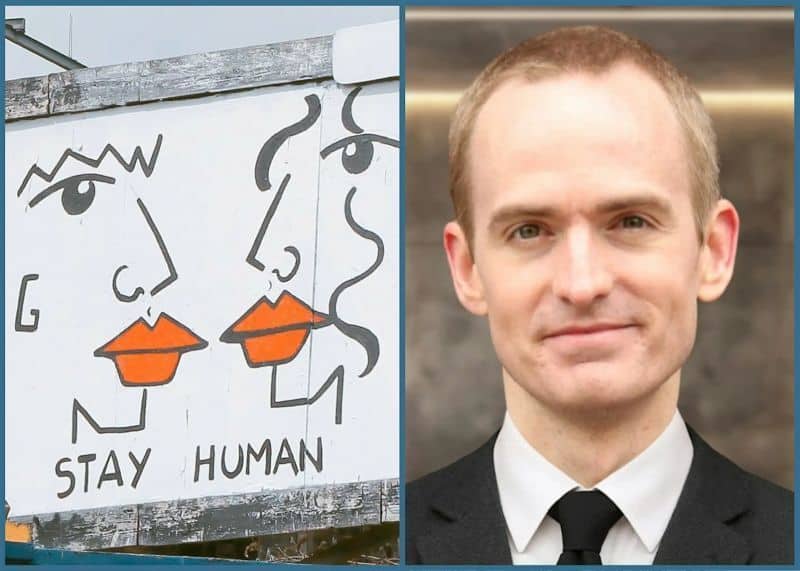
Mr Sanders, whose lecture was the fifth in the series Staying Human, organised by the Together for the Common Good organisation, urged bishops and priests to understand the significance of AI and its impact.
They should, he said, focus especially on young people at risk of losing work as AI takes on increasing amounts of processing and analysis. Meanwhile people should “treat the parish as an important anchor” as loss of work could cause the fragmentation of communities and “the link between human work and survival is severed”.
According to Mr Sanders, there are four key areas of work and decision-making that must remain the province of human beings and not be handed over to machines. These are:
- Judgment and moral weight — such as the role a judge plays in handing down a sentence to someone convicted or a doctor’s decision to operate
- Presence with the suffering — such as the role played by a doctor at a bedside, a social worker helping those in distress and needing care, or a priest in a confessional
- Formation of conscience — this would include parenting, the work of teachers, and the church helping people with discernment about their lives
- Community — the kind of meaning that people find in friendships, or with neighbours or in their parishes.
These were aspects of society “that can go undetected by an economic analysis”, Mr Sanders said, but were essential to people thriving and finding meaning.
Mr Sanders’s lecture comes at a time when there is growing interest in the Roman Catholic Church in the impact of AI on society. Last year, after his election as pontiff, Pope Leo said AI would be one of his priorities and next week his first encyclical, or teaching document, is due to be published and will be about AI.
He has already referred to AI, including speaking about its role in healthcare, saying that medical professionalism can never be reduced just to diagnosis but is about the relationship with the patient. Last Sunday he issued a message for the annual Roman Catholic World Communications Day.
“The digital revolution requires digital literacy, along with humanistic and cultural education,” he said, “to understand how algorithms shape our perception of reality, how AI biases work, what mechanisms determine the presence of certain content in our feeds, what the economic principles and models of the AI economy are and how they might change.”
And he warned that the real threat to humanity was its willingness to offload the ability to listen and think critically to AI and social-media algorithms.
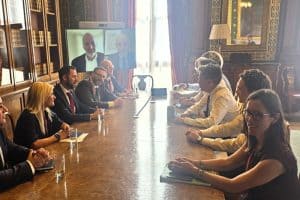
Last week, the Archbishop of Westminster, Richard Moth, hosted a panel discussion on AI at his London home, Archbishop’s House, to consider the problems caused by AI and how faith could respond. Among the speakers was Bernard Achampong, head of AudioUK who said systems being created reflected the values and incentives of the people using them, so “AI exposes our biases” and amplified what already existed.
“Truth today is shaped by many factors. A neutral, efficient machine is now amplifying the factors we endorse and the cracks are beginning to show,” Mr Achampong said.
“If the question is whether AI will make us more or less intelligent, we should find the answer in how we become more human in our use of it. What is in the service of truth must also be in service of relationship and relationship is the heart of being human.”
Among the Catholic AI systems that have been set up is Magisterium AI, founded by Mr Sanders as a platform to make all the church’s teaching and other documents — from synods, councils, papal encyclicals to yearbooks and baptismal records — available through it. He says it pulls together material that would otherwise sit in specialist libraries or church basements.
Meanwhile, young Catholics have set up a support group, Catholics in Tech, to explore the ethical aspects of their work and how church teaching relates to it. Their members were among the audience on Wednesday who heard Mr Sanders’s lecture.