CofE ‘Living in Love and Faith’ project on sexuality is closed down – but discussion continues
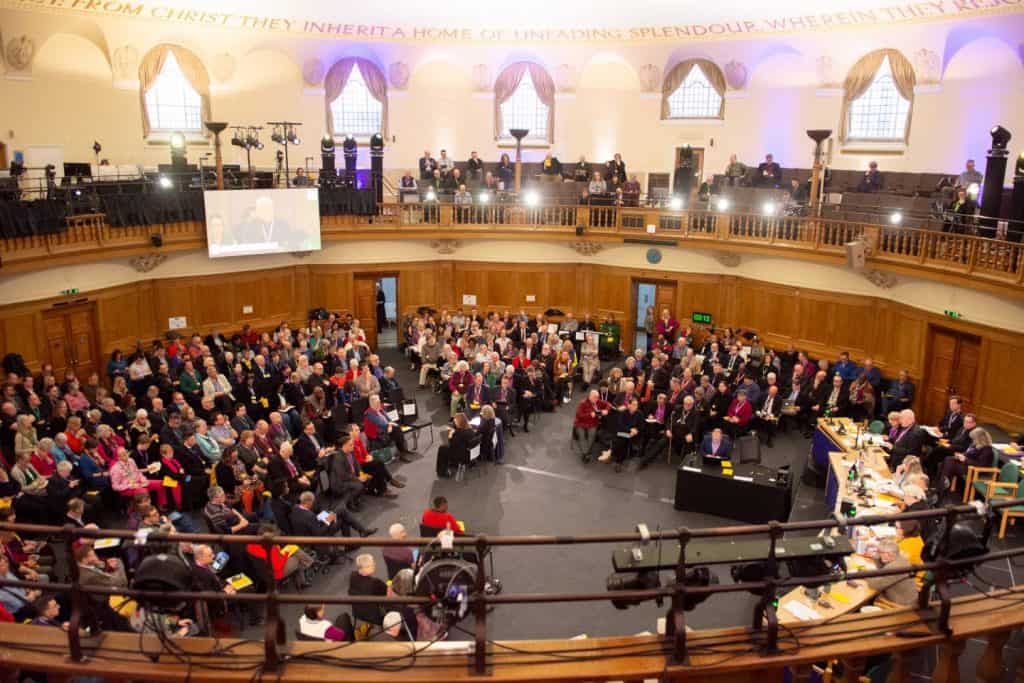
“Living in Love and Faith”, the Church of England’s long-running process on sexuality and relationships, was formally brought to a close by the general synod yesterday after failing to secure consensus on same-sex relationships. The debate has left deep divisions within the Church, with some warning of possible schism. The only substantive change to emerge from the process was the decision to permit prayers of blessing for same-sex couples within existing services. The decision followed a five-hour, often passionate debate. LGBTQ+ campaigners and supportive clergy expressed anger that the process was being curtailed while key questions remain unresolved — including whether to introduce stand-alone services of blessing and whether clergy in same-sex civil marriages may serve without restriction. Two new working groups will now be established to continue discussions. However, opponents fear the issues will return to synod, triggering further contested debates and close votes. Prof Helen King summed it up: “The problem is it’s too much of an end for some and not enough of an end for others”. It’s expected that the issue will dominate the synod elections this summer, where members are chosen for five-year terms. The next stage is that bishops will select the people on the new working groups and decide whether or when the issues come back to synod. The Archbishop of York, Stephen Cottrell, apologised for everything and said: “We need to bring LLF to a close so as to create the space where this work can breathe”. View the debate here
Church must resource interfaith work – ‘it’s not just dialogue, it’s about action’
Interfaith work in England is in crisis, according to the Bishop of Leicester Martyn Snow. He told the general synod that there were multiple reasons for this: the general polarisation of society, the impacts of global events such as Gaza or India-Pakistan, and social media. But there was another reason – the CofE is not resourcing interfaith work properly. He said interfaith work is not just about dialogue, but about action. He has been asked to convene a meeting of interfaith leaders so the government minister responsible for the implementation of the Child Poverty Strategy can find out what faith groups are doing to address poverty. The bishop, who takes the lead on poverty issues, said “If we are serious about addressing the multifaceted nature of poverty, we must work in partnership, both ecumenically and with other faith groups, and we must resource that work properly”.
Synod re-commits to ending poverty
The general synod re-committed to ending poverty and challenging politicians and business leaders about the “unjust structures and decisions that cause and exacerbate poverty”. The debate marked the 40th anniversary of “Faith in the City”, a CofE report arguing that inner-city decline is driven by structural economic change, unemployment, poor housing and racial inequality. Speakers pointed out that Black and minority ethnic communities are disproportionately affected by poverty in England. Story here
Other news
Epstein and Bannon discussed ‘taking down’ Pope Francis
The Religion News Service reports that the Epstein files show that Epstein and former Trump aide Steve Bannon discussed strategies to undermine Pope Francis. They exchanged text messages in June 2019 about the book “In the Closet of the Vatican”, by Frédéric Martel, which claimed that 80 per cent of clergy at the Vatican were gay. The messages suggest a film of the book was to be made. Bannon said: “You are now exec producer of ‘ITCOTV’”, followed by “Will take down Francis”, then “The Clintons, Xi, Francis , EU—come on brother “. A film was never made. RNS reports that emails between Bannon and Epstein from 2018 “lament the Vatican’s push against xenophobia, racism and populism, as well as the Holy See’s relationship with China”.
British Muslim Trust launch event
The British Muslim Trust has held an official launch event outlining details of its government-backed national helpline to monitor anti-Muslim hate crimes across the UK. The Ministry of Housing Communities and Local Government announced last July that it is funding the Trust to undertake independent monitoring of anti-Muslim hate, engage with affected communities, and publish regular reports. Trustees include business leader and philanthropist Shabir Randeree, and Rahima Aziz. The CEO is Akeela Ahmed. The invited audience included Faith and Communities Minister Miatta Fahnbulleh and the Mayor of London Sadiq Khan, who said “Proud of their faith and proud of the place they call home, London’s Muslim communities have strengthened the social fabric of our communities. The British Muslim Trust will help ensure those stories are heard and protected”.
Crown Prosecution Service seeks fresh ruling in Quran-burning case
The Crown Prosecution Service is appealing against the overturning of a conviction in the case of Hamit Coskun, a Turkish-born man of Kurdish and Armenian heritage who burned a Quran outside the Turkish consulate in London last year. Coskun was initially convicted under public order legislation, but that ruling was later quashed on appeal. The CPS is now seeking to challenge that reversal, with the case due back in court next Tuesday. The National Secular Society said: “We cannot allow this appeal to succeed. The criminal law is not there to shield people from being upset, even grievously upset.” It argues that pursuing the case suggests “an impulse to revive blasphemy law by other means”.
Vatican warns of schism over planned traditionalist bishop consecrations
The Vatican has held a meeting with the Society of St Pius X, a breakaway traditionalist Catholic group, to discuss its plans to consecrate new bishops on 1 July without papal consent. Cardinal Víctor Manuel Fernández, head of the Vatican’s doctrine office, warned of the risk of schism if it goes ahead. The Society was founded in opposition to the Second Vatican Council. It celebrates the traditional Latin Mass but is not in communion with Rome. The Vatican has offered talks to regularise the Society’s status, but only if it calls off the ceremony.
Church investors using global benchmark to fight modern slavery
An estimated 50 million people are trapped in modern slavery, 28 million of them in forced labour, with women and children disproportionately affected. Last Sunday, on the 12th World Day against Human Trafficking, Pope Leo renewed the call to end this “grave crime against humanity”. He called for prayer and awareness, but increasingly, faith leaders and investors argue that moral conviction must also be exercised in the marketplace. Dr James Corah of CCLA, an investment management company serving churches, charities and local authorities, says churches have a distinctive role to play through shareholder influence. To support that effort, CCLA has published its first modern slavery global benchmark, assessing 111 global companies on how effectively they identify, address and prevent slavery in their supply chains. Read our article here
13th century Yorkshire church closes after £500,000 repair bill
The 13th century church of St Martin in Yapham, East Yorkshire, is to close by the end of this year, after the parochial church council discovered it would cost £500,000 for essential repairs. The church was originally built on clay and began to decay in one corner, but the roof, drainage systems and windows all needed repair. David Millican, lay chair of the PCC, told the BBC that it would be “the end of a very long and upsetting saga when we eventually shut the fence”, but the cost was well beyond their reach. Historic England placed the church on its risk register in 2024 and said it was sorry the church was closing, but many are vulnerable to similar challenges.
Royal florist backs national drive for local church flowers
A rural church in the village of Harpley in Worcestershire has launched a national campaign urging churches to use locally grown, British flowers as part of their environmental commitment. The Sustainable Church Flowers movement began at St Bartholomew’s, championed by a churchwarden whose husband, Shane Connolly, is a florist by royal appointment, arranging flowers for the King’s Coronation and for the weddings of the King and Queen and the Prince and Princess of Wales. The King was so taken with the idea of sustainable flower arrangements, that he asked Mr Connolly to arrange flowers at Cathedrals distributing Maundy money. Campaigners say that around 90 per cent of flowers sold in Britain are imported, often carrying a heavy carbon footprint due to transport and heated glasshouses. The Harpley team took their message to the general synod, showing a film and supporting their bishop who urged cathedrals and parishes to source flowers locally and abandon “oasis” floral foam, which does not fully biodegrade. One member questioned why synod was discussing flowers instead of more serious items, like Palestine or finance. But the debate captured imaginations and there was unanimous support to get behind the movement.