Church warning as far right wins 44 per cent support in German state
The far-right AfD – Alternative for Germany – party is predicted to have won 44 per cent of the vote in the state elections in Saxony-Anhalt, in the east of the country – the first time a far right party has achieved this electoral success in Germany since WWII. But the churches have expressed alarm at AfD’s policies which include “remigration” – deporting more people who have no right to remain, restricting asylum and removing refugee protections for some Ukrainians. It wants more emphasis on German identity, a more Russian friendly foreign policy and less support for Ukraine. Just before the state election, the Catholic Bishop of Magdeburg, Gerhard Feige, warned against extremism. He said: “One must beware of its nationalistic and xenophobic evil spirit”. The night before the vote, Magdeburg Cathedral had words projected onto it in the darkness, which said: “What we love, we do not give up. True love of one’s homeland is not the AfD.”
Debate on assisted dying centres on palliative care
Lord David Blunkett has joined more than 58,000 people and almost 300 MPs and peers in a campaign calling on the government to improve end-of-life care, as Parliament prepares to consider again the assisted dying bill. The private members bill, proposed by Labour MP Lauren Edwards, returns to the Commons on Friday. It is the same as the bill which Kim Leadbeater proposed a year ago. It fell as it ran out of time in the House of Lords, following widespread concern over the protection of vulnerable people. However, the Commons supported it with a majority of 23.
Hospice UK says hospices have a £745 million funding gap and Lord Blunkett told the i paper that he wants Andy Burnham to come up with half of this, saying this “would bring about fairness and much needed stability and a recognition of their crucial role in end of life care”. The Prime Minister has said that palliative and social care funding needs to be fixed before the debate on assisted dying progresses.
The Press Association has commissioned a poll which has found that a third of those surveyed feel the law should only be changed if there is more funding for end-of-life care alongside. However, 61 per cent support the return of the Bill to parliament. The poll, by Ipsos, was of 1,133 people aged 16-75, surveyed at the end of August.
The campaigning organisation Care Not Killing has released a survey of 100 MPs, which found two thirds were concerned that if the assisted dying bill is seen as not protecting the vulnerable, this will undermine trust in politics. MPs who were elected before 2024 were more likely to say the bill is a distraction. The survey was by Whitestone Insight.
Tough questioning for Israeli embassy official over settler violence
Israel’s most senior diplomat in the UK faced tough questioning from the Board of Deputies over settler violence in the West Bank and forthcoming British sanctions. Jewish News reports that at the Board’s plenary meeting, Christian Cantor, Israel’s Chargé d’Affaires, was pressed on why the Israeli government was not doing more to tackle what was described as “appalling” violence. The Board’s president, Phil Rosenberg, has previously called for an immediate end to extremist settler violence in the West Bank, while warning that proposed UK sanctions could damage relations with Israel and have harmful consequences for British Jews. He told the meeting that following a conversation with the foreign secretary, they had received assurances that their concerns were understood and would be taken into account. Cantor acknowledged the concerns, saying they were conveyed “all the time” to Jerusalem. He also warned that British measures could trigger Israeli retaliation and a “tit for tat” cycle.
‘Endangered’ CofE vicars defended by journalists
A Times comment piece has supported the Church of England, in the wake of a report which says “vicars are becoming an endangered species”. The article says when there is a failure to recruit and retain clergy “it would be fair to call this a national crisis, as an established church exists to serve all… The Church of England merits the good will of all who, even if not subscribing to its credo, recognise the essential humane and charitable impulse it serves”. In The Telegraph, columnist Allison Pearson criticises the “crisis” in the CofE, citing the shortage of clergy, excessive bureaucracy, the merger of parishes and the £100m reparation for slavery fund. Vicars, she says “are part of the bedrock of our society, like so much else of value, they could easily disappear…. We may not be in regular communication with God, if we even knew what that meant, but we are grateful that there are vicars who do know and who are keeping the line open should we feel the need to be in touch with Him.”
Pope hopes diplomatic talks this weekend will bring peace in Ukraine
The Pope has said he hopes that “the efforts being made in recent days to resume negotiations will bear concrete fruit and pave the way for diplomacy.” US envoys Steve Witkoff and Jared Kushner travelled to Russia for talks on Saturday with Russian President Vladimir Putin, and then to Kyiv on Sunday for talks with the Ukrainian President Volodymyr Zelensky. Pope Leo said: “My heart goes out to the suffering of the people, who have been living in distress and fear for years.” He renewed his appeal “to end the violence and halt the destruction, and to open hearts to dialogue, and peace.”
Vatican correspondent for Crux steps down
Elise Ann Allen, Vatican correspondent at the Catholic publication Crux, has announced that she is stepping down, months after her husband John Allen, the editor of Crux, died aged 61 from cancer. She released a statement saying that this has been a year of transition: “This was not a light decision, but a very thoughtful and considered one, and it makes sense for me at this time in my life.” Crux was started by the owner of the Boston Globe in 2014 and John Allen became editor two years later. Elise Ann Allen says she hasn’t “the slightest clue” as to what comes next, but she is hoping for a bright and wonderful future.
‘Stolen Generations’ cloak presented in Adelaide
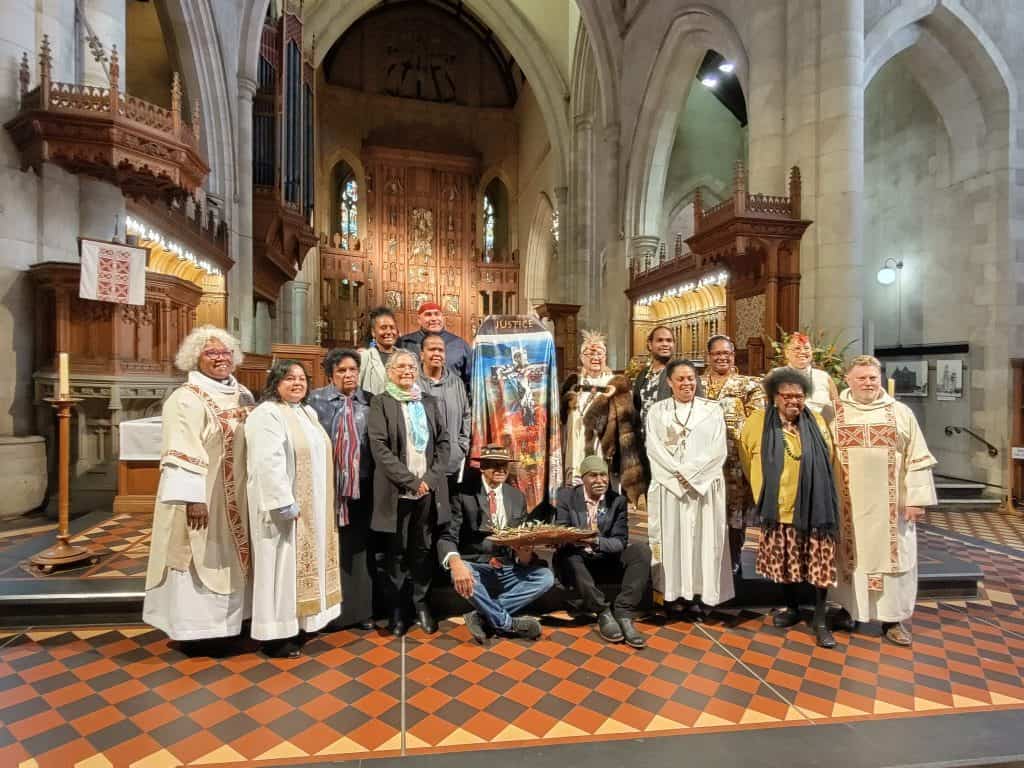
A richly patterned cope, a long flowing ceremonial cloak worn by clergy, which commemorates the “stolen generations” of Aboriginal and Torres Strait Islander children who were forcibly removed from their families, was presented to First Nations people at AdelaideCathedral yesterday. The cope was commissioned by the former Archbishop of Canterbury, Justin Welby, following an official visit to Australia. It was created over three years by Liverpool artist Terry Duffy and incorporates the colours of the Australian landscape on fine silk, with depictions of influential First Nations figures, flags, their military past, ancestral pathways, and ancient rock art. The church says it is a sacred garment which encourages reflection on truth, justice, and reconciliation. Pastor Ray Minniecon, Aboriginal Elder, pastor and long-standing advocate for members of the Stolen Generations, said the story lives on in families, communities, and memory.
Katie Taylor world boxing champion and committed Christian
Katie Taylor, the 40 year old Irish boxer who became the women’s super-lightweight world champion for the third time at Dublin’s Croke Park this weekend, is a committed Christian whose faith is on display at every bout. As she made her final walk to the ring, she sang the name of Jesus with arms outstretched as a gospel song played in the background to a crowd of 80,000. And afterwards she gave an interview, saying her career had been beyond her wildest dreams. God had done the impossible in her life, time and time again, and she gave Him the glory. In her long career, she had a record 26 wins and one defeat.