By Catherine Pepinster
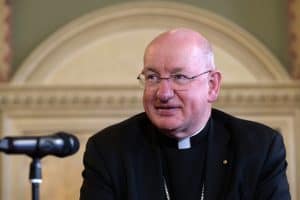
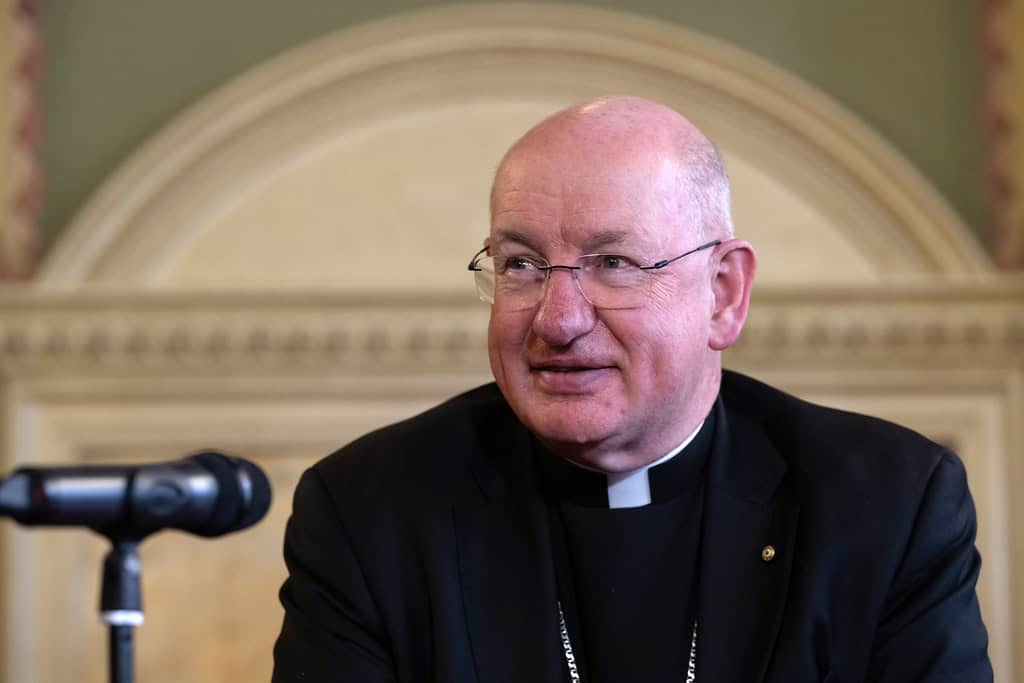
Bishop Richard Moth has been appointed as the next Roman Catholic Archbishop of Westminster, succeeding Cardinal Vincent Nichols.
Bishop Moth, 67, he has been Bishop of Arundel and Brighton for the past 10 years and before that was Bishop of the Armed Forces.
He brings to the role a deep interest in social justice, especially in prisons and mental health, education, and poverty.
The day before he was appointed, he issued a statement in his capacity as chairman of the Department for Social Justice of the Catholics Bishops Conference of England and Wales, voicing grave concern about the hostile language used about migrants and refugees.
“The Holy Family had to travel to Egypt as refugees,” he said. “We should empathise with all who come to this country for their safety”
The statement was made at a time when politicians who have created an anti-migrant platform have also started talking about protecting Christian culture, while the far-right activist Tommy Robinson has urged his followers to “put Christ back into Christmas”.
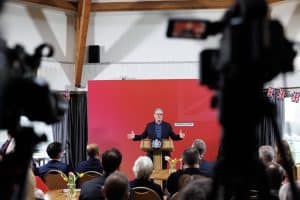
At a news conference following his appointment, Bishop Moth said that those in the church “have to persevere in talking about the dignity of the human person, to say that everybody has value, wherever they come from”.
He also referred to the large number of different nationalities among the Catholic population. “The international flavour that the Catholic Church brings to this country is precious. It is important for the church to proclaim it,” he said.
He highlighted that prayer, formation and mission would be key priorities in Westminster, as they had been in Arundel and Brighton, and that mission would be aimed at not only Catholics but towards other Christian communities and those of other faiths.
And he suggested that the Catholic Church’s concerns regarding the treatment of prisoners, migrants and others on the margins of society would be part of this: “The work of social justice is where [mission] can happen to great effect.”
Richard Moth was born in Zambia in 1958, the son of Catholic parents, and was then brought up in Kent. He trained for the priesthood straight from school at the seminary of St John’s, Wonersh, in Surrey, which shut in 2022.
He was ordained a priest in 1982, and worked in parishes within the Archdiocese of Southwark, later becoming private secretary to the Archbishop of Southwark and then vicar-general for that diocese.
He served as Bishop of the Armed Forces from 2009 to 2016 and became Bishop of Arundel and Brighton in 2015. He was appointed at a difficult time, following the resignation of the previous bishop, Kieran Conry, who admitted to being “unfaithful”.
His appointment to Westminster comes after months of speculation regarding the choosing of a successor to Cardinal Nichols, who has stayed in post for five years past the retirement age of 75.
In recent weeks, Catholics have been debating whether a problem held up the appointment — made by the Pope, after advice from the papal nuncio (ambassador) to the UK and discussion by the Vatican Dicastery (department) for Bishops — such as another candidate turning the role down.
Bishop Moth told journalists that he first found out last weekend that he had been chosen by Pope Leo XIV when he received a phone call asking him for a meeting with the nuncio. He said that he was very grateful for the trust placed in him by Pope Leo but that he felt “a certain amount of apprehension”.
“This is going to be a big change … the biggest learning curve is the scale and profile [of the role],” he said.
The diocese of Arundel and Brighton has a weekly mass attendance of 43,000 — about 25 per cent of the diocese’s estimated Catholic population — and the Archdiocese of Westminster has a Catholic population of 450,000 with 212 parishes and 206 schools.
Its archbishop also plays a national role and is perceived as the leader of Roman Catholics in England and Wales and often acts as a spokesman for the Church on major national issues. All its archbishops, since the diocese was created in 1850, have been appointed cardinal by the Pope of their day.
Bishop Moth will be installed as archbishop at a mass at Westminster Cathedral on 14 February.
“My first task will be to get to know the priests and people of Westminster and I look forward now to serving them,” he said.
“With them, and building on the firm foundations that have been laid by so many down the years, I look forward to continuing the great adventure that is the life of the church and witness to the Gospel.”
Among the issues in the new archbishop’s in-tray are the future structure of the diocese and whether it has enough priests to serve all its parishes. There will also be discussions about Catholic schools and whether, as demographics change, some schools have falling rolls and others need to increase their intake.
Traditional Catholics will want to see how the new archbishop responds to requests for the Old Rite of the Mass to be celebrated, while women will be looking to see whether Moth encourages them to take leadership roles in the archdiocese. Rome recently ruled out allowing women to become deacons — for the time being.
Safeguarding and the way the new archbishop deals with child sexual abuse will also be a key issue. Today Moth stressed that he is always ready to talk to survivors. “The opportunity to talk is always there”, he said.
He will also be coming into his new role at the same time as Dame Sarah Mullally, the Archbishop elect of Canterbury, whom he said he knows a little and looks forward to working with her.
But he would not be drawn on detailed issues during his first encounter with the press. Using an analogy from his hobby of horse-riding, he said that: “It is important never to rush a fence.”
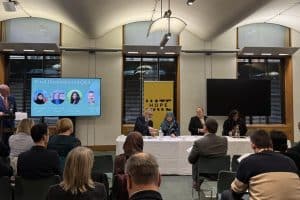
Among those who know him are Sister Gemma Simmonds, director of the Religious Life Institute. Speaking at a Religion Media Centre webinar, she described him as “a man of great prayer”, referring to the time he spends at the Benedictine abbeys of Pluscarden in Scotland and Worth in West Sussex.
Anthony McClaran, vice-chancellor of St Mary’s University, Strawberry Hill, where Bishop Moth has chaired governors for 14 years, told the webinar that the new archbishop was “a great listener. His chairing is something of a masterclass.”