By Lianne Kolirin
Theirs is the unlikeliest of friendships in a city still reeling from the effects of a fatal terrorist attack four months ago.
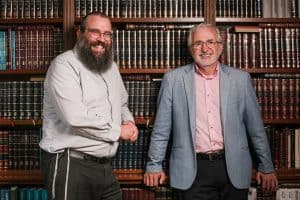
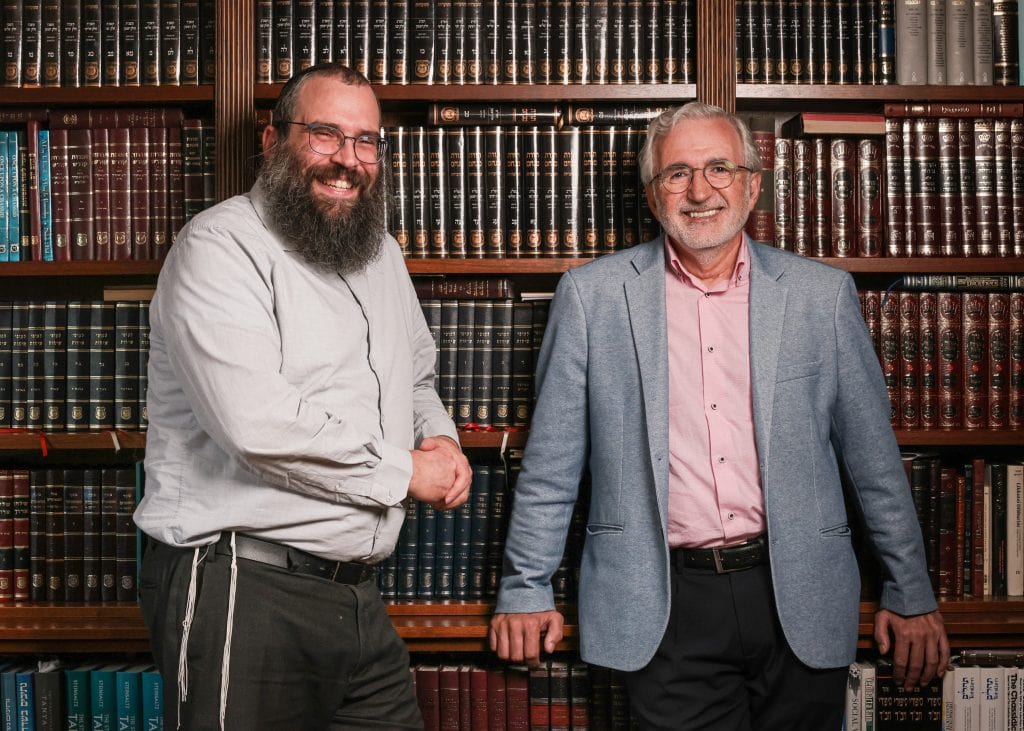
“We’re great mates,” said Rabbi Dovid Lewis of his relationship with Imam Nasser Kurdy.
This is not a throwaway line, as listeners of The Rabbi, the Imam and the Power of Dialogue podcast can attest. The men have used their series to show how powerful talking can be in bridging divides between two communities.
In the eight episodes so far, they have discussed topics from the definition of Zionism and how social media has accentuated antagonism between their two communities, to the terrorist attacks on Heaton Park synagogue in Manchester and at Bondi Beach in Australia.
Friendship does not mean they always agree. Far from it. The podcast, as the online introduction states, seeks to explore how “despite their many disagreements” they have “managed to stay friends while war rages thousands of miles away”.
Rabbi Lewis has been the full-time rabbi of the Orthodox Bowdon Synagogue since 2011. Dr Kurdy, a consultant orthopaedic surgeon, previously served as a lay imam for the Altrincham and Hale Muslim Association. The pair frequently encountered each other at interfaith initiatives in south Manchester.
“We were bumping into each other but almost like two ships in the night,” Dr Kurdy said of the time before they became friends 13 years ago.
Eventually Rabbi Lewis suggested his synagogue host an iftar in 2018. It was “like a first date”, they told the Religion Media Centre, as both sides were unsure of each other. It proved to be a “phenomenal experience”, says Rabbi Lewis, whose synagogue went on to repeat the iftar several times, including an online version during the pandemic.
The communities subsequently volunteered together for a local homeless shelter, cooking traditional Asian recipes in a kosher kitchen. “We realised that working together for the betterment of Manchester, we could do a lot,” Rabbi Lewis said.
When news of their collaboration spread, the two men were invited into a couple of schools to give assemblies on how they became friends.
One might have expected their relationship to have stalled after Hamas attacked Israel on October 7 2023, leading to the bloody war in Gaza — but the opposite happened.
Soon after the initial attack, Rabbi Lewis heard from Mark Schweiger, one of his congregants, who desperately wanted to do something to ease communal tensions. His idea was to get a rabbi and an imam to speak together in schools.
“I said, ‘Hi, I’m a rabbi and I have an imam and we’ve done this before’,” Lewis said. “To his credit, he took our small little thing and supersized it.”
With Mr Schweiger’s help, they have now visited dozens of schools, mainly across Greater Manchester, and addressed about 15,000 schoolchildren. “Without Mark it wouldn’t have gone that far,” Dr Kurdy said.
“By and large the talks begin with ‘Hi, my name’s Dovid Lewis. I’m a Mancunian, I’m a rabbi, I’m a Jew and I support Israel. Standing next to me is my very good friend.”
The doctor continued: “I’m Nasser Kurdy, I’m an Arab, I was born in Syria from a Jordanian background. I’m a Muslim and I’m pro-Palestinian so how come we’re standing here together, side by side? Some of you may see that this is something odd considering what’s happening in the Middle East, but we’re here to tell you how we do it.”
Where the conversation goes depends on the audience, the mood and the news of the day. “When we started we didn’t know what the other was going to say so in a sense we were experiencing and experimenting the other — how will Dovid respond to what I’ve said and how am I going to respond to what he says,” Dr Kurdy said.
“Over a period of time we gained trust. Sometimes I’d say something that would make Dovid think, ‘Hold on a minute, why did you say that?’ and vice versa. But over time we realised we weren’t saying it to trip or to trick the other … we actually speak honestly and from the heart. We don’t feel obliged to hold back.”
Their young audiences can ask difficult questions and even be hostile. Rabbi Lewis recalled an event at a school with a large Muslim population. “One of the boys turned round and said to me, ‘The whole thing’s a waste of time — how can you stand there and say you support Israel when Israel is committing a holocaust in Gaza?’
“The temperature of the room shot up. I took a breath and then Nasser stepped in and said, ‘Let me answer this one.’
“I’ve never been prouder to call him my friend. Emotionally, but not excitedly, knowledgeably but not academic and bookie, Nasser explained what the Holocaust was and why the war in Gaza was not a holocaust. He said ‘that doesn’t mean I agree with what the [Israel Defense Forces are] doing but let’s not start throwing around these words which are not necessarily offensive but they are triggering.’
“At that point I thought, ‘Here’s somebody I can trust when the conversation is difficult’.”
In 2017, Dr Kurdy was stabbed in the neck outside the Altrincham mosque. When he later examined his CT scan, he realised how close he had come to death.
He set out to forgive his attacker — who was jailed for five years and four months — and wrote a book about the experience. He went on to deliver his message to schools, community groups and prisons. His work promoting peace and forgiveness earned him an MBE in the King’s new year’s honours list.
Rabbi Lewis, who comes from the Heaton Park area of north Manchester, where his great uncle was the rabbi for 35 years, also has direct experience of where hatred can lead. His cousin Rabbi Eli Schlanger was among those murdered on Bondi Beach in December.
Although their experiences lend weight to their words, they are not immune to criticism. Dr Kurdy said he sometimes came under fire from Muslim pupils.
“At one point,” he recalled, “one of the students was having a go at me and Dovid stood in and said, ‘Do you realise who this person is? Do you realise what happened to him, the stabbing, the forgiveness …
“‘You’re not looking at somebody who just came off the street and is trying to give an opinion like on YouTube or other channels. This is a trustworthy person who has been the leader of his community for a number of years. You’re having a go at him because there’s some anger inside of you but you really have to rethink your position towards him’.”
The rabbi has met similar hostility. “The Jewish kids will sometimes get annoyed with me, like, ‘You didn’t go at him, you didn’t pull the rug out.’ I’ve got better things to do than waste my time with that — this is about understanding, being curious and learning.”
There are moments, however, that defy expectation. When the pair attended a sixth-form college, they were warned that one student planned to leave when the rabbi spoke.
“He didn’t want to be in the same room as me,” Rabbi Lewis said. “To his credit, he stayed for my opening line and then he stayed for Nasser as well and then when it was my turn to respond he looked up, facing away from me and he listened.
“At the end of half an hour he walked up to me and said, ‘Is it OK if I shake your hand?’ ‘No it’s not,’ I said. ‘I want a hug.’ In his life he’d never believed he could actually sit in the same room as a Jew.”
The content and delivery of the school talks, coupled with how they were received, proved so compelling that Mark Schweiger helped them to launch the podcast, which he produces. As with their school addresses, the two men regularly banter with each other and nothing is off-limits.
Mr Schweiger told the RMC that the inspiration for the initiative is “to show young people that a Jew and a Muslim can stand side by side, under the shared banner of humanity, empathy, and unity”.
“Together,” he said, “we can model how to have difficult conversations, how to disagree respectfully, and how to feel compassion for each other’s struggles.” Of the two men, he added: “Their authentic friendship and courage bring alive the values of peace and respect in classrooms and assemblies, leaving a deep and lasting impact.”
Ultimately, what the rabbi and the imam would like to see is more people reaching across the religious divide to make friends.
“Everybody’s hurting about what’s happening — it’s how you express that,” Dr Kurdy said. “We’re not shy of standing and talking to people. I’m a surgeon and by nature an alpha male and we give lectures, we talk. Where we operate is called the theatre as well so we’re performing all the time. And Dovid, if you go to one of his sermons, he’s definitely not shy.”
Rabbi Lewis laughed and added: “There’s no one doing what we do but as my siblings remind me constantly — there ain’t nothing special about me. Find someone you trust and if you can’t find that, develop that trust.”
Rabbi David and Imam Nasser will be appearing at the JW3 Centre in north London on 27 April for “An Evening with the Rabbi and the Imam” – details here