Middle East crisis ‘triggers massive displacement in Lebanon’
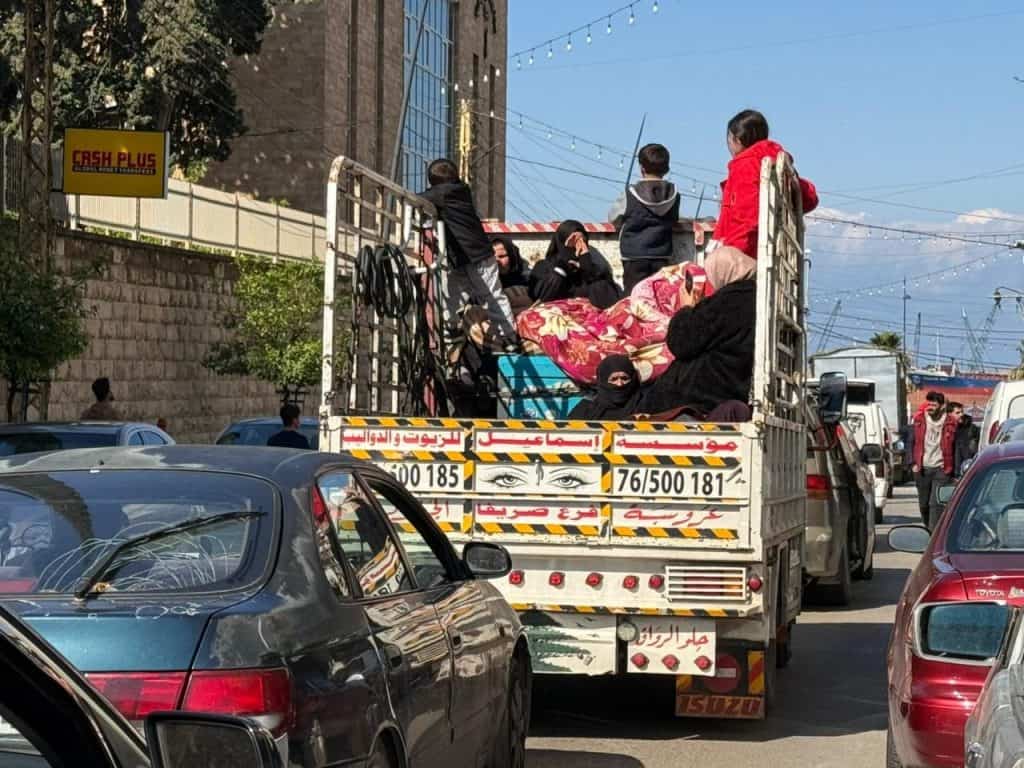
The aid agency Islamic Relief says its workers in Lebanon are reporting mass panic and displacement, with families sheltering in schools to try to escape airstrikes and enforced evacuation. It says there are fears that more than one million people in Lebanon will be displaced, causing a major humanitarian crisis. Thousands have packed their belongings into cars and trucks, and roads are jammed as people flee north towards Beirut, which has itself been bombed. Islamic Relief says it is preparing to respond to growing humanitarian needs across the region, by providing food, water, blankets, mattresses, and hygiene kits. Islamic Relief Worldwide says it is “deeply alarmed by the escalating military conflict” and is calling on all parties to exercise restraint and pursue a diplomatic resolution.
Presiding bishop of US Episcopal church ‘alarmed’ at strikes on Iran
The Presiding Bishop of The Episcopal Church, Sean Rowe, has spoken of his alarm at the US-Israeli strike on Iran, which he said happened despite negotiations which many hoped “would prevent armed conflict in this fragile region, which is home to so many religious traditions and faithful people”. He asked the church to pray for the people in the Holy Land, and for the people of Iran and the Diocese of Iran as “retaliation inevitably follows, suffering that will spread across the entire region”. His statement is here
Archbishop in Jerusalem and the Middle East says attacks ‘strike at heart of the diocese’
The Primate of the Episcopal Church in Jerusalem and the Middle East, Hosam Naoum, has spoken of the “terrifying speed” with which the “cycle of violence” is moving through the Middle East. In a pastoral letter he said “the developments strike at the very soul of our Province of Jerusalem & the Middle East. Every single nation now engaged in this combat, and those bearing the brunt of the retaliatory strikes, resides within our ecclesiastical boundaries”. He called for unceasing prayer to protect the innocent and a sound mind for the leaders involved “that they might recognize the futility of this bloodshed and turn back from the precipice of a global catastrophe”.
Impact of global tension on faith communities in Britain
Global events have repercussions on British faith communities and interfaith relations, with rising tension and hate crime. Maira Butt reports on initiatives to assess the impact of global tensions on communities here, with a Woolf Institute Commission underway and a Good Faith Partnership report on how tension affects relations within faith groups as well as between different traditions. Her report is here
Chief Rabbi appeals for the miracle of Purim to be re-enacted in Iran
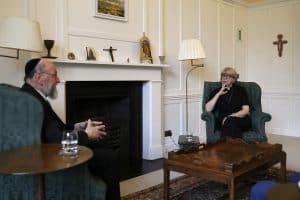
The Chief Rabbi, Sir Ephraim Mirvis, has led prayers urging a re-enactment of the miracle of Purim amid Israel’s conflict with Iran. In the Purim story, a Jewish woman, Esther, married the King in Persia and revealed her religion to stop a slaughter of Jews in the country. Speaking as the military action began, Sir Ephraim told a United Synagogue gathering: “We look forward to a re-enactment of the miracle of Purim… In the same way as the tables were turned, and in ancient Persia, the Jews triumphed, so too today in Iran, which is the modern-day state of Persia, may we see a swift and absolute victory for those who are seeking to guarantee our safety, our freedom, our peace, and our security in the future.” Jewish Chronicle report here.
In Israel, there is a ban on public gatherings which has affected churches, mosques and synagogues where the faithful are observing Lent, Ramadan and Purim. The Religion News Service reports from Jerusalem that there is a palpable sense of loss. The report says that Jewish children and adults have been encouraged to continue dressing in fancy dress, a Purim custom, as they seek safety in bomb shelters.
Other news
Gafcon to launch alternative Anglican Communion this week
Gafcon, the movement of global Anglicans with conservative ideas, is holding a four day conference in Nigeria this week when it will set up an alternative Anglican communion. It will also start the process for choosing a new “first among equals” in place of the Archbishop of Canterbury. The gathering of bishops in Abuja, will declare that this new Global Anglican Communion represents the true continuity of historic Anglicanism. Gafcon split away in June 2008 opposed to the Anglican communion’s moves towards accepting same sex relationships and ordaining women as bishops and priests. There are 42 Anglican provinces, or regions, and there are 10 Gafcon provinces. Gafcon’s main membership is in the Global South, with pockets of support elsewhere.
Role change for Archbishop of Canterbury as president of the main global Anglican church
The Anglican Consultative Council, which helps to run the mainstream worldwide Anglican church, will consider proposals to replace or dilute the place of the Archbishop of Canterbury as president, at its meeting in Belfast in June. The Council and the President are two of the four structures which seek to keep the church united, but this has come under strain with differences of opinion of same sex relationships, and the role of women as priests and bishops. This has come into stark relief now the role is held for the first time by a women, Dame Sarah Mullally. The meeting in June will discuss whether to create a council of regional primates, sharing the pastoral ministry of the Archbishop of Canterbury; or alternatively, abandoning the role of president, with clarification on the role of the chair. Dame Sarah said she was looking forward to attending the meeting – her first as Archbishop of Canterbury – and considering the proposals, as the church seeks to “walk together to the highest degree possible”.
Justin Welby reveals he has sought psychiatric help after resigning in 2024
The former Archbishop of Canterbury, Justin Welby, has revealed that he has been seeing a psychotherapist and a psychiatrist, after he was forced to resign shortly after the publication of the Makin review into the serial abuser John Smyth. The report described failings in the Church of England, over its handling of abuse claims against Smyth which allowed him to continue abusing boys and young men for decades. Speaking to Gyles Brandreth, the broadcaster and former MP, on his Rosebud podcast, he was asked whether he had sought help to cope with the scandal, beyond turning to his wife and speaking to God. He replied: “I’ve been seeing a psychotherapist for a considerable period of time. And a psychiatrist. Very helpful. It’s not about saying, ‘oh, it didn’t matter’, or anything like that, quite the reverse – how does one live with such a failure?” Telegraph report here
Briefing today: The BBC Charter review and the future of religious broadcasting
We are holding a zoom briefing today at 1200, on the BBC Charter Review and the future of religious broadcasting. It is open for public consultation until 10 March and seeks answers on how the BBC can adapt and be secured for the future at a time of technological and societal change. Religious broadcasting has been embedded within the BBC public service settlement, but in the new media landscape of algorithms and global competition, will there be a demand for such programmes? And how will the BBC challenges of trust, funding, competition and public service to the nation, impact religious programming. Our host is Torin Douglas, former BBC media correspondent, and our guests include: The Archbishop of York, Stephen Cottrell; Anna McNamee, Executive Director, Sandford St Martin’s Trust; Alison Green, Head of Digital at CTVC; Bishop John Arnold, Catholic Bishops’ Conference and Roger Bolton, broadcaster. To join the briefing, get the link from [email protected]