BBC committed to universal public service ‘representing the whole of the UK’
The BBC’s response to the public consultation on the future of the Corporation says “bold choices are needed to secure the BBC as a universal public service for generations to come”. Providing something for everyone includes “trusted news, children’s content, education, local and global journalism, UK storytelling and support for the creative economy. A driver for personal value, as well as economic, cultural and social.” It says it is committed to representing the whole of the UK and lists services for the public good as children’s, arts culture and music, sport, drama/comedy, entertainment and factual, including programmes like Pilgrimage, which “inspire, spark curiosity and help audiences make sense of their world”. It says the licence fee should continue to fund a wide range of services that inform, educate and entertain, but without reform to its funding model, the BBC will no longer be able to maintain its breadth. At present 94 per cent of adults use the BBC but only 80 per cent pay. It says it is up to the government to decide on a future funding scheme, but “a universal service requires a universal funding model” and it floated the idea of a household levy. Advertising or any commercialisation of public service activity “cannot erode universality”, and paying by subscription, public service content behind a paywall, is inconsistent with the public mission of a universal BBC. The closing date for public submissions to the green paper on the BBC Royal Charter Review, is 10 March. Here’s the link
Westminster Quaker Meeting House raided again by Metropolitan Police
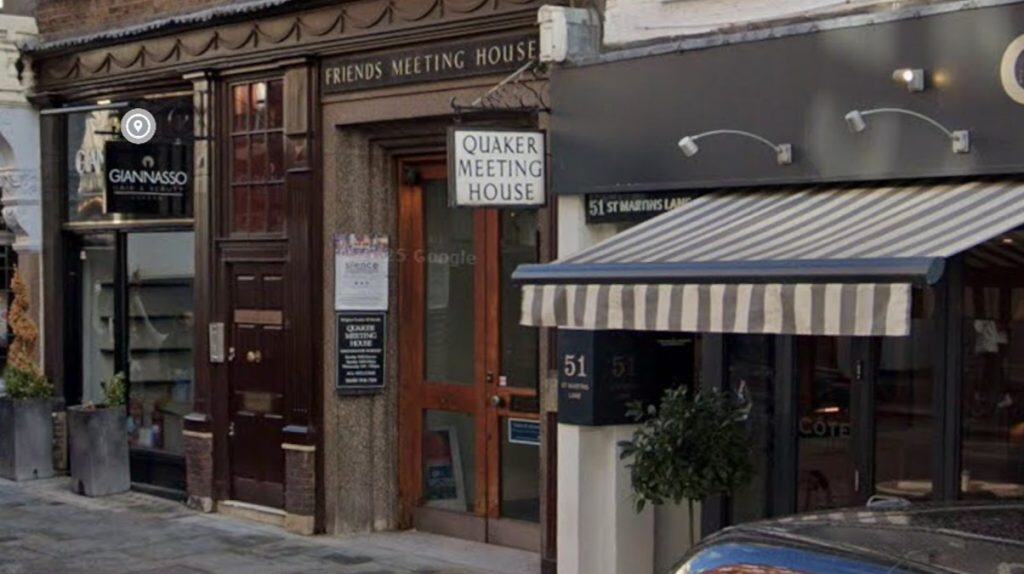
The Metropolitan Police say 15 people were arrested last night at the Quaker Meeting House in Westminster “as part of an operation to disrupt plans for mass shoplifting by activists from Take Back Power”. In a statement, it says the activists had gathered for “non-violent direct action training” and were “interrupted” by police officers who had grounds to suspect them. Deputy Assistant Commissioner James Harman said: “I know that a similar operation at the same Quaker Meeting House last March, which saw the arrest of a number of Youth Demand activists, attracted some concern. While we reflected carefully on those previous concerns before approving tonight’s operation, and took steps to ensure we caused minimal disruption, we ultimately felt we had no choice but to act. We cannot get into a situation where groups planning criminal acts can escape police action simply by booking rooms in certain venues.” One man arrested has since been bailed and 14 were taken into custody at London police stations where they remain. Oliver Robertson, head of witness and worship for Quakers in Britain, said the fact this is the second time in a year that the police have raided the meeting house, dramatically illuminates the broader trend of cracking down on those who disagree with the government. He said the right to protest is fundamental to democracy: “Whilst we take the planning of criminal acts very seriously, we believe that this incident is a deliberate targeting of committed young people who want to make our country a more equitable place. This raid is part of a systematic stifling of dissent.”
World Christian leaders ‘dismayed’ by war and appeal for peace and justice
The Anglican Communion, the Lutheran World Federation, the World Communion of Reformed Churches and the World Methodist Council say they are ‘profoundly dismayed at the international community’s failure’ to prevent wars across the world. Their statement says: “Instead of pursuing the difficult but necessary paths of diplomacy and dialogue, nations have increasingly resorted to military solutions, pouring vast amounts of resources into arms rather than into peace processes and humanitarian assistance for the vulnerable. Justice demands that perpetrators of violence and the individuals and countries responsible for atrocities and violation of international law must be held accountable for their actions.” They re-affirm their strong commitment to peace and multilateralism – “countries of the world pursuing a common goal of justice, peace and sustainability, based on principles of inclusivity, equality, and cooperation”. Full statement is here
Gafcon pulls back from electing a leader to rival the Archbishop of Canterbury
Gafcon, the global conservative Anglican movement set up in opposition to progressive changes in the Anglican communion, has pulled back from moves to elect a leader “the first among equals”, who would have rivalled the Archbishop of Canterbury. It has also decided to turn the Global Primates Council into the Global Anglican Council, with laity and clergy sharing power with archbishops. The decisions have surprised commentators who were expecting changes representing a schism. Anglican Ink, a conservative news website, described this as a “u-turn in structure and strategy” which appeared without warning. The decision was taken during the Gafcon conference in Abuja, Nigeria, where 300 bishops and 100 clergy and laity are assembled. The Primates elected Archbishop Laurent Mbanda of Rwanda to chair the newly formed Council, with the vice chairman Archbishop Miguel Uchoa of Brazil, and the general secretary Bishop Paul Donison, from Texas. All will serve until the Gafcon conference in Athens in 2028.
Anglican unity proposals ‘had no influence on Gafcon decision’
As the Gafcon conference opened, the Anglican Communion Office released further details of proposals to reshape the role of the Archbishop of Canterbury as president of the Communion. One option would create a council of regional primates sharing pastoral leadership; another would abolish the presidency altogether and clarify the authority of the chair. The presidency forms part of the Communion’s structures intended to hold the global church together, but these have come under strain amid disputes over same-sex relationships and the ordination of women as priests. The issue is highlighted by the fact that the presidency is now held for the first time by a woman, Sarah Mullally. Anglican Ink reports that the Gafcon leaders were asked whether this proposal from the Anglican Communion had led to their change of strategy, but they said it had no influence.
Ending of government grant for listed church repairs leaves parishes ‘in the lurch’
The Telegraph reports on the impact of the government’s decision to close its Listed Places of Worship Grant Scheme, which allowed places of worship to reclaim VAT on certain repairs. The scheme closed six weeks before its cut-off date of 31 March, because it ran out of money. The article quotes Sir Philip Rutnam, chairman of the National Churches Trust, saying that the scheme was a lifeline for churches raising funds for repairs, and the change “leaves potentially hundreds of churches in the lurch”. A Culture Department spokesman told The Telegraph that the new Places of Worship Renewal Fund is designed to target funding to communities that need it the most.
Muslim Council of Britain lists three key issues for May local elections
The Muslim Council of Britain has produced a Ramadan 2026 Election Toolkit, with information on how to register to vote, the role of local authorities and a list of three British Muslim community manifesto pledges. These are key areas which Muslims can encourage their candidates to prioritise and address in their campaigns: Better, more inclusive spending of local budgets on dedicated youth services, sport and recreational facilities and tackling knife crime; Challenging the rise of Islamophobia through championing consistent reporting and monitoring instances and ensuring access to local online tools to report hate crime swiftly; and thirdly, solidarity through ethical spending, moving investments away from companies “complicit in the oppression of Palestinians”. The toolkit warns mosques against endorsing a single party or using resources to promote candidates.
Reporter stranded in Israel joins other Brits to find their own way home
Lianne Kolirin, a freelance reporter who writes for us at the Religion Media Centre, has been stranded in Israel for a week, as flights were cancelled because of the war. Her story is told in The Times, as she reports a lack of support from the Foreign Office to provide information about possible routes out. This compares with people she has met from Romania, whose government provided buses and reduced air fares home. She, along with many others, is using her own resources to travel 250 miles by taxi to Egypt, and fly back from there.
Royal support for Holi celebrations in Leicester
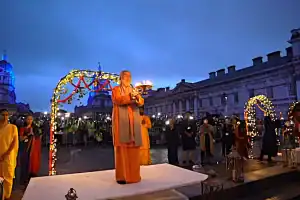
The Princess of Wales went to Leicester yesterday, to see some of the customs which have made the city famous for its celebrations of the Hindu festival of Holi, heralding new life, light and Spring. She watched a Sufi dancer and a Bollywood dance performance, met shopkeepers on the golden mile selling fabric and clothes, and visited a family run restaurant named after the Bollywood film, Bobby. Her visit came three days after a large Holi celebration at Spinney Hill Park in the city, where 3,000 people took part in traditional customs including throwing colourful paint, eating festival food, dancing and gathering round a bonfire. The Holi festival is predominantly Hindu, but many Sikhs and Jains mark it also, and in Britain, people of all faiths and non, join in.
Tea and a special cake for the Archbishop of Canterbury
The Archbishop of Canterbury has been given a cake made by the Great British Bake Off winner, Jasmine Mitchell, to celebrate her installation, which takes place in Canterbury later this month. Worthy of a showstopper, the cake is made with fig, honey, and almond, decorated with olive branches to symbolise peace and healing, and with a piped scallop shell to mark Sarah Mullally’s love of walking and pilgrimage. Jasmine is a committed Christian and student doctor, and said meeting Archbishop Sarah was “such a joy”.