By Catherine Pepinster
The prime minister, Andy Burnham, is considering a visit to the Vatican to meet Pope Leo XIV in the spring, one of the pontiff’s most senior officials said last night.
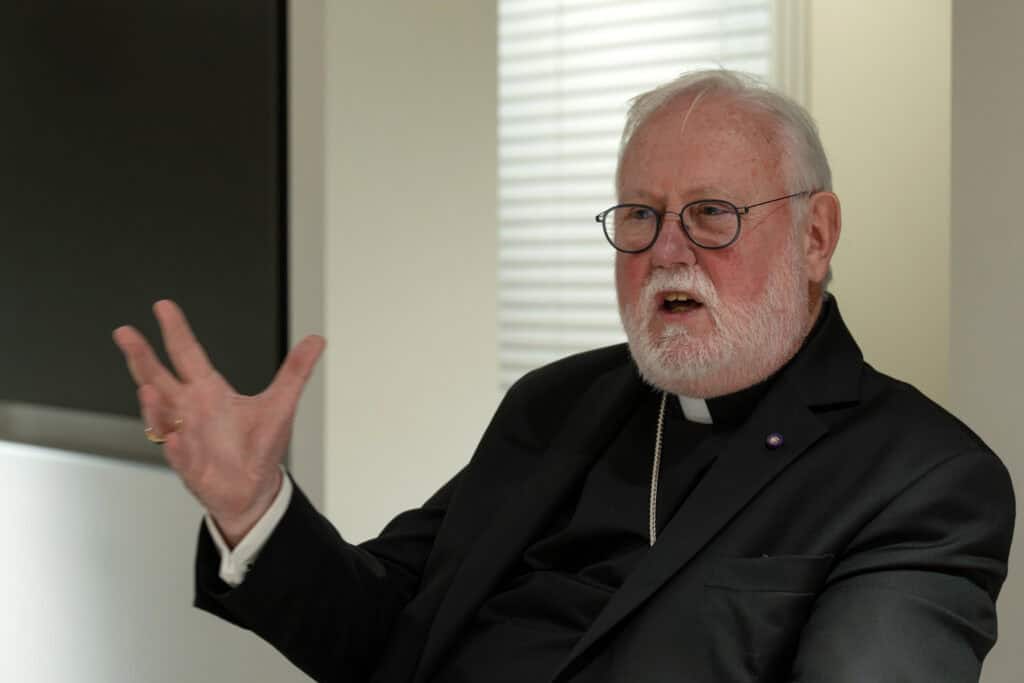
Archbishop Sir Paul Gallagher said Burnham, who was raised Catholic, has expressed enthusiasm for the trip to Rome.
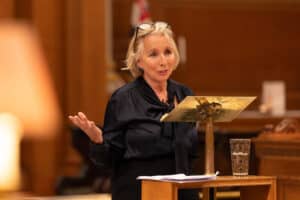
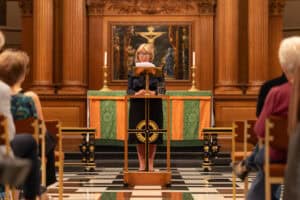
Giving The Tablet lecture on diplomacy and peace, he said Burnham’s Catholic background makes a difference to relations with the Catholic church. Having a Catholic as a political leader is significant, he said, because they were comfortable with Catholic social teaching concepts such as subsidiarity, solidarity and the common good.
“It will be interesting to see to what extent Catholic formation shapes his steps”, he said.
Gallagher, who has spent 12 years as the Holy See’s minister for relations with states, was knighted by the King after his historic visit to Vatican last year, when Charles prayed with Pope Leo.
Like Burnham, he was raised in Liverpool and influenced in his early years by the Archbishop of Liverpool, Derek Worlock. After studying for the priesthood and serving as a parish priest in the Liverpool neighbourhood of Fazakerley, he joined the Holy See’s diplomatic service, working across the globe.
Archbishop Gallagher gave the lecture on Tuesday evening, as it was announced that Pope Leo had cancer, after an operation on his lung. He said that the Pope’s health issues revealed him as “vulnerable like the rest of us”.
His lecture also touched on Vatican diplomacy and Russia, relations with the Ukraine, divisions within the Catholic church in the US, and calls from business leaders and politicians for the church to offer a moral lead on artificial intelligence.
“We all get the feeling that the stakes in many ways, are much higher,” he said of the current state of the world.
The archbishop had flown to London from Geneva, and before that he was in Pakistan. His role as the second most senior diplomat of the Holy See — he is deputy to the secretary of state, Cardinal Pietro Parolin — takes him around the world. The Holy See also has ambassadors, known as nuncios, across the globe.
One of Gallagher’s first postings was in Burundi in 1997, where he arrived three days after the nuncio had been shot dead. Another was in Tanzania where he arrived with his predecessor in situ and so there was no bed available. He slept on the floor on a mattress.
Other diplomats, he said, did not understand the financial constraints of papal diplomacy: “When I happen to mention something about my flight over, they say, ‘You fly commercial?’ in astonishment. They obviously imagine I might fly in my own plane.”
But the Holy See, he said, had distinct advantages when it came to diplomacy. “We are not in competition with our colleagues for trade deals, or direct investment. Nor are we engaging with governments to advance economic interest. Being unencumbered by such concerns allows the Holy See a far greater freedom than is enjoyed by a lot of diplomatic counterparts.
“Another point of contrast with many other diplomatic services is the Holy See’s commitment to keeping lines of dialogue open. When it is phrased like that, with safety in the abstract, it receives plaudits.
“But when seen in practice, it is often the cause of some very strong criticism. Successive popes have been condemned for receiving this head of government or that politician. The diplomacy of the Holy See seeks to provoke the common good of all people, regardless of who their leaders are.”
Maintaining the lines of dialogue, while often frustrating and time-consuming, he said, was crucial in keeping the dream of peace alive. Sometimes that might mean talking to people who had disrupted that peace in the first place.
That priority took Archbishop Gallagher to Russia in August. At a press conference in Moscow, he said of the conflict with Ukraine, in front of Russia’s foreign minister, Sergey Lavrov: “Let us be clear. This war must end.”
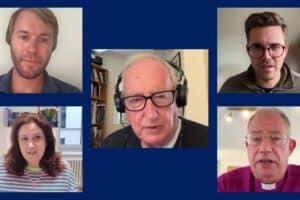
At the Tablet lecture, the archbishop was asked by moderator Julie Etchingham about the extent to which the recent deal between Vladimir Putin and Donald Trump over energy meant the peace process was in the dust. He described it as “on life support”.
He indicated that in the next few months “we will see if the international community including the Holy See can exert pressure and get people back to the negotiating table”.
According to Gallagher, the Vatican’s diplomacy is focused on peace and serving the Gospel. It “does not possess weapons or infantry, divisions or battalions, but it does have the voice of the Holy Father” who he described as “our chief diplomat”.
The Holy See, he said, worked to support fundamental human rights, the freedom of religion, the sanctity of life and to protect creation. In recent times another addition to this list has been artificial intelligence. Business and civil leaders, he said, have been “actively calling for moral guidance on such a new frontier from the Holy See”.
Earlier this year Pope Leo issued his first encyclical, or teaching document Magnifica Humanitas, which included substantial reflections on AI, in which he urged that the technological advance must serve humanity rather than concentrate power.
While his views on AI garnered all the attention at the time of publication, it explored other issues too and said that the “just war theory” — developed by the Catholic church for centuries regarding the causes and conduct of war — was outdated.
Asked after the lecture about the consequences of the Pope’s comment on just war, Archbishop Gallagher said that it had caused a few problems for papal diplomats as several embassies had been in touch, worried what this meant for defence policies and for Catholics serving in the military.
The idea of a just war, he said, was something on which Catholic institutions needed to work together, given the immense capacity of modern weapons, whether war could be justified. This was a work in progress, he said.
Gallagher admitted during his lecture that the Holy See’s efforts can fail when it comes to war, when it was trying to help with the liberation of countries or “trying to have children spared the worst effects of life in such places”. “The lack of success can be very hard indeed, he said, “but our light never goes out because it does not come from an earthly source, it comes from Jesus Christ.
“One can never escape the feeling that more can be done but I am confident that we have done our small part in keeping the dream of peace alive for our own time”.