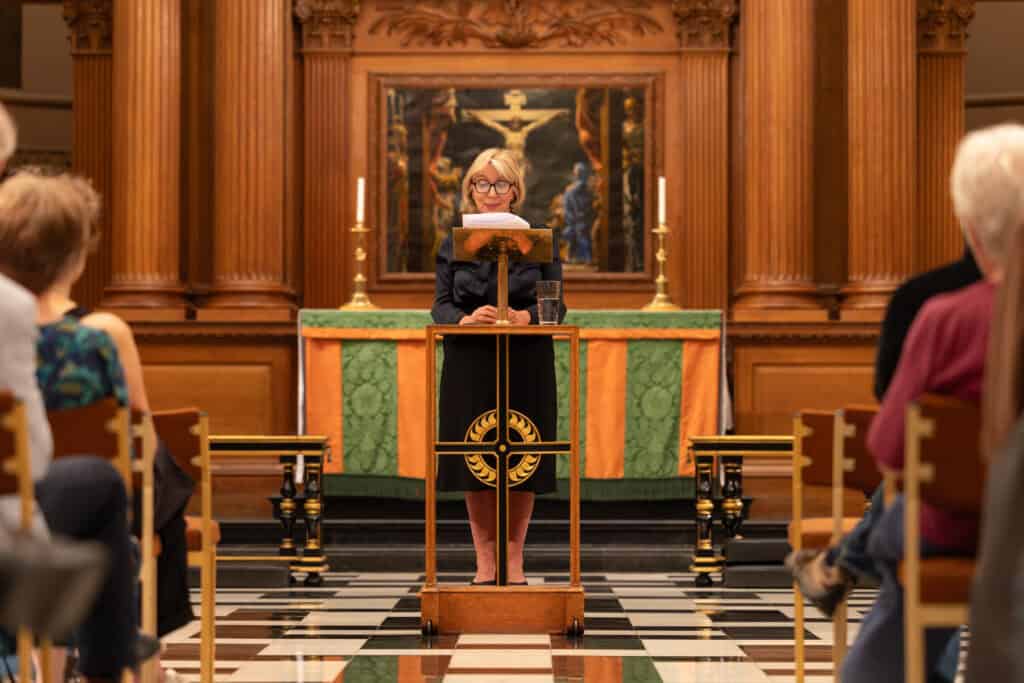
Sarah Sands calls for media to capture renewed public interest in religion
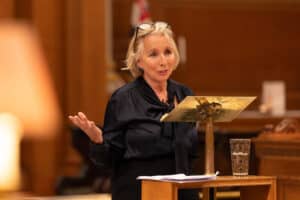
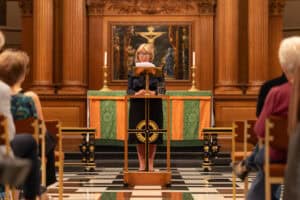
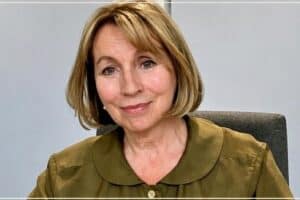
The new CEO of Hymns Ancient and Modern, Sarah Sands, says the media has a responsibility to capture a renewed interest in religion. Delivering the annual lecture of the Religion Media Centre, she said people are genuinely interested, curious and open to religion “in a way that they probably hadn’t been for a generation, and so the media has a responsibility to capture that”. If there were a need for the beauty and mystery of religion, she believes it is now.
Her intention in her new role is to reflect the religious sphere beyond the structure of the church: “We will embrace discussion of nature and art and poetry and pilgrimage – I hope it does lead to the church door”. She spoke of the need to find where the audience is and where their interest lies, “and that’s why I’m particularly interested in pilgrimage, poetry and enchantment because that is bringing in people who are not necessarily traditional churchgoers”. Her three principles since starting her role just six months ago are to raise profile, expand audience, and increase revenues.
She joined the Christian publishing company after a career in news journalism, having edited the Sunday Telegraph, the London Evening Standard and BBC Radio 4’s Today programme. Sadly, she said, there was a lack of knowledge about religion in the media: “If we are to understand human motivation and the sense of what lies beyond us, it’s helpful to know about religion. But sadly, not many journalists do”, giving a list of notable exceptions including Edward Stourton. However, she added that “the press may not deal much in theology, but it knows the value of a photograph of a spire in the mist, a cathedral at sunrise or sunset”.
She said the natural relationship between the news industry and the gospels is “bearing witness” and the right to ask questions must be defended, warning that “the forces against asking questions are closing ranks”. She said journalists encounter danger, hostility and lies, and they die trying to find out the truth.
Addressing the challenging financial climate for the press, where there are no longer the resources “to allow some serious reporting around the country”, she said there is “a thrill to see green shoots”. She gave examples such as the St Alban’s Times flourishing and new audiences emerging with community-based publications under the “Mill” titles and suggested: “Wouldn’t it be cheering to see a wider grassroots, community-led revival, both of church going and of news. We could think of it as the return of the parish.” Sarah Sands’ address was recorded and will be put up on our YouTube channel soon.
Burnham puts ‘common good’ at heart of Labour conference speech
The theme of “the common good” ran throughout Andy Burnham’s first conference speech as Labour leader. His Catholic upbringing is well documented and “the common good” is a fundamental principle of Catholic social teaching. He said his parents “gave me a care for people. Forged by her faith, his politics and the values of this great city.” The Catechism of the Catholic Church defines the common good as “the sum total of social conditions” that enable individuals and groups to flourish, including respect for human dignity, social wellbeing and peace. In his conference speech, to applause, he said: “We built the common good. Or at least we did until the 1980s. Suddenly, the common wealth we had created, this party, the wealth we had created for the many was seen as an opportunity for the few. Homes. Water. Energy. Transport. Care. Broken up and sold off. The British Right talk about ‘taking back control’. Never let them forget, they are the ones that gave it away in the first place.” Speech in full is here. Church Times report here.
Pope ‘not in panic mode’ over AI
Pope Leo has told journalists that he is not panicking over dire predictions about the dangers of Artificial Intelligence, though he takes seriously the warnings raised by senior researchers in the industry. Speaking to the media on his flight back to Rome from France, he said: “If someone were to ask me, am I in panic mode, no I’m not, I sleep at night”. Earlier this month, a former researcher at the AI company Anthropic warned that AI could kill all humans within a decade, and there were calls for the industry to slow down the pace of development. Donald Trump dismissed the warnings saying America must win the development competition, and critics claimed it was a scare story to affect financial fortunes. Pope Leo said: “I don’t think that is fake news, as some have said, to try and cause … financial or some other kind of benefit”. The Pope’s encyclical on AI, Magnifica Humanitas, published in May, called for greater regulation. Since then there have been stories of AI creating cyber attacks, hacking into medical files, and this morning, giving information on developing biological weapons and methods of assassination. Pope Leo told journalists that the Vatican has organised a commission on AI, to govern its use of the technology and to “continue to promote dialogue, study and investigation to find ways to make sure that AI doesn’t get to a point where it destroys humanity.” He said: “We have to keep working. We can’t just sit back and pretend nothing is going to happen”. National Catholic Register report here.
Eiffel Tower executive leaves after female staff sidelined during Hindu visit
The head of the company operating the Eiffel Tower is leaving his job after the recent incident of female staff being sidelined during a visit by Hindu religious leaders. The decision led to a strike which closed down visitors entry. In a statement, Société d’Exploitation de la Tour Eiffel said that Patrick Branco Ruivo, who has been in charge since 2018, would leave his job at the end of the year after an internal investigation revealed the “unacceptable” removal of female staff and “operational flaws and shortcomings” in organising the visit. The incident on 5 September involved a visit by a delegation of about 100 people connected to the Hindu group Bochasanwasi Akshar Purushottam Swaminarayan Sanstha (abbreviated as BAPS), who were in Paris to attend the inauguration of a new mandir, or temple. Ordained monks in several Hindu, Jain, and Buddhist orders observe a rule to avoid direct interaction with the opposite gender. Read our explainer here
Vatican cardinal to visit UK for interfaith dialogue with Dharmic religions
The Vatican’s cardinal who leads inter-religious dialogue, Cardinal George Jacob Koovakad, is to visit Britain in October to meet representatives of Dharmic religions. The visit has the theme “Together in prayer and dialogue for peace”, and will take place in London and Birmingham. He said: “Nowadays we do not live in a situation where there is only one religion or one spirituality or one vision. It is a multicultural, multi-religious global situation, because of migration and people moving around the world for different motives. So, it is important that the people who are religious, who believe in values and in God, know and respect each other. That is why this visit for me is very important… when there is a friendship, then we can work together to promote mutual respect, understanding, and peace.” More on the story here
‘Bubble Gum Buddha’ campaign selling Buddhism to younger generation
South Korea is embracing a new, youth-focused form of Buddhism, with the Buddha becoming an unlikely icon, chewing bubble-gum, DJing, travelling on the underground, eating fruit cake, appearing on T-shirts, mugs and notebooks. Temples are holding matchmaking events and overnight “temple stays”, where participants meditate and eat vegetarian food. Rappers and DJs are staging all-night Buddha-themed dance parties in “hip Buddhism”, attracting younger people who have grown up with material wealth and are now looking for inner happiness and peace of mind. Times story here