
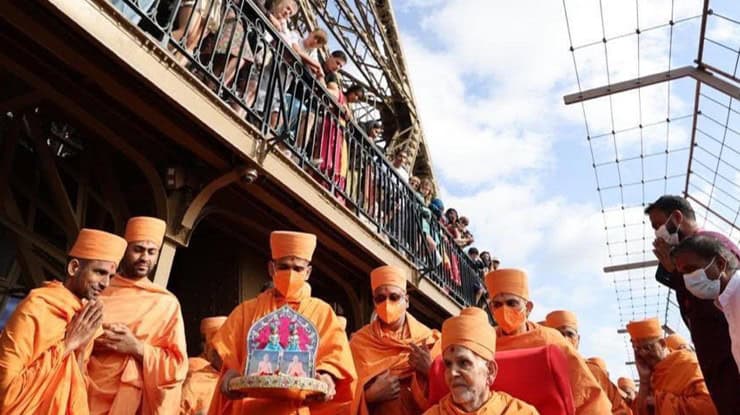
A delegation of about 100 people connected to the Hindu group Bochasanwasi Akshar Purushottam Swaminarayan Sanstha (abbreviated as BAPS), visited the Eiffel Tower on 5 September. They were in Paris to attend the inauguration of a new mandir, or temple, at Bussy-Saint-Georges, east of Paris. Two days later, the Eiffel Tower was closed by a staff strike over instructions from the tower’s management that had moved female staff away from their posts during the visit. A visit by Hindu monks, known as swamis, to pray for peace quickly became a national argument about equality, secularism, and religious liberty, as Tilak Parekh explains:
The visit and the aftermath
The delegation included Mahant Swami Maharaj, 92, spiritual head of BAPS, who had travelled to France for the mandir’s inauguration. Devotees in France describe the purpose of the tower visit as devotional: with the mandir being opened, they had requested their guru to offer prayers for peace and wellbeing for Paris at the city’s defining landmark. Each of the parties involved has since set out its position publicly.
Staff, in a statement issued through the General Confederation of Labour union (CGT), condemned workplace instructions from the Eiffel Tower management that they say left female employees sidelined, replaced, and rendered invisible. They said that some were asked to leave their posts, in certain cases replaced by male colleagues; female employees were told not to cross particular areas while the delegation was present. Diane Davoine, a union representative, said her colleagues felt humiliated.
The Société d’exploitation de la tour Eiffel (SETE), which operates the attraction, first said that it agreed to accommodate the visit on terms that would “limit interactions with women”. While the company accepted those terms, they clarified that, in hindsight, they should not have. More recently, Ariel Weil, who heads SETE, said an internal review would establish where responsibility lay, but has indicated that the instructions given by SETE to its staff may have been “a bit overzealous” in trying to accommodate the delegation.
BAPS Paris, in statements posted on 7 and 8 September, said the visit had been co-ordinated with the tower teams at the start of normal opening hours to avoid inconveniencing others, and that to the best of its knowledge nobody was prevented from accessing the site. An organiser with BAPS France explained that the timing and arrangements had to be co-ordinated with the tower’s staff in advance, since the group was large and had several elderly members in wheelchairs, including Mahant Swami Maharaj, whose presence draws large gatherings.
The BAPS statement on X offered sincere apologies to anyone hurt or inconvenienced, and it told CNN that the co-ordination for the visit was “never, at any point, intended as a request rooted in gender, and any suggestion to the contrary does not reflect the spirit or values of our fellowship or the delegation”.
BAPS volunteers who co-ordinated the visit have relayed that they merely explained the swamis’ religious discipline to the site’s management and that operational decisions about staffing were taken by the tower itself. One organiser said: “We never expected or even imagined that they would move female staff from their work positions.”
These statements miss the steps in between, particularly how a description of monastic practice came to be operationalised as an instruction that women employees should move. That is the question that the two inquiries announced by the mayor of Paris, Emmanuel Grégoire are expected to answer within a week. One has been commissioned by SETE from an outside party, and another by the City of Paris as majority owner.
The Swaminarayan tradition
BAPS is a Hindu fellowship within the wider Swaminarayan tradition that worships Bhagwan Swaminarayan (1781-1830) and is led today by Mahant Swami Maharaj, the sixth spiritual successor in its guru lineage. It counts more than a million followers and over 1,300 mandirs. Its international presence followed Gujarati migration to East Africa, then Britain, North America, and continental Europe, and it is best known publicly for large stone mandirs — including ones in London, Delhi, and Abu Dhabi — and for extensive volunteer and humanitarian work.
The newly inaugurated mandir in France is in Bussy-Saint-Georges on the Esplanade des Religions et des Cultures. This is a street the town set aside for places of worship, which includes a mosque, a synagogue and Buddhist pagodas.
The vow at the centre of the story
Rules governing contact between religious devotees, including monks, and members of the opposite gender are a familiar feature across Christian, Jewish, Islamic, and Hindu traditions. In the Hindu context, the term for this practice is brahmacharya, a restraint also observed across other Indian religious traditions. Ordained monks in several Hindu, Jain, and Buddhist orders observe a more rigorous form under which they avoid direct interaction with the opposite gender.
The practice sits alongside other renunciations of family, property, wealth and personal identity, and is directed at the swami’s own attachments, rather than at the standing of women. The purpose is to free the swami for a life oriented wholly towards God and the service of humanity. Swamis routinely move through crowded, mixed public spaces in the course of pastoral and humanitarian work, governing their own gaze, path, and distance without expecting others to rearrange themselves.
The vow, therefore, does not of itself impose a requirement that women accommodate the swamis. In cases such as the one in Paris, then, the relevant questions concern implementation rather than the religious discipline itself.
Voices beyond the Tower
In the days since, some commentators have extended the conversation on the Eiffel Tower visit into broader claims about the place of women in BAPS, and in Hinduism more generally. Women within the fellowship have publicly contested those claims in posts on social media and online forums. Their argument is that women have long held prominent devotional and organisational roles in BAPS, and that this sits awkwardly with an account of Hinduism built around women’s exclusion.
Some pointed to the women’s convention held for the mandir’s opening, and to a procession at Bussy-Saint-Georges led by women and girls, which they described as involving several thousand participants.
I encountered a recurring theme in what I was told was frustration at the coverage: that these perspectives have gone largely unreported, and that outsiders have been left to speak on their behalf. Their testimony does not settle the workplace question, which is about instructions given to employees not a part of the community. The voices of the women devotees do, however, belong in the conversation about gender and Hinduism that the Eiffel Tower visit has prompted.
Religious expression in secular spaces
This is less a story about religious practice than about its entry into a secular workplace. Somewhere between BAPS making its request to visit the Eiffel Tower and the tower’s management organising it, a discipline practised by the swamis became a staffing instruction for women employees. Self-restraint was translated into restraint of others.
A fuller understanding of the practice as directed at the swamis’ own conduct might have left the employees the choice of whether and how to accommodate it, rather than deciding for them. What the Tower needed was a clearer exchange between the parties; what the public commentary needs is a fuller understanding of what passed between them, and of the practice at the root of it.
Tilak Parekh is a researcher at the University of Cambridge