By Lianne Kolirin
Faith-based content creators have described how they have had to stay “mindful” of succumbing to the addictive nature of social media.
The Rev Pippa White, known as “the TikTok vicar” has spoken out about how easy it is to be drawn in by the buzz generated by social media.
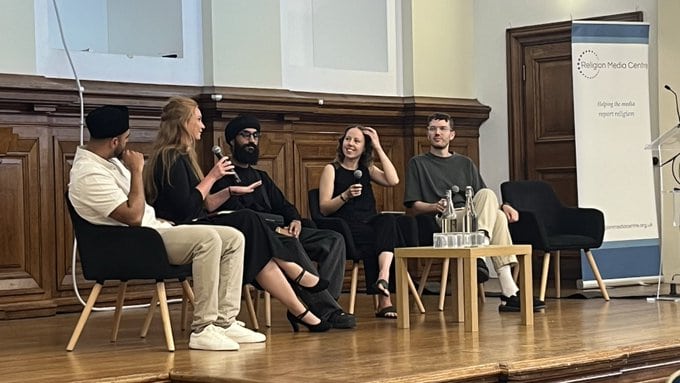
Ms White, 30, whose TikTok handle is “not_a_priestess”, was one of several religious content creators participating in a panel at this year’s Religion Media Festival. The discussion, Faith in the Feed” centred on how the young generation is shaping online conversations about faith, ethics and culture.
When asked about the pressure of maintaining an identity as a person of faith while “feeding the algorithm” to produce more content, Ms White said: “For me, it’s less tension and it’s more temptation as a faith leader, because I know we talk about how addictive social media is and the dopamine, and how it taps into your brain. I think that’s just as true for content creators as it is for people viewing.”
Addressing the event at Methodist Central Hall last month, Ms White — who has more than 31,000 followers on TikTok — said: “When you see your videos go viral and it all kicks off, and you get loads of views and loads of followers you do get that really satisfying dopamine rush. I think that is a temptation I try to be so wary of.”
She said she is motivated by her desire to improve “representation for young female priests” and “to build trust” in the church. It’s not about “chasing that dopamine,” she said, “which I think we have to be really mindful of because I think that’s where you can hit the rocks.”
Fellow panellist Sabah Ahmedi, known online as “the young imam”, agreed with that sentiment, saying that as a content creator of faith it’s important to remember the overall messaging.
“When I first started my social media platform, I nearly got divorced,” he said. “No one tells you how to build a social media platform: you just get thrown in the deep end, and it was in the beginning, chasing that dopamine, chasing the likes, and it took over my life.
“My wife said to me that this is not going to work if you can’t balance life as a husband, as a father, as a faith leader.”
It was at that point he realised he had to adjust his content to reflect “what’s happening in the world”, while also showing “a hint of my life behind the scenes as a husband, as a father, as a son, as a friend”.
“Social media is dangerous — you can’t say it’s not,” said the imam, who has almost 19,000 followers on Instagram. “When I rechannelled and reprogrammed what my account was five years down the line, I can say I’m trying my best to be the best dad that I can, the best husband, and the best son. So, it’s a journey.
“I think if you’ve not got a purpose, I’d think twice before going on social media, because it can be a battle every single day.”
The Way UK is a Christian digital youth ministry that describes its work as “breaking assumptions” about Christianity. Part-funded by the Church of England, it has a huge reach, with 1.2 million followers across Instagram, YouTube, and TikTok. The lead producer, Tom Chappell said its target audience is aged 14 to 24, which means the upcoming ban on social media for under-16s will have an impact on them.
“In terms of reaching Gen Alpha, those that are really going to be affected by this ban, we’re going to have to come up with something else,” he said.
Chappell said he and his team recognised the pitfalls posed by social media. “We’ve joked in the past about wanting to make short-form content videos encouraging people to delete social media because it’s such a cause for anxiety.
“I work in this space as a producer. I don’t have it on my phone, I check it on my desktop or my laptop most days, but I can’t have it on my phone — it causes too much anxiety looking for that dopamine hit.”
Content such as that produced by The Way and religious influencers has proved incredibly popular with younger generations, who may not relate as easily to traditional faith leaders and their places of worship. Virdi Mazaria, another of the panellists, is coming from a different angle, however. He is not a faith leader but a former candidate on the BBC1’s The Apprentice, and a Sikh.
With more than 25,000 followers on Instagram, Mr Mazaria uses his social media to showcase his work and lifestyle as a DJ and entrepreneur — he has his own fashion label — first.
“You might see me at an England game or a Man United game, you might see me at a restaurant, or you might even see me at the gurdwara praying, but everything looks aesthetically clean,” he said.
“I want someone who clicks on my page not to see a Sikh first. I want them to see a human first, and that’s what my mission was with my social media. I wanted to normalise the fact a Sikh turban-wearing man can be doing the things that anyone can be doing in this culture.”
Chappell said they have had to “explore” how to “stay true” to their beliefs when working on content. “I think it’s way more important getting a few thousand likes on that kind of post compared with hundreds of thousands, because ultimately, if someone sits on it and dwells on it, we believe they’ll get way more out of it,” he said.
Content that is “close to the wire” tends to do best, he said. “I don’t want to sound too crass, but Gen Z Christians love talking about sex and relationships. Not that we go into minute detail about these things, but they love the topic, and one of our best-performing videos is ‘how far is too far before you are married?’ Or ‘what does it mean to be single?’ ”
Ms White said that in terms of feedback, her content generates “the two extremes and nothing in between”. While some are inspired by her modern, inclusive approach, others label her a “wolf in sheep’s clothing”, she said.
“I always say it’s like TripAdvisor. If you go to a restaurant and it’s fine, you don’t really put it on TripAdvisor. If you go to a restaurant and love it, you’ll leave a lovely comment. If you go to it and you hate it, you’ll leave a comment.”
Sabah Ahmedi said his inbox was filled with messages not just from young Muslims but from “across the board”.
“There are even people who are not of faith who message me with their day-to-day struggles, because they know that it’s a non-judgmental platform,” he said.
“They know it’s a safe space, and that’s the whole purpose of my platform. It’s to create a safe space for conversation and dialogue, for us to all come together. because we’ve got more in common than not. We all bleed red, and we’ve got to unite on those commonalities.”