By Maira Butt
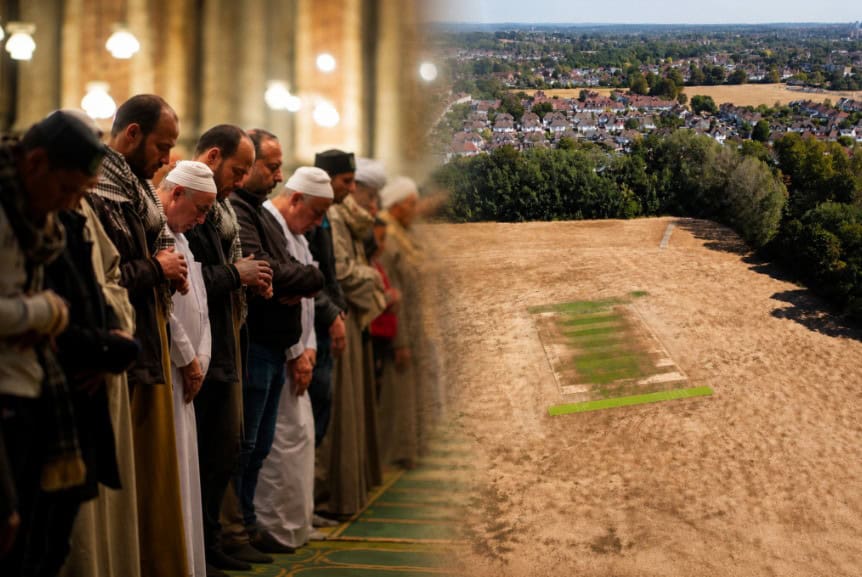
This summer has been defined by record-breaking heatwaves and images of raging wildfires.
In the UK, everyday life has been significantly disrupted for many. The demand for air conditioners has outstripped supply and the government has issued emergency alerts.
The UK Health Security Agency estimated there were 2,877 heat-associated deaths during the height of the heatwaves in England across May and June.
In the Muslim population, a socially conservative and family-oriented community, attention has turned to the future and how increasingly extreme weather could affect loved ones and daily life.
‘Part of our experience’
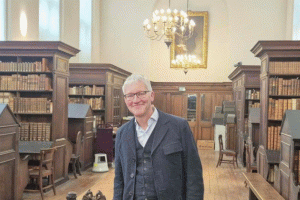
Kamran Shezad, director of the Islamic Foundation for Ecology and Environmental Sciences, says: “For many Muslims, climate change is beginning to feel much more real and immediate.
“Extreme heat is increasingly part of our experience here in the UK, prompting people to ask what it means for our families, our communities and our future.”
The sheer scale of the recent heatwave, he says, has been deeply concerning to the Muslims he has spoken to, with a particular worry for older people, those living with health conditions, children and people who are socially or economically vulnerable.
“Climate change does not discriminate,” he adds. “We are all experiencing the anxiety and uncertainty that comes with a changing climate regardless of faith or background.”
The extreme weather has also led to practical concerns: how can homes be kept cool in the summer and warm in the winter?
Stewards of the Earth
Islam has a deeply rooted environmental ethic, Mr Shezad says, with the Quran making repeated references to the natural world as part of God’s creation. “Human beings have a responsibility to care for the earth,” he said.
“The teachings and example of the Prophet Muhammad also provide principles for living with moderation, avoiding waste and treating creation with care and compassion.”
These principles are the foundation of Al Mizan: A Covenant for the Earth, a declaration on the environment developed through collaboration between Muslim scholars, environmental experts and institutions, with the support of the United Nations Environment Programme.
“Al Mizan brings together Islamic teachings on creation, stewardship, justice and responsibility and calls upon Muslims to respond to the environmental and climate crisis as a matter of faith,” Mr Shezad says.
In a series of guides designed by Mr Shezad, he makes several Quranic references including: “It is He who has appointed you stewards in the Earth.”
‘Strength in our actions’
On a practical level, he is working with Muslim communities in the UK and across the world on how to make an impact.
“There is strength in both our individual actions and our collective actions,” he says. “At an individual level, we can all take a step back and think about the resources we consume, what we buy, what we eat, how much energy and water we use and what we throw away.
“The aim is not to expect people to live perfect lives, but to become more mindful of the choices we make and the impact those choices can have. It is easy to feel that one person’s actions are too small to make a difference. But when millions of people make small changes, those actions can add up to something significant.
“And from an Islamic perspective, there is another dimension too … our intentions matter and our efforts to care for God’s creation have value in themselves.”
Faith communities as climate advocates
But Islam is an inherently communal religion with family, interpersonal relationships and institutions at its core. Mr Shezad believes that faith communities have an “important role to play in advocating for the changes needed to reduce emissions, protect nature and help our communities to adapt”.
“Places of worship have significant social capital. They are trusted spaces at the heart of their communities, with established networks, committed volunteers and the ability to bring people together around shared concerns,” he says.
“They also often have the ear of politicians and other decision-makers, which gives them an important opportunity to influence policymakers and change-makers, raise the concerns of their communities and advocate for more ambitious climate action.”
Some of the work being done on the ground includes that being led by the Bahu Trust, based in Birmingham, where Mr Shezad is the sustainability lead, as well as other organisations he works with, such as the interfaith group Footsteps, and Ashden, a climate and science-based organisation. He also sits on the multi-faith advisory council to the UN Interagency Task Force on Religion and Sustainable Development.
“Together, they are working to build the capacity of grassroots faith communities to take action on climate change and nature,” he says.
Praying for rain
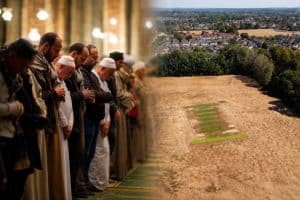
Part of the work has also been spiritual. Muslim scholars across the UK called on the community to pray for rain shortly after drought was declared across more than 70 per cent of the UK on 10 August.
The practice, specifically known as Istisqa, means to seek water from Allah through a range of means including prayer. During the time of the Prophet, the region — mostly arid desert — was often beset by a shortfall of rain.
An action list published by Islamic Portal called on imams to call for rain in Friday sermons and to be mindful of water usage. The government also issued guidance to the Muslim community to use less water when undertaking ablutions or wudhu, the ritual cleansing performed before prayer.
Britain’s first eco-friendly mosque, Cambridge Central Mosque, has worked on a project aimed at reducing water usage with South Staffordshire Water, and Cambridge University’s divinity faculty. The project is estimated to have saved up to 5,900 litres a day. Muslims were asked to use about a litre for wudhu, which is in line with what the Prophet is understood to have used for the practice. Another aspect focused on teaching parts of the Asian community to use less water when cooking rice.
However, the scheme was criticised, with Mike Wood, the Conservative shadow minister for the Cabinet Office, telling the Telegraph that such initiatives, while “noble”, were a “waste of taxpayers’ money”.
Analysis by Greenpeace UK published in July found that 2.87 billion litres of water were lost through leaky pipes across England and Wales every day.
“Families are already facing huge bill increases; they will not be best pleased that their money is being spent on bizarre schemes centred on trying to change long-standing religious and cultural practices,” Mr Wood said.
‘Enormous potential to help’
Mr Shezad believes communities already have the infrastructure to tackle the challenges before them. “Faith communities are deeply rooted in neighbourhoods,” he says. “They already have buildings, volunteers, trusted leaders and networks of people who care about their communities. That gives them enormous potential to help people respond to challenges such as extreme heat, energy poverty, food insecurity and the loss of nature.
“The opportunity now is to harness that existing community strength and turn places of worship into places of climate resilience for communities. We are developing an interfaith toolkit to help places of worship prepare for and respond to climate impacts, working alongside local authorities to strengthen community preparedness.
“This is a good example of the faith sector and public services working together to support people before, during and after climate-related emergencies.”