By Catherine Pepinster
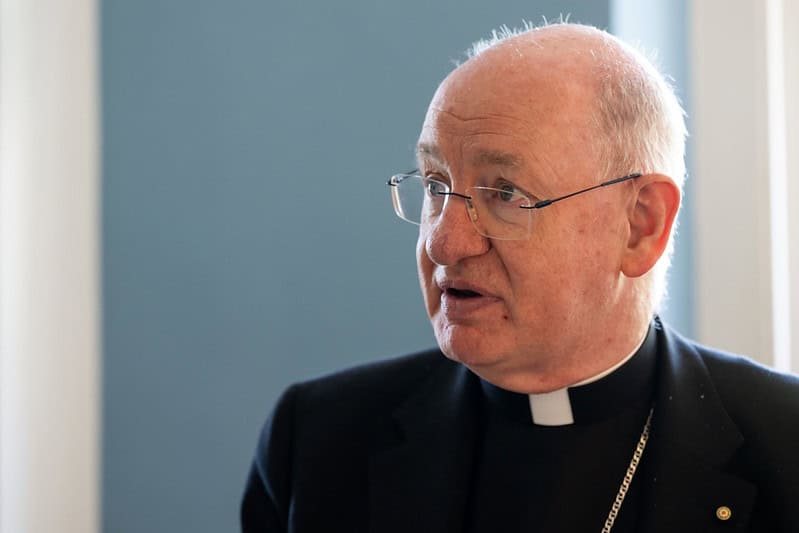
The Roman Catholic Archbishop of Westminster pledged yesterday to work with the Archbishop of Canterbury with what he called “the openness of conversation”, despite continuing obstacles blocking full unity between Catholics and Anglicans.
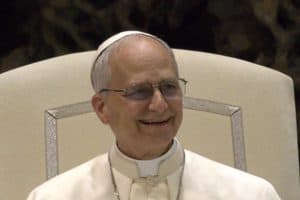
Archbishop Richard Moth was speaking in London days after he was in Rome to witness the first meeting between Archbishop Sarah Mullally and Pope Leo XIV. During the meeting between the Pope and the Anglican primate, Pope Leo said: “While much progress has been made on some historically divisive issues, new problems have arisen in recent decades, rendering the pathway to full communion more difficult to discern” — a remark many observers took to mean women’s ordination.
At a press conference in London, when asked whether having a woman as Archbishop of Canterbury is a complicating factor in ecumenical relations with the Catholic church, which has a male-only priesthood, Archbishop Moth acknowledged that “as Pope Leo said, there is a recognition of obstacles”. But, he said, there was an openness of conversation and a “desire to continue the conversation and build a relationship”.
“[With] Archbishop Sarah and I, and other Christian leaders and leaders of other faiths, there is a real concern for the common good. Out of that comes that desire that all people are able to live in peace and harmony within our society,” he said.
Dame Sarah attended the installation of Richard Moth as Archbishop of Westminster at Westminster Cathedral on 14 February and he in turn attended her installation at Canterbury Cathedral on 25 March when he gave a reading. They also work together as presidents of the ecumenical body, Churches Together in England.
As well as attending Archbishop Mullally’s meeting with Pope Leo, Archbishop Moth also spent several days just outside Rome with his fellow Catholic bishops of England and Wales at Palazzola, the villa and retreat house of the English College seminary in Rome. There the bishops elected Moth as president of the Catholic Bishops Conference of England and Wales. They also issued a statement, confirming their support for Pope Leo’s recent call for peace, after Donald Trump’s criticisms of the Pope. The statement, published as a sign of solidarity with Pope Leo, asked Catholics to pray for an enduring peace with justice in the world’s conflict zones.
Archbishop Moth said his priority was the church’s mission of the Gospel. “We look at the challenges in the world around us and that very often shapes our priorities. But it’s not just about being reactive, it’s about having a real consciousness that the Gospel message is an eternal message, the fact of God’s love for us all, that’s something that’s unchanging, and it’s about bringing that message into the world.
“For me, ‘mission’ is very much a priority: a mission grounded in prayer and our celebration of the liturgy, and a mission that enables us to bring the light of the Gospel and the peace of Christ into the world in which we live.”
Several Catholic dioceses reported large numbers of people coming forward at Easter to be baptised and to be received into the Catholic church. Archbishop Moth said that he and his fellow bishops had discussed this and while they were aware that the findings of the Bible Society’s Quiet Revival report have now been disputed, “What we are experiencing and this is definite, is a rise in the number of baptisms and receptions, this year and last.”
Full statistics would need to be studied in due course, he said, when dioceses compiled their figures which would give a clearer picture of receptions of Christians from different denominations and baptisms of people who were not Christians before joining the Catholic Church.
“To determine whether there has really been a quiet revival, we will have to wait a number of years and then look back. It’s too early on that journey to see whether that really is the case. But there is a rising number”.
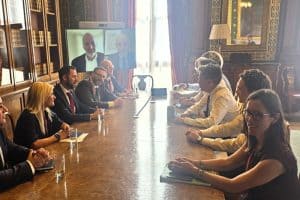
Archbishop Moth, who has long been the Catholic Bishops’ Conference spokesman on prisons, said that he is going to retain his responsibility within the conference for prisons and that he had spoken to Sir Keir Starmer, about prison reform during the Downing Street Easter reception for Christian organisations and church representatives.
He thanked Sir Keir, he said, for changes to sentencing. Under the Sentencing Act 2026, most convicted criminals who would have faced less than a year in jail will now receive a suspended sentence instead. Moth said this was an example of how the church would speak out on behalf of the vulnerable, for the children of prisoners are among those impacted by crime.