By Lianne Kolirin
Changing funeral rituals and methods of disposing of the body indicate new forms of spirituality linked to nature and the environment, ideas that do not fit into categories of religion tested in opinion polls.
Undertakers are exploring alternatives to environmentally unfriendly cremation, including the possibility of human composting.
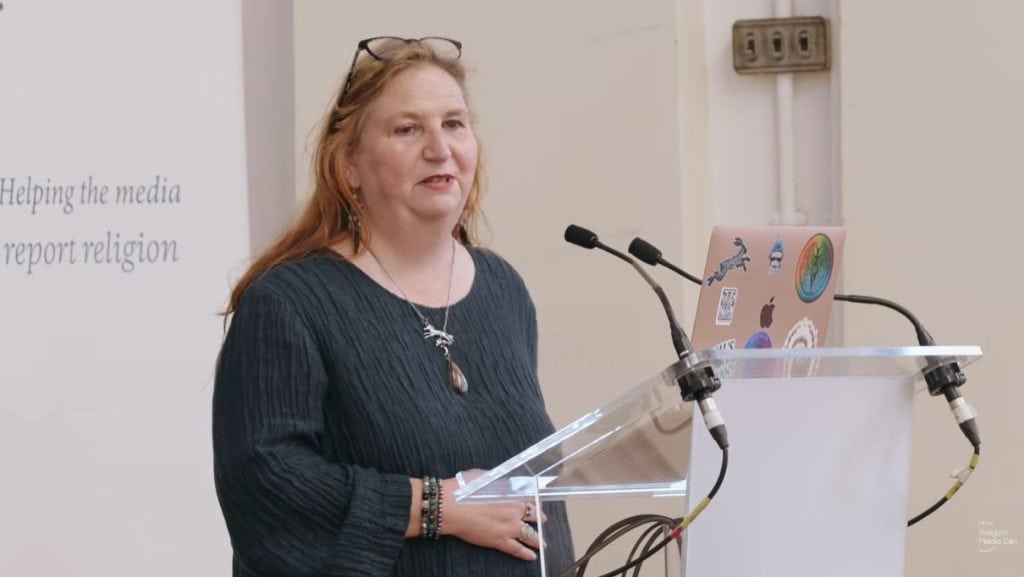
About 70 per cent of funerals in Britain involve cremation but the practice is becoming increasingly problematic because it relies on fossil fuels, according to Dr Jenny Uzzell, an academic and progressive funeral director.
Dr Uzell told the Religion Media Centre’s annual festival that cremation was introduced in late 19th century in response to public health risks posed by traditional burials after a series of cholera epidemics overwhelmed the country’s graveyards.
“While cremation was once heralded as a modern and hygienic solution to the problems caused by overcrowded graveyards, it is now seen as a problem in its own right due to the huge amount of power that it requires and the emissions that it releases into the atmosphere,” she said.
As such, she explained, the search is on for greener alternatives. She gave the example of Kristoffer Hughes, chief of the Anglesey Druid Order, who recently founded Eterrna, a company hoping to become the first in Britain to offer “terramation”, or human composting.
“As the name suggests, this is a process that reduces a body into usable compost in about 40 days using little or no external power,” she said.
“Resomation”, also known as water cremation, is another potential alternative. “This is a process that effectively dissolves the body in a heated and pressurised alkaline solution,” she said.
There are now almost as many natural burial sites in England as there are crematoria, Dr Uzell said. “These sites are managed primarily as natural meadow or woodland with minimal visible memorialisation,” she said. Embalming is not permitted, nor are gravestones; every element must be biodegradable.
The increased popularity of such funerals reflects a growing public concern about the environment, she said, adding that some are motivated to “give back” with “the ultimate gift of your own body as a way of nourishing the earth”.
She said such attitudes reflect “an amorphous and undefined spirituality” connected to the natural world which did not fit easily into more traditional religious concepts.
“It has no scriptures, no priesthood, and no set rituals or liturgy,” she said, adding that for many it centres on “a desire to reconnect with the natural world”.
It is for this reason she believes it’s important to look more deeply at religious “nones”. The 2021 Census indicated that 37.2 per cent of the population said they had no religion.
“A decline in organised religion, particularly among the young, does not map neatly into a rise in hard atheism, but is linked to a growth in a new way of ‘religioning’ that is decentralised and amorphous, but which also marks a reaction against a reductionist materialism,” Dr Uzzell said.
She acknowledged that it was a small but growing trend that the media should adopt a nuanced approach towards. “I would suggest that the challenge facing the media today is to recognise and engage with this ‘religioning’ that often hides under the sometimes-misleading term ‘non-religion’,” she said.
View Dr Uzzell’s address at the Festival here