Archbishop of Canterbury makes oath of allegiance to the King
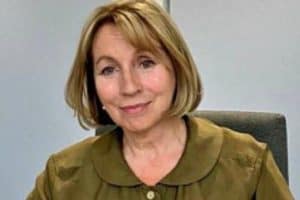
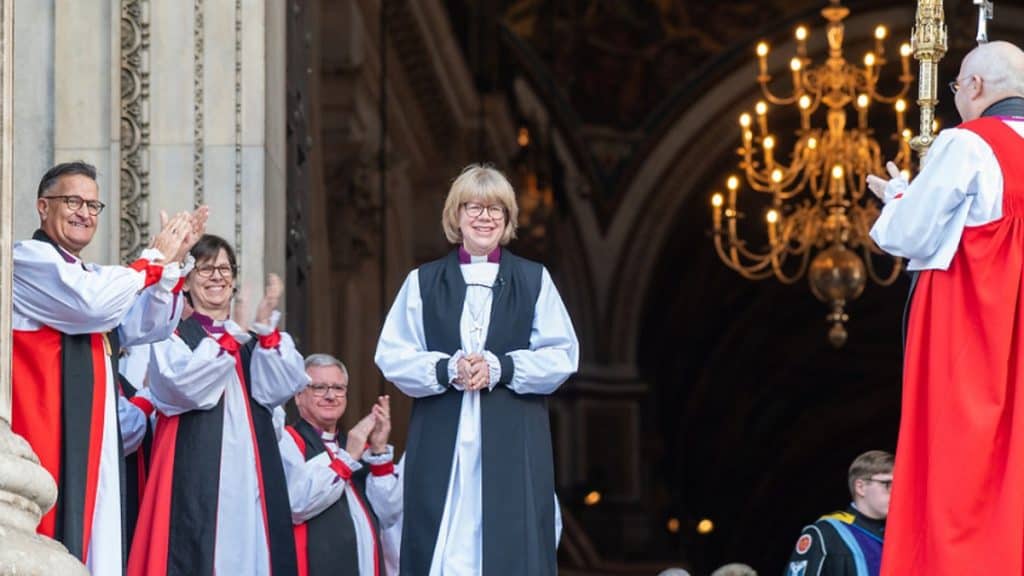
The next Archbishop of Canterbury, Dame Sarah Mullally, took another important step towards her installation in Canterbury on 25 March, when she made the oath of allegiance to the sovereign, acknowledging the King as the supreme governor of the Church of England, a ceremony going back to Elizabeth I.
Afterwards she said she was grateful for the King’s support: “I give thanks for His Majesty’s deep Christian faith, demonstrated in his life of service to our nation and the Commonwealth.”
The ‘unflappable steady nature’ of the next Archbishop of Canterbury
Authors of books on Sarah Mullally say they have heard a consistent picture from across the Church of England, of her “unflappable” character, inspiring trust among those she has served during her 24 years of ministry.
Speaking at a Religion Media Centre briefing, Tim Wyatt said she was “very pastoral”, while also “an incredibly driven administrator, a bureaucrat, a managerial person”, bringing her experience as Chief Nursing Officer to the Church of England. Dr Andrew Atherstone noted her “unflappable and steady nature” which would bring less drama and “might be a blessing to the church for this next phase”.
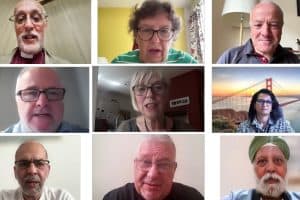
Several members of the General Synod joined the discussion on what lies ahead for the Church of England under her leadership, with key issues set to be aired again at next week’s General Synod. The issue of same-sex blessings, which has caused deep divisions, is not going away. One said there was a groundswell of support from the church; another admitted the prayers, now permitted, would not be removed, and the discussion must now be about process. With those divisions unresolved, it was predicted that this summer’s elections to the General Synod would be closely contested. Watch/listen to the briefing.
Tim Wyatt’s book is “Archbishop Sarah Mullally: And ten urgent challenges for the Church of England”, Darton, Longman & Todd Ltd. Andrew Atherstone’s book is “Archbishop Sarah Mullally: A Biography”, Hodder and Stoughton.
New project explores faith and identity in contemporary England
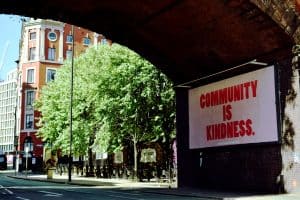
The “Faith and England’s national identities” project was launched last night, aiming to develop new theological and religious insights into how people in contemporary Britain understand their identity. The initiative sits within the Centre for English Identity and Politics at the University of Southampton, directed by John Denham, the former Labour MP and Communities Secretary. Christian, Jewish, Hindu and Muslim speakers identified elements of a shared national identity, including a sense of common humanity, a willingness to engage with difference, and a commitment to inclusion.
The main speaker, Professor Linda Woodhead, addressed growing anxieties around identity that have fuelled right-wing political movements and the rise of Christian nationalism. She argued that the two are closely connected, saying: “Our understanding of authoritarianism is incomplete if we don’t take seriously authoritarian forms of religion,” which she suggested are often tolerated in wider society. Professor Woodhead, F D Maurice Professor of Moral and Social Theology at King’s College London, drew on Maurice’s vision of a national religion that “relies on the Spirit of God to maintain national steadfastness, to support the love of truth, and to purify patriotism from exclusiveness”. More about the project here.
Catholic priest in Gaza pleads for war to stop
Gaza’s only Catholic parish priest, Father Gabriel Romanelli, says the war is far from over despite the ceasefire called on 10 October 2025, with more than 500 killed since then. He told the charity Aid to the Church in Need that there are dire living conditions, with people living in tents and getting drenched when it rains. He said water is poorly treated, badly stored or contaminated, facilitating the spread of disease; respiratory and digestive diseases are multiplying; bombing has continued, destroying houses, resulting in death and injury.
In a note of despair, he said that “it seems that no one in the world is really involving themselves in an effective way”. Israel Defence Forces have defended military action, saying this is a response to Hamas violations or attacks.
Board of Deputies ‘concerned’ at Palestine Action acquittals
The Board of Deputies says it is concerned at the acquittal of six Palestine Action protesters, on charges of aggravated burglary at a UK subsidiary of an Israeli defence firm. The protesters, aged between 21 and 31, were also charged with criminal damage and violent disorder, but the jury reached partial or no verdicts on those counts, and they could face a retrial. Five have been released, but one, Samuel Corner, remains in custody, charged with grievous bodily harm on police sergeant Kate Evans – the jury was unable to reach a verdict.
In a statement, the Board says: “While it is important to respect the integrity of the judicial process, there is a serious danger of perverse justifications being used as a shield for criminality. It cannot be the case that those who commit serious criminal acts, including violent assaults, are able to evade the consequences of their actions.” It says the incident “underlines the urgency of the Home Office’s current review into public order and hate crime legislation”. BBC report on court case here.
BBC’s ‘Voice of India’ broadcaster Sir Mark Tully, remembered in New Delhi
A memorial service has been held at the Cathedral Church of the Redemption in New Delhi for Sir Mark Tully, the BBC’s “Voice of India” and long-time presenter of BBC Radio 4’s weekly exploration of spiritual themes, Something Understood. Sir Mark, who died in New Delhi last month at the age of 90, originally intended to become a Church of England priest, but then turned to journalism, feeling that he was “too undisciplined and too fond of beer” for ordination. As the BBC’s correspondent in Delhi, he covered major religion news stories such as the storming of the Golden Temple in Amritsar by the Indian Army in 1984, and the demolition of the historic Babri mosque in Ayodhya by a Hindu mob in 1992.
He retained a strong love of the church and Anglican liturgy throughout his life, but stated in a 2019 interview that “living in India, with so many religions around me, I no longer believe that Christianity is the only way to God”. The BBC says that a memorial in London is planned for a future date.
US House Speaker quotes Bible to defend immigration policy
The US House Speaker, Mike Johnson, has taken issue with the Pope over his use of a Bible verse in his criticism of US immigration policies. Pope Leo had urged “deep reflection” on how migrants are treated in the United States, quoting Matthew 25:35: “I was a stranger and you welcomed me”.
Mike Johnson took to X to quote multiple Bible verses in defence of the policy, saying: “People of all religious faiths should support a strong national border and Christians certainly should”. The commandment to love our neighbours as ourselves “was never directed to the government, but to INDIVIDUAL believers”. He said civil government should enforce the law “so that order can be maintained in this fallen world, crime can be kept at bay, and people can live peacefully”.
Pew Research charts belief in God in America
Pew Research has extracted more data from its 2023-2024 Religious Landscape Study to show how many people believe in God, pray, believe in heaven and attend church. The study was of 36,908 US adults from July 2023 – March 2024.
Pew has scaled down the numbers, imagining the data is based on a town of 100 people. It finds: 83 believe in God or a universal spirit; 38 say religion is very important in their life; 44 pray every day; 70 believe in an afterlife; and 25 attend religious services in person weekly or more often. The full story is here.
Three sacred cloths from the Kaaba delivered to Jeffrey Epstein in Florida
The Epstein files reveal that three pieces of the Kiswa, sacred cloth which covers the Kaaba in Mecca, were shipped to Jeffrey Epstein from Saudi Arabia to Florida. The cloths are black and embroidered in gold, and are removed and replaced at the Kaaba each year. The messages indicate that one piece was from inside the Kaaba, one from the outer covering that was used, and a third made not used. Middle East Eye is among many publications with the story, reporting that the correspondence, dated February and March 2017, shows the involvement of a UAE-based businesswoman in the transaction.
Winged angel face resembling Italian PM removed after outrage
The face depicting a winged angel, which bore a striking resemblance to Italy’s prime minister, Giorgia Meloni, has been removed from a fresco at the Basilica of St Lawrence in Lucina in central Rome. It was painted by the artist Bruno Valentinetti, during a restoration project to remove water damage, and caused such interest that visitors queued to see it. But the artist told La Repubblica that the Vatican asked him to remove it. He said the face was similar to the original painting, but has reportedly admitted that it was the prime minister’s face. Cardinal Baldo Reina, the diocese’s vicar general, is quoted saying: “Images of sacred art and Christian tradition cannot be misused or exploited.” Guardian story here.