
Pope appeals for ceasefire in the Middle East
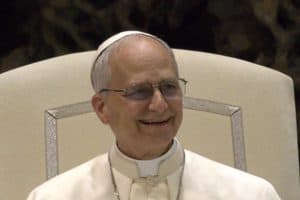
Pope Leo has once more appealed for a ceasefire in the Middle East. In his Sunday address at St Peter’s Square, he expressed concern for the serious crisis underway in Lebanon and said of the whole region that violence can never lead to justice, stability and peace: “The peoples of the Middle East have been suffering the atrocious violence of war. Thousands of innocent people have been killed, and many others have been forced to abandon their homes. I renew my prayerful closeness to all those who have lost their loved ones in the attacks that have struck schools, hospitals, and residential areas”.
Aid agencies in Lebanon calls for immediate ceasefire
The Lebanon Humanitarian International NGO Forum, which represents 73 aid agencies including major Christian and Muslim organisations, is calling for an immediate ceasefire to stop further mass displacement of people across Lebanon. They are seeking safety for civilians and aid workers, and immediate funding for life-saving assistance. Hundreds of thousands of people have been forcibly evacuated from the south and have fled north to escape bombardment, but they need shelter, cash, health, water, sanitation, education, and protection. The Forum says the scale and speed of displacement are overwhelming fragile local systems. It says: “Humanitarian assistance alone cannot keep pace with the scale and speed of suffering caused by continued hostilities. Urgent diplomatic action is required to de-escalate the situation, protect civilians, and prevent further displacement and destruction.”
Christians ‘at heightened risk’ in Middle East as war continues
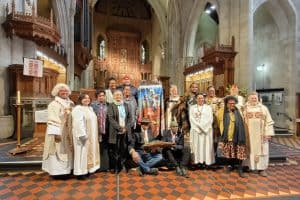
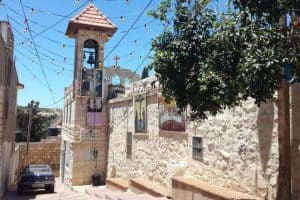
Christians from across the Middle East’s ancient churches will gather at St Mary’s Cathedral of the Holy Apostolic Catholic Assyrian Church of the East, in Ealing, west London on Friday to pray for persecuted Christians in the region. Although the Stations of the Cross service – a traditional Lenten meditation – was planned before the US-Israel conflict with Iran began, it will have added poignancy now. The act of worship will involve representatives and choirs of the Chaldean, Armenian, Syriac Orthodox, Coptic, Maronite, Melkite, Assyrian and Syriac Catholic Churches – the churches to be found in countries like Iraq, Lebanon and Syria, which, like other countries neighbouring Iran, such as the United Arab Emirates and Qatar, are facing bombardment at the moment. Catherine Pepinster reports on the heightened risk for Christians in the region, here.
Hindu swami offer support to workers in Abu Dhabi
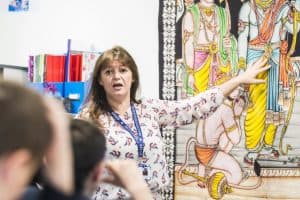
The resident monks at the BAPS Hindu Mandir in Abu Dhabi, the only traditional Hindu stone temple in the Middle East, have been offering pastoral care and food support for a scattered congregation, as the area has come under fire from Iran in the Middle East war. They have been living in the basement of the temple, organising virtual prayer assemblies to an audience of ex-pat Indian workers, the largest ethnic group in the UAE. But they have also crossed faith lines to offer support to workers of all faiths. Brahmaviharidas Swami, the head swami (teacher) on the ground in Abu Dhabi, and other swamis, visited a residential compound near refineries and industrial sites, housing workers of many different nationalities and faiths, speaking to the workers about the uncertainty of war, how to manage the fear and anxiety that comes with it, the role of faith, safety protocols, and looking out for one another. Film here.
Explosion in Amsterdam latest in series of global antisemitic attacks
A Jewish school in Amsterdam has been damaged by an explosion on Saturday in a targeted attack on the city’s Jewish community. No one was injured. The police say CCTV footage appears to show a suspect placing the device and are appealing for witnesses. The attack happened two days after Ayman Mohamad Ghazali, born in Lebanon and a naturalised US citizen, drove a van into a synagogue in Michigan, setting it ablaze. He died from a self-inflicted gunshot to the head. The World Jewish Congress said these were the latest in a series of antisemitic terror attacks, citing others in Canada, a synagogue in Liège Belgium, and Gracie Mansion in New York. It urged world leaders to take urgent action to stop such attacks.
Green party ‘to disestablish the Church of England’
The Daily Mail reports that the Green Party intends to disestablish the Church of England if it wins the next general election. It says it has seen a policy document saying the church will become self-governing, with the Prime Minister having no say in selecting the Archbishop of Canterbury, the Second Church Estates Commissioner in the Commons would be abolished, as would the bishops in the Lords. The paper has contacted the CofE for comment.
Sarah Mullally’s six day pilgrimage to Canterbury, preparing to be Archbishop
Dame Sarah Mullally is to go on a six day pilgrimage from London to Canterbury as part of her spiritual preparation for her installation as Archbishop of Canterbury on 25 March. The “Becket Camino” route will start on 17 March at Southwark Cathedral, then to Lesnes Abbey near Erith, Rochester Cathedral, Aylesford Priory, the Shrine of St Jude in Faversham and Chartham, arriving at Canterbury on Monday 22 March. Lambeth Palace says its the first time in modern history that an Archbishop of Canterbury has undertaken a pilgrimage of this nature in the lead-up to their Installation. She will be accompanied by her husband Eamonn, and will meet other pilgrims, visiting schools and churches on the way. She says: “As I prepare for my installation at Canterbury Cathedral, it feels deeply humbling to be following in the footsteps of those who have walked this ancient route. For centuries, faithful pilgrims have flocked to Canterbury, and I will be reflecting on this tradition as we make our way through the Kent countryside and its towns and cities. I’m looking forward to visiting local churches, cathedrals and holy sites along the route – and to meeting people, praying with them and hearing their stories.”
The conservative evangelical roots of Archbishop Sarah Mullaly
Prof Andrew Atherstone, who has written a biography of Sarah Mullally, has explained her conservative evangelical upbringing and church life, in the years before she went forward for ordination. In an article in The Times, he said she attended St John’s parish church in Woking, “part of the Bible belt of evangelical congregations”, with a congregation of more than 850 members and flourishing youth ministry, and it was here that she was converted aged 16 and joined youth events at All Souls church Langham Place. She was president of the Christian Union at the Polytechnic of the South Bank, where she studied nursing and joined another evangelical church, St Stephen’s Lambeth, where she stayed for 20 years bringing up her family there. Prof Atherstone concludes: “Although Mullally is often simplistically pigeonholed as liberal and progressive, her surprisingly deep formation in conservative theology and culture makes her a more complex, and multidimensional, archbishop”… Catherine Pepinster writes in The Telegraph about Sarah Mullally’s chances of being a reconciler between the Church of England’s “warring evangelical, Catholic traditionalist and liberal-progressive factions”, a task which may prove impossible.
Scottish parliament votes tomorrow on assisted dying
The Scottish parliament will vote tomorrow (Tuesday) on the assisted dying bill, which was debated for four days last week with 175 amendments. MSP Liam McArthur, who brought forward the bill, said it was now “bulletproof”, with extra safeguards introduced. Adoctor must carry out an assessment in private, doctors must find out if the patient is receiving social or mental health care, and palliative and hospice care must be discussed with the patient. But the Royal College of Psychiatrists in Scotland withdrew support saying there was an unacceptable lack of clarity and scrutiny over protections for healthcare workers. Mr McArthur has argued that “without safe access to this choice we would be condemning a number of dying people to unimaginable suffering”. The Catholic Church, the Church of Scotland and the Free Church of Scotland have urged MSPs to reject the bill. There are fears that vulnerable people may be under pressure, people may end their lives because they feel like a burden, and there is concern over the impact on people with disabilities. In May 2025, MSPs passed the first stage of the bill by 70 votes in favour, to 56 against.
Calls to pressure Nigerian president over Christian killings
Parliament’s all-party group for international freedom of religion or belief is reported to have written to the government urging them to put pressure on Nigeria’s president over the persecution of Christians. President Bola Ahmed Tinubu and his wife, Oluremi, are due to make a state visit to Britain this week. The Telegraph reports that the APPG’s chairman, DUP MP Jim Shannon, said Nigeria needed to “take concrete steps to prevent the harassment, persecution and killing of Christians, while ensuring that perpetrators are investigated and prosecuted”. Groups monitoring religious freedom say Islamist militant groups, such as Boko Haram and Fulani militia are behind the violence and they suggest more than 7,000 Christians were killed in Nigeria for their faith in the first seven months of 2025. Around 45 per cent of the population is Christian and 53 per cent is Muslim.
National Secular Society takes legal action over theological colleges
The Guardian reports that the National Secular Society is preparing to take legal action against the Office for Students over public funding for 12 theological colleges, which it says potentially breaches laws protecting freedom of speech and academic freedom. Stephen Evans, the NSS’s chief executive, is quoted saying that the colleges should not have been registered in the first place. They first raised the issue in 2021. Story is here