By Maira Butt
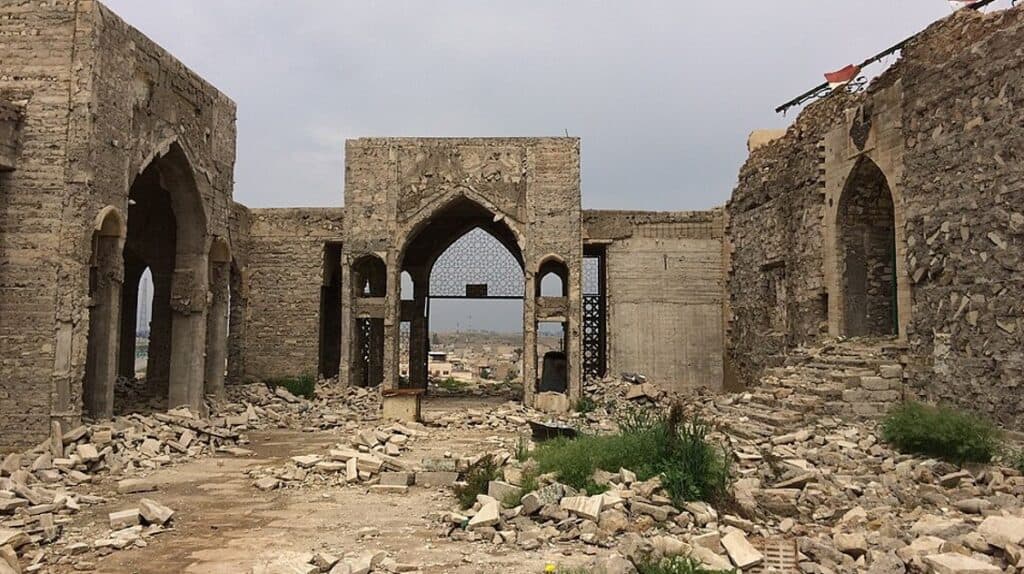
Wars, climate disasters and humanitarian crises are proliferating across the world. With international emergencies focused on supplying shelter, food and medication, the rubble of sacred sites left behind can feel like an afterthought.
But churches, mosques, synagogues, shrines and other holy spaces carry a community’s memory, identity and traditions. When protected and opened to others during peacetime, they can become places of encounter between different faiths.
Sacred Sites Promoting Pluralism, launched in 2023, explores how stewardship of these spaces can counter religious persecution and advance peaceful coexistence.
In March, the Good Faith Partnership hosted the group at the House of Lords for discussions on transatlantic freedom of religion and belief.
Then in April, the al-Khoei Foundation and the al-Baqee Organisation organised another event at the House of Lords, hosted by Lord Rook. The event focused on the heritage of holy sites across the Middle East.
Aliya Azam, an interfaith co-ordinator at the al-Khoei Foundation, also delivered a speech and told the Religion Media Centre that the initiative aimed not only to protect the religious heritage of the respective faith groups but the “religious heritage of humankind”.
The gathering marked 100 years since Jannat-ul-Baqi, the oldest cemetery in the centre of Medina, Saudi Arabia, was destroyed when the country was under the rule of an austere Wahhabi alliance that considered the graves incompatible with religious teachings against the construction of shrines and the veneration of saints.
Among those buried there are the Prophet Muhammad’s grandson and later descendants. For Shia Muslims, these include the second, fourth, fifth and sixth Imams.
The aim of al-Baqee, a global non-governmental organisation dedicated to raising awareness and advocating for the preservation and reconstruction of Islamic heritage sites, and al-Khoei, which has the same focus, is to have this cemetery rebuilt.
“These shrines are very important,” Ms Azam said. They are not only part of the religious heritage of the faiths that hold them dear but they are also part of the religious heritage of humankind.
“As such they ought to be respected by everyone, and where they have been destroyed, they should be restored and made beautiful for the sake of God and for the sake of the servants of God. Not to do so would be a betrayal of our collective religious heritage.”
She refers to figures released in March by the Iranian Ministry of Cultural Heritage, Tourism and Handicrafts, which said at least 56 museums, historical buildings, and cultural sites, had been seriously damaged during the US-Israeli military campaign.
Knox Thames, executive director for the Everett Centre for Global Religious Freedom, said: “Sacred sites can foster relationships by exposing individuals to different beliefs or communities, which is necessary for conflict prevention.
“It’s hard to hate someone you know as a friend. Sacred sites can help communities rediscover pluralistic traditions embedded in their own history, and inoculate against tropes of religious nationalism.”
Mr Thames recalled an experience in al-Qosh in northern Iraq, overlooking the Nineveh Plains, where the tomb of the biblical prophet Nahum stands. After the invasion by Daesh, also known as Islamic State, Mr Thames’s diplomatic efforts were focused on working out how to “reconnect this tapestry of faith that had been ripped apart”.
“Iraq’s tiny Jewish community were making a pilgrimage to the dilapidated site,” he recalled. “The tomb itself was being cared for by Christians living next door. And the surrounding area was protected by Sunni Muslim Kurdish forces.
“Each community had a different faith but a shared history. It came together through their shared connection to the same sacred place. It was bringing groups together. That moment stayed with me. And it asked a profound question: are we overlooking tools of peacemaking right amongst us?”
He added: “Sacred sites are not only places of worship; they actively shape histories of coexistence and social cohesion in communities today, demonstrating their potential to bridge divides.”
Sacred sites are defined as unique spaces of intersection, embodying conceptions of the divine while also holding a community’s cultural heritage and connecting to the past. They can also be contemporary places of worship, pilgrimage and gathering.
“These places contain both tangible heritage — their physical structures — and intangible heritage — the beliefs, songs, customs, and rituals that give them meaning,” Mr Thames said.
“Our research has led us to a central conclusion: by intentionally leveraging sacred sites, we can locally and sustainably advance pluralism, diversity, and respect for different beliefs — offering a distinctive avenue for peace, beyond traditional frameworks.”
Three areas that have traditionally operated separately are brought together with the place-based project: human rights and freedom of religion or belief, cultural heritage protection and interfaith engagement. Sacred sites provide the intersection at which all three interests converge, allowing communities a locally rooted way to confront intolerance while they recover histories of coexistence.
But, Mr Thames stressed, preservation was not enough and that the sites must be actively engaged with to foster inclusion.
Lord Rook, who opened the April event, said that sacred spaces were important for a variety of reasons besides the preservation of history and cultural heritage. He believed they fostered understanding and a shared humanity between groups and advocated for the creation of new sacred spaces.
“When there is war and conflict, when there is trouble and chaos, and we stop having access to holy sites, then we have a profound problem for humanity, because those sites enable us to learn about one another,” he said. “Those sites enable holy and religious and sacred encounter.
“I think it’s hugely important not just that we protect and promote those holy sites’ history, but that we continue to create holy and sacred places in our own communities.”
For Lord Rook, that definition of a sacred place can extend beyond traditional religious monuments and can be simpler and closer to home.
He pointed to a Methodist church in his community that operated as a warm and welcoming centre for people facing isolation, financial hardship or difficulty heating their homes and feeding their children. That, he said, was “a truly holy site” and sacredness could be created through the relationships and acts of care that take place within a space.
As sites of considerable importance among faith groups, he also believes that there is something divine about the sites that can draw on its own power and spark something in the hearts and minds of believers.
“A thin place is a place where it seems that Heaven and earth are very close together. It’s a holy space where it seems that the line between Heaven and earth is almost merged, where you can experience Heaven on earth here and now.
“By protecting and promoting our ancient sacred sites we enable people to experience how Heaven and earth have connected in the past and we take a step in the race of humanity to greater unity. And what’s more, by creating and cultivating holy and sacred spaces we bring Heaven a little closer to earth now.”