Muslims have been in Britain for centuries but within the community there are branches that hold varying beliefs and practices. Perhaps the most well known of these is the difference between Sunni and Shia Muslims. The UK Census records only religious affiliation and not the numbers within the groups. While Sunnis make up the vast majority, the Shia community are estimated to make up between 5 – 10 per cent of the total Muslim population. Maria Butt investigates
Core principles
Shia Muslims believe that leadership of the Muslim community should have remained within the Prophet Muhammad’s family, beginning with Ali ibn Abi Talib, his cousin and son-in-law. Sunni Muslims believe that the leader should be chosen by the Muslim community. The division stems from differing understandings of the source of religious and community authority after the Prophet Muhammad.
The terms to denote the two groups formalised about the 10th century, before which there were often overlaps and the identification of each group was less clear.
Shia and Sunni share the same core principles including belief in one God, the Quran as a divine revelation, Muhammad as the final prophet, prayer, fasting during Ramadan and pilgrimage to Mecca. However, there are some differences in some aspects of theology, religious authority, jurisprudence and devotional practices, including details of ritual prayer.
Twelver Shia Muslims, who constitute the largest Shia tradition globally and are an important part pf British Shia life, recognise a succession of Twelve Imams, religious leaders descended from the progeny of Ali and the Prophet’s daughter Fatima. Other Shia traditions, including Ismailis, have different understandings of succession and the role of Imams.
Among many observant Twelver Shia Muslims, religious and legal guidance is sought from senior jurists known as marajiʿ (singular: marjaʿ). Najaf in Iraq and Qom in Iran are major centres of Shia scholarship, and British Shia communities maintain connections with scholars and religious institutions in both places while there is also an increasingly established body of scholarship and religious leadership within Britain.
A key event in the Shia calendar is Ashura, which commemorates the death of Imam Husayn at Karbala in 680 CE. It occurs on the 10th day of the Islamic month of Muharram and is marked as a solemn event with mourning, sermons and charitable activity. The Islamic calendar is lunar, so the date moves about 10–11 days earlier each year in the Gregorian calendar.
History and migration
Shia Muslims began to establish communal life in the UK in the 1950s, driven mainly by migration from South Asia as a result of the partition of Pakistan and India in 1947.
While academic research suggests there were individual Shia Muslims present in the UK from the 19th century, larger communities developed in the 20th century.
According to the Al-Mahdi Institute, the earliest recorded Majalis (Shia commemorative gatherings) among the South Asian diaspora took place in Scotland in 1946 and 1947. Shia Muslims in the UK, however, come from a variety of backgrounds including Pakistan and India, as well as East Africa and the Middle East including Lebanon, Iraq, Iran, Bahrain and Kuwait.
Most Muslims in Pakistan are Sunni but there is a sizable minority who are Shia. Iran and Iraq are predominantly Shia.
Institutions and mosques
During the 1980s, the emergence of organised Shia scholarship led to the creation of the first British Shia hawza (religious seminary) in Birmingham in 1983, which then moved to London. Brent in northwest London is an important centre of Shia religious education since the mid-1980s, shaped in part by the arrival of refugees from Iraq, which was then ruled by Saddam Hussein. The first British hawza (seminary) emerged in Birmingham in 1983 Brent hosted Shia education facilities from the mid-1980s. https://link.springer.com/article/10.1007/s11562-026-00615-5
The Al-Khoei Foundation is one of the most significant Twelver Shia institutions in Britain. Established in north west London in 1989 under the auspices of Grand Ayatollah Sayyid Abu al-Qasim al-Khoei, one of the most influential Shia religious authorities of the twentieth century. It has developed as an international religious, educational and charitable organisation, engaged in interfaith relations and humanitarian work, and rooted in the scholarly tradition of Najaf in Iraq., It successfully pressed for a greater focus on the Shia tradition in GCSE and A level religious studies in 2015, and has worked with different government departments on community issues.
In 1993, the Majlis-e-Ulama-e-Shia in Europe was established with a convention, providing an organised platform for Shia scholars and subsequently developing networks and activities across Britain and Europe.
Muharram and Ashura processions have also become more visible and popular over the decades. This year, marches have taken place across London, Birmingham, Manchester and other cities for Ashura, attracting tens of thousands. In Iraq, the day can draw crowds of tens of millions.
Shia mourning practices vary widely between communities and cultural traditions. They can include readings, sermons, processions and rhythmic chest-beating known as matam or latm. A tiny minority of Shia Muslims practise forms of ritual bloodletting, a subject of religious debate and disagreement. In Britain the alternative is to donate blood to medical charities. The Imam Hussain blood donation campaign has led to more than 57,000 blood donations to date.
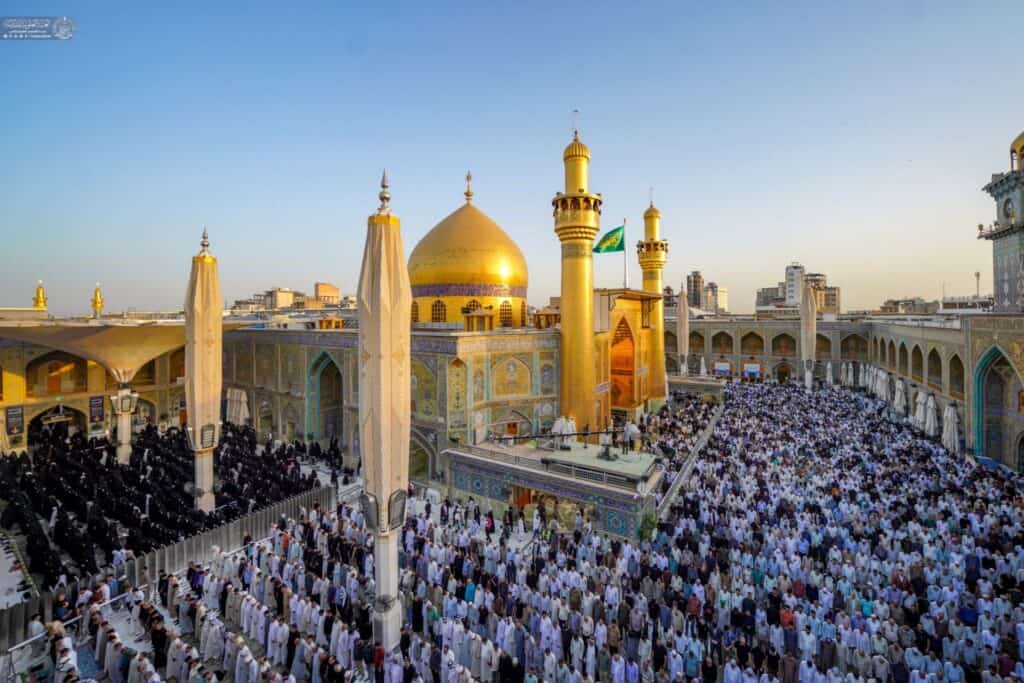
The Day of Arbaeen is also significant, marking 40 days after Ashura, the day Hussain ibn Ali was killed in Karbala. He is considered to be one who sacrificed his life in the pursuit of social justice. Millions of pilgrims travel to Karbala in Iraq to commemorate him. This is one of the world’s largest annual gatherings, with more than 21 million attendees in some years.
During the 2010s and onwards, the institutions have expanded, with the Imamiyyah Council, under the Majlis-e-Ulama-e-Shia Europe, established in 2021 to provide a forum for co-operation between groups.
Social justice
A 2019 study by researchers at Cambridge University and SOAS University of London, found that young Shia Muslims have been leaders in social activist spaces on university campuses.
These campaigns prioritise notions of “justice, equality and human rights”, undergirded by the principles of Shia Islam. “Shia students are thus actively engaged in renegotiating and reimagining their religious commitments and identity for the turbulent politics of the 21st century,” the study says.
Some prominent Shia Muslim figures include the journalist Mehdi Hasan, who founded the independent digital media company Zeteo in 2024. He has resisted the idea of an endless theological war between Sunnis and Shias and says that modern conflicts are driven by geopolitical interests.
In 2020, he said “sectarianism is a plague” following the death of Aya Hachem, a 19-year-old girl killed in Blackburn during a fight between two business owners. He criticised those spotlighting Aya’s identity as a Shia, saying: “Anti-Shia hatred is out of control.”
In a number of countries, Shia communities have faced state discrimination, sectarian violence or persecution. In Britain, Shia Muslims can also encounter anti-Shia prejudice or sectarian abuse alongside wider forms of anti-Muslim hostility. Relations between Sunni and Shia Muslims are diverse and the Shia community say relations should not be characterised as inherently antagonistic.
Baroness Warsi, the lawyer and peer, has also criticised any discrimination towards Shia Muslims, saying that “hostile and violent sectarianism is not just un-Islamic: it is anti-Islamic”.
A March 2026 a University of Leicester study published in Psychology and Psychotherapy said Shia Muslims are a positive example of “acculturation”, deftly intertwining their identities as both British citizens and Muslims. However, researchers also identified the emotional toll of such experiences of belonging.
Charitable giving is also a key component of Shia practice with the Khoja Shia Ithnaasheri Muslim Community of London reporting more than £2.6 million in charitable expenditure in 2023 as well as substantial spending on community activities.
Contemporary experiences
Recent conflicts and political instability across the Middle East and South Asia have had a significant impact on sections of Britain’s Shia Muslim community. The Shia community here say that many British Shia families retain close family, religious, charitable and cultural connections with communities in Afghanistan, Iraq, Iran, Lebanon, Pakistan and elsewhere. Wars, military escalation and humanitarian crises can prompt efforts to provide financial or humanitarian support to family members and communities overseas.
This may involve complex banking, regulatory and charity-compliance requirements, particularly where sanctions or financial restrictions apply. Some British Shia Muslims describe an experience of being a “minority within a minority”, sharing in the wider experiences and challenges faced by British Muslims while also encountering Shia-specific prejudice and, at times, feeling insufficiently understood within wider Muslim, interfaith and civic settings. At the same time, extensive networks and organisations contribute to community resilience during periods of international crisis and change.
Conclusion
The history of Shia Islam in Britain is more than one of migration and religious difference. British Shia communities are internally diverse and include long-established and newer communities with South Asian, East African, Middle Eastern, and Afghan backgrounds, alongside generations of Shia Muslims born and raised in Britain. Their history is also one of institution building, charitable activity, education, civic participation, interfaith engagement and adaptation, alongside continuing discussions about identity, religious authority and belonging.
Additional information was provided by the Al-Khoei Foundation.