By Maira Butt
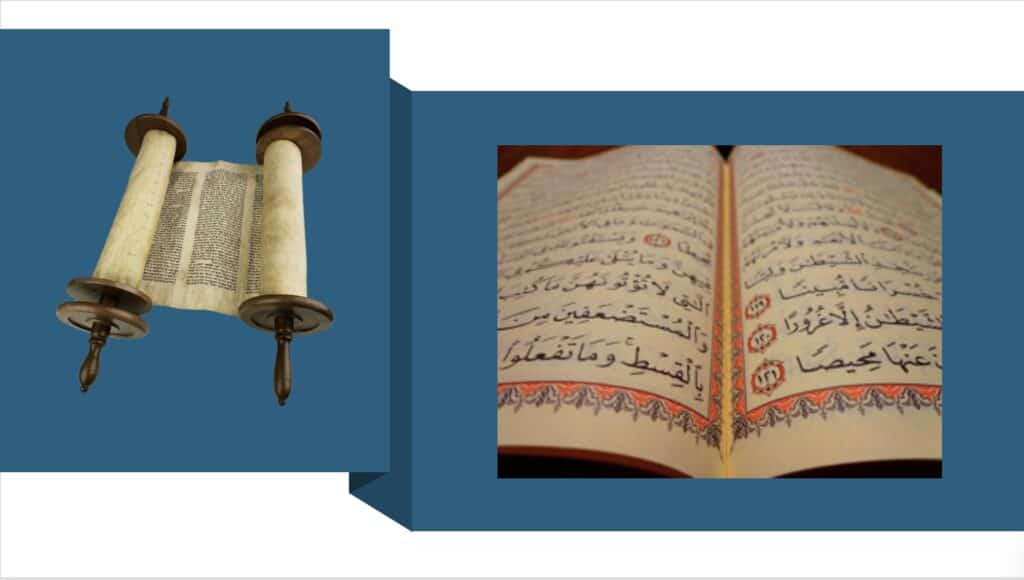
The history of the world is for many the history of religion. For thousands of years, the prevailing ideas, culture, art, and politics of society have been drawn in by the gravitational pull of the often-warring Abrahamic brothers of Judaism, Christianity and Islam.
While western religious thought is regularly referred to as the proverbial “Judeo-Christian tradition”, there has been little serious space for connections between the Torah and the texts of Islam. Until now.
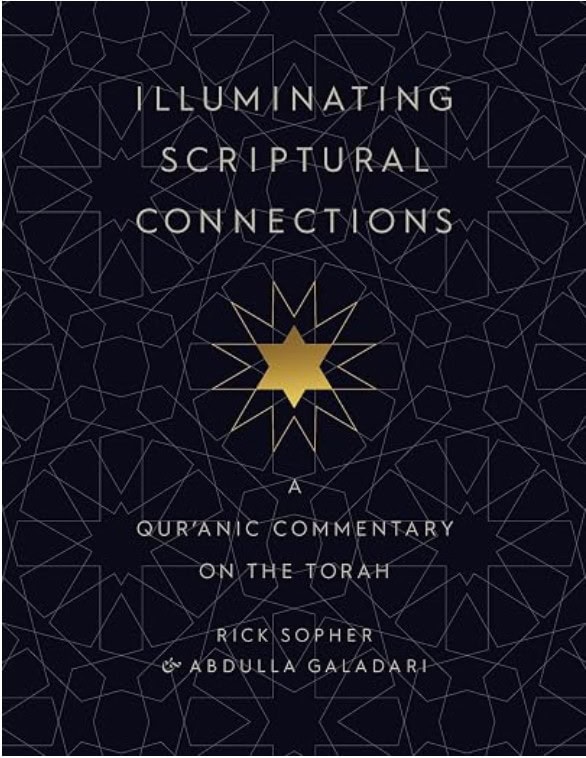
In Illuminating Scriptural Connections: A Qur’anic Commentary on the Torah, Rick Sopher and Abdulla Galadari have taken the 54 weekly portions of the Torah and studied how the texts can be viewed through the lens of the Quran.
What follows is an in-depth examination of the foundational texts of the faiths, which Mr Sopher says has undergone rigorous examination by academics and scholars. It comes at a time when religious tensions and hate crimes are heightened for all.
While the Quran’s references to the Torah and Gospels are well-known to Muslims, (the text regularly refers to both and calls Jews and Christians the “People of the Book”), Mr Sopher says that the source materials are not often studied by Muslims.
Likewise, he says that there is little understanding of the Quran within the Jewish community and people are often surprised at the similarities.
Mr Sopher is deeply grounded in interfaith relations and is a fellow of the Woolf Institute, an interfaith foundation based in Cambridge. Recently, he has been deeply engaged in exploring Jewish-Muslim relations, including the scriptural connections.
In 2007, he was awarded the Chevalier de la Légion d’Honneur by French president Jacques Chirac for his work in religious education. He was also, until recently, chief executive of the banking institution Edmond de Rothschild Capital Holdings, where he now serves as a senior adviser.
But the scriptural project was also deeply personal to him. His family lived in Iraq for over 2,000 years before they were forced to leave following discrimination against Jewish people. After millennia of living there in relative peace, by 1971, they had all left.
He noticed similarities in the language of the Torah and the Quran after he started learning Arabic with a teacher, in an attempt to make sense of the language roots.
“We started: ‘In the beginning, God created the heavens and the earth’. Well, the heavens and the earth in Hebrew are shamayim va aretz, and in Arabic and the Quran, it’s samawat wal-ard. I could immediately see the similar sounds reflecting the language connections of those words in the scriptures.”
The spark of an idea was born. He dug deeper trying to understand what had driven his family out of the land that they had called home for so long.
He says: “I wanted to know why. And was the Quran and its theology something to do with it or not? Did the Quran require perpetual enmity with Jewish people or not? I think the answer to both those questions at the end of writing this book and researching it, is probably not.”
The reality is more complex as the Quran is critical of some Jewish people who it accuses of not respecting their own laws, he says. The Torah meanwhile, does not accept successive religious traditions or their prophets within the schema of its own religious ideology.
The lack of cross-cultural and interfaith analysis of the texts has led to misunderstandings and fear on all sides.
“Most Jewish people that I have come across have not read the Quran and yet have a preconceived image of what they think it says,” he suggests. “I’ve come to tell them that it is not the war manual they might think it is. It’s not a book that is telling people to impose shariah [Islamic law] everywhere they go. That is not the main focus or purpose of the Quran.”
So, what is the Quran?
For Mr Sopher, it is in “large part a commentary on material found in the Bible”. As an example, he explains that the story of Noah in the Quran is told in relatively fleeting terms, with the details of how long the flood lasted and more, being told in more depth in the Torah.
“In order to understand many of the stories or comments that underlie messages contained in the Quran, the underlying story is often found in the Bible,” he says.
“I think the Quran is commenting on material that people are supposed to know, and that they’re supposed to know the Bible. It therefore seems hard to understand how the Quran could be properly understood without also being familiar with the biblical material.”
He refers to quotes within the Quran itself that ask its audience to consult earlier scriptures:
“So if you are in doubt, [O Muhammad], about that which We have revealed to you, then ask those who have been reading the Scripture before you.” Quran 10:94
Mr Sopher has hopes that the book will serve as a leaping off point for rigorous interfaith dialogue. Current interfaith initiatives focus on bridge-building and opening the lines of communication. Illuminating Scriptural Connections sets the foundation for something far more substantial, for mutual understanding based on the connections between the foundational texts.
An illustration depicting this is the cover of the weighty hardback book itself, which features the Star of David within the intricate 12-point star that is often at the centre of Islamic architecture and art and symbolises divine wholeness. In a seamless visual presentation of the ethos of the book, it brings the faiths together not just side by side, but connecting with each other.
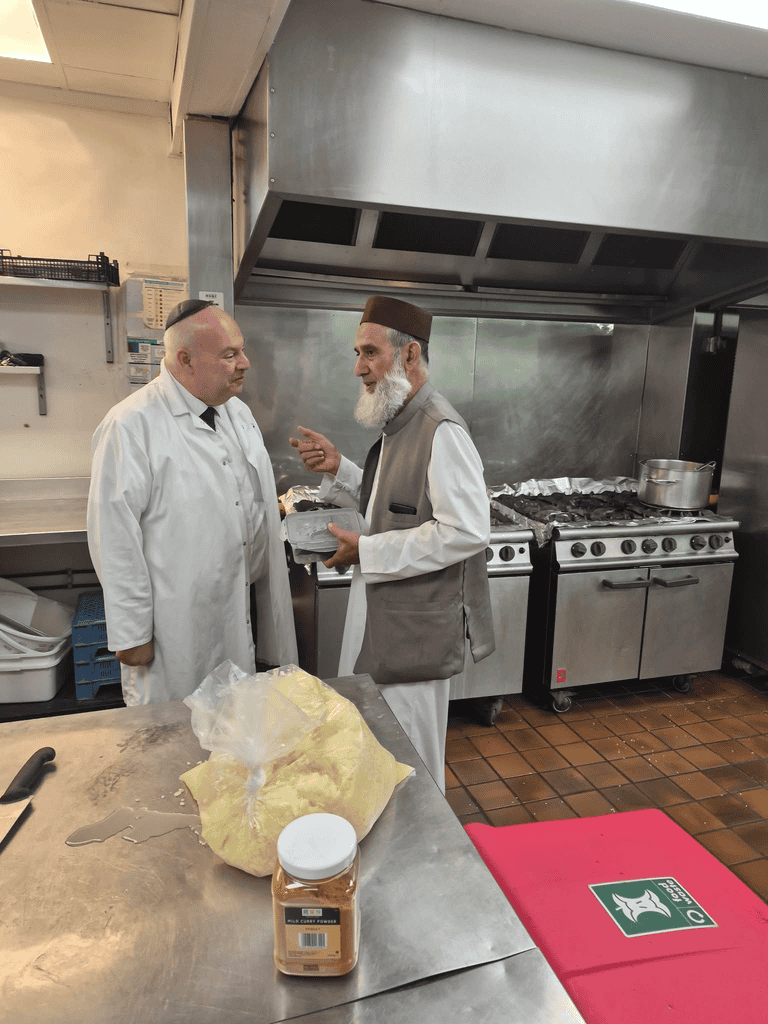
Mr Sopher also brought the spirit of the text alive at the book’s launch where catering for kosher and halal could have been done separately for rabbis and imams as it so often is.
“When I’ve been at events with rabbis and imams and the food comes along, they say, ‘OK, now the imams can go over there where there’s the halal food and the rabbis, we’ve got kosher food for you, and that’s in that corner over there.”
He thought this was a “bit odd” especially as a verse of the Quran reads: “The food of the People of the Book is permissible for you and yours is permissible for them.” Quran 5:5
“For this event, I didn’t want to serve two different meals and have people going off into two different corners when you’ve just had a nice time together,” he said.
He brought in the Halal Food Authority and kosher experts to visit the caterer at the same time and had them both approve the same food in a way he believes has “never been done before” in this format.
The instance was an example of bringing texts to life in a way that can be lived and breathed by the adherents of religions that have shaped the world.