New definition of anti-Muslim hate finally released
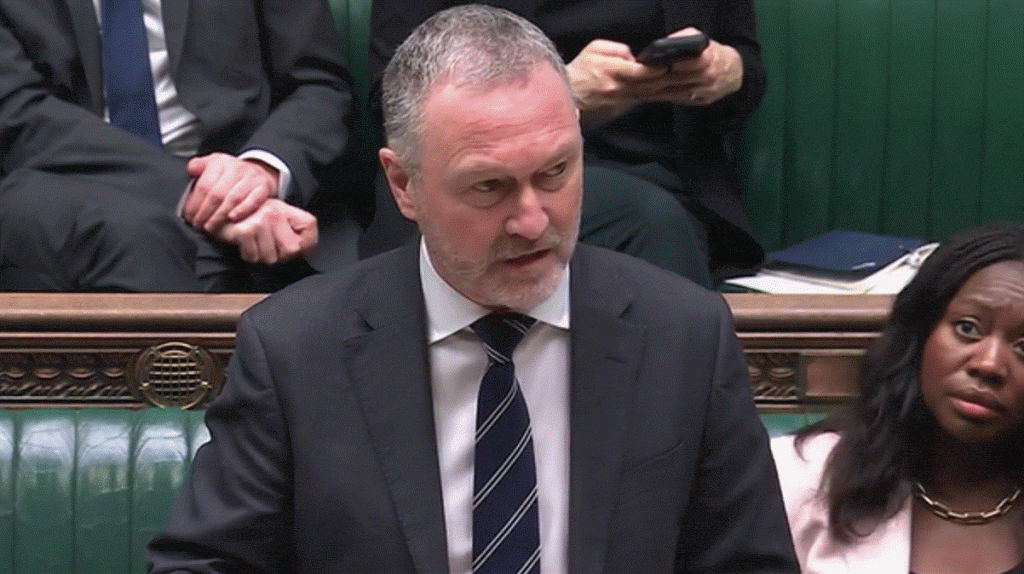
The government has approved the wording of a new definition of anti-Muslim hate, replacing an earlier definition of Islamophobia, which had been criticised for linking to racism. The Communities Secretary, Steve Reed, unveiled the new wording while announcing the government’s strategy for social cohesion. The definition itself runs to three paragraphs but does not use the word “Islamophobia”. Here it is (chapter 3):
“Anti-Muslim hostility is intentionally engaging in, assisting or encouraging criminal acts – including acts of violence, vandalism, harassment, or intimidation, whether physical, verbal, written or electronically communicated – that are directed at Muslims because of their religion or at those who are perceived to be Muslim, including where that perception is based on assumptions about ethnicity, race or appearance.
“It is also the prejudicial stereotyping of Muslims, or people perceived to be Muslim including because of their ethnic or racial backgrounds or their appearance, and treating them as a collective group defined by fixed and negative characteristics, with the intention of encouraging hatred against them, irrespective of their actual opinions, beliefs or actions as individuals.
“It is engaging in unlawful discrimination where the relevant conduct – including the creation or use of practices and biases within institutions – is intended to disadvantage Muslims in public and economic life.”
This is the definition which it replaces: “Islamophobia is rooted in racism and is a type of racism that targets expressions of Muslimness or perceived Muslimness.”
New definition ‘will not bring in blasphemy law by back door’
In a statement to the Commons, Mr Reed said there was “absolutely no question” that the new definition would bring in blasphemy laws by the back door, rather it “safeguards our fundamental right to freedom of speech”. He told MPs that the social cohesion strategy, “Protecting What Matters”, set out steps towards a more confident, cohesive and united kingdom, which was at threat from “those who seek to divide and weaken”, feeding off deliberate misinformation, hatred and extremism. The government had a duty to act as Muslim communities were facing shocking levels of abuse. The strategy and wording follows etensive liaison withh a taskforce, and in answer to MPs’ questions, Mr Reed made clear there had not been pro-active engagement with the Muslim Council of Britain in the process. He also said he had found that local faith communities were frequently involved in taking decisions with local councils, on schemes to develop their towns and advance social cohesion. Hansard account of debate here. Watch the debate here.
Call for action to tackle biased media reporting of British Muslims and Islam
The social cohesion statement was delivered at exactly the same time as a launch event for the Centre for Media Monitoring’s report on bias in the reporting of Islam. The report, “State of British Media 2025”, published yesterday, said 50 per cent of UK reporting on Muslims in 2025 was biased and 70 per cent associated Muslims with negative aspects of behaviour. During the launch event, the report’s analyst Faisal Hanif, said that Artificial Intelligence enabled the collection of 40,000 items of data over a year. The AI categorised articles according to five criteria including bias, negative portrayal, generalisations, misrepresentation, and omitting context, and it found the worst record of bias was held by the Spectator, followed by GB news, and the least by the BBC and ITV. Several speakers said the problem was getting worse in the media since the Centre for Media Monitoring first began its work eight years ago and action was needed now. The meeting proposed ideas such as tightening and broadening regulation, publicising the means of making complaints, organising journalist training especially around language, and employing more Muslim journalists. The point was made that broadcasters had the best record for not showing bias and public service broadcasting needed more money to continue its work.
Ramadan enters its final ten nights, when Muslims seek Laylat al-Qadr.
One of the most significant moments of Ramadan is Laylat al-Qadr, the Night of Power, marked in the final 10 days of the month. It’s considered a time of unique importance and sacredness and commemorates the night that the Quran was revealed to the Prophet Muhammad. Destinies and warnings are said to become clear in flashes of spiritual insight, as the season holds magical power. Extra prayers and good deeds carried out on the night are multiplied in their reward and goodness. Maira Butt reports here.
US cardinals speak out against Iran war
Two US cardinals have condemned the conduct and justification of the war in Iran, waged by the United States and Israel. Cardinal Robert McElroy, the Archbishop of Washington, said the conflict failed to meet the minimum moral criteria of the church’s just war teaching, such as responding to an imminent threat or ensuring the benefits would outweigh the harm. He warned that Lebanon could descend into civil war, global oil supplies were under strain, and Iran’s potential collapse could create dangerous new realities. And Cardinal Blase Cupich, the archbishop of Leo’s hometown Chicago, denounced the White House’ social media posts of the war, saying: “A real war with real death and real suffering being treated like it’s a video game — it’s sickening. Our government is treating the suffering of the Iranian people as a backdrop for our own entertainment, as if it’s just another piece of content to be swiped through while we’re waiting in line at the grocery store.” Associated Press report here.
Dame Sarah Mullally ‘didn’t quite believe it’ when chosen to be archbishop of Canterbury
Dame Sarah Mullally has said that when she was told in a phone call that she’d been chosen to be the next Archbishop of Canterbury, she didn’t quite believe it and asked them to repeat it. In an interview with the Rev Kate Bottley for the BBC’s Songs of Praise, she said that she felt a little excited, and “if they felt I was called, then that was, for me, the God moment”. Her personal decision to be a Christian came during her confirmation classes when she “couldn’t imagine life without God”. The interview was recorded for International Women’s Day, and she reflected on the speed of change in the Church of England, from allowing women to be ordained priests in 1994, to a woman being appointed archbishop in 2025. Opposition to women priests is one cause of a split in the worldwide Anglican Communion, but Dame Sarah said she offered generosity to those people and saw her role as a shepherd enabling ministry of others to flourish. See the interview again here
Bangor review calls for charity merger after cathedral spending row
A review into the governance of the Bangor Diocesan Board of Finance and the Bangor Diocesan Trust, suggests they should merge for stronger accountability, transparency and good governance. It examined past organisational structures which led to the scandal that emerged in 2025, when it was found that £418,000 was spent on new cathedral furniture, including chairs, paid for by the diocesan charity rather than the cathedral charity. The review acknowledged improvements since but also recommended updating membership and responsibilities of the trustee boards after the merger, better financial planning, risk management, staff training and project management. Church Times story here.
Film about ‘the first hymn’ to be shown in UK cinemas this month
A film about an early Christian hymn, found on papyrus in Egypt and re-imagined as a modern Christian worship song, will be shown in UK cinemas from 24 March. “The First Hymn” is being shown in Australia and the USA, and here in the UK it will be shown in Odeon and Showcase cinemas nationwide. It has been produced by the Australian “Undeceptions” podcast group, run by Wheaton College Professor John Dickson, an author, academic and songwriter. He found the papyrus fragment, dated to the mid-200s AD, in a vault at Oxford University. A fifth of the words were missing, but he worked with musicologists to re-create the hymn from the remaining 35 words, with the melody notation written directly above: “Let all be silent, the shining stars not sound forth, all rushing rivers be stilled as we sing our hymn to the Father, Son, the Holy Spirit, as all powers cry out in answer, Amen, Amen, might, praise and glory forever to our God, the only giver of all good gifts. Amen. Amen.” The film trailer is here.