By Catherine Pepinster
Artificial intelligence is fast, it’s number-crunching, information-analysing and seductive. It transforms much of what humanity does — but ultimately it is no alternative to the wisdom that humans can bring to their thinking.
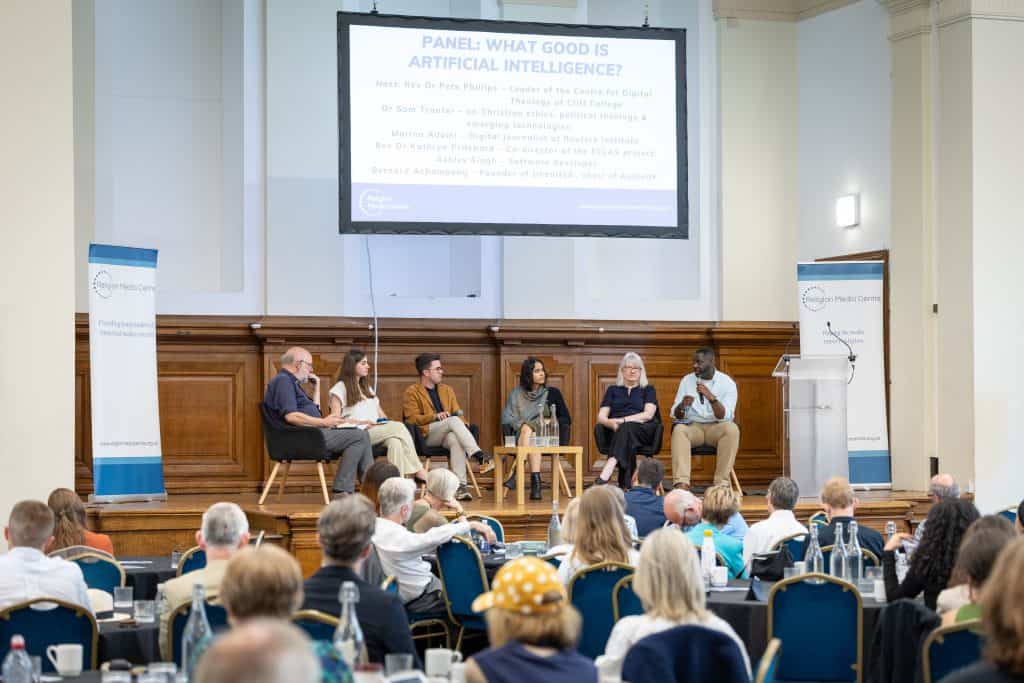
That was the conclusion of a round table discussion on AI at the Religion Media Centre Festival on Monday.
The panel, chaired by the Rev Dr Pete Phillips, leader of the Centre for Digital Theology at Cliff College, explored what good was artificial intelligence. While most of the panel could see significant benefits to AI in solving problems and completing tasks quickly, they also saw drawbacks. AI, they believed, is not so much good, but conditionally good.
The profound impact of AI on all parts of life — work, leisure, home life, and healthcare — has long been predicted but Dr Phillips’s questioning of the panel showed that this influence is being felt right now and is no longer something in the future. As Bernard Achampong, founder of Unedited and chair of Audio UK, said: “Anyone who is using a smartphone is using AI in some way, shape or form.”
Ashley Singh, a software developer who has worked on Catholic AI, a platform designed to bring together Catholic documents, sources and teaching, explained that AI mimicked how the human brain worked.
She described how an AI system was fed enough data for it to understand the grammar of language and the structure of sentences. Increasing amounts of data were provided to make its “thinking” more sophisticated. Large language models (LLMs) are advanced forms of artificial intelligence that could not only read and understand but also generated human-like text — the kind of systems that power bots like ChatGPT and Claude.
Faith organisations have started to focus on AI and its impact on the human condition. In February 2024 the Church of England’s General Synod recognised the scale of AI’s impact on the world of work in particular, calling it another industrial revolution.
In May this year Pope Leo XIV released an encyclical or teaching document on AI, warning that it must serve humanity, not concentrate power even more in the hands of the few. Days later, his warning was endorsed by the Archbishop of Canterbury, Sarah Mullally, in the House of Lords, who said that society was at risk of AI being unleashed “without the theological, philosophical and spiritual framework with which to make decisions about creating, controlling, using or directing it”.
Several of the RMC panel, including Marina Adami, a digital journalist at the Reuters Institute for the Study of Journalism at Oxford University, said they used such systems for time-saving on tasks.
“I prefer to use it for tasks that I otherwise find a bit boring and maybe a bit of a waste of my time, so I use it a lot for transcription, as many journalists do,” she said.
The Rev Dr Kathryn Pritchard, an adviser with the Church of England faith and public life team, praised AI for its usefulness in helping with research. But she and the rest of the panel also voiced concern about drawbacks to AI.
Mr Achampong compared it to the impact of McDonald’s on food. “We all know McDonald’s is not the most nutritious. They probably have some interesting practices in terms of how they sustain the world, but it’s good enough when it’s 10 o’clock and you need something to eat,” he said. “That’s where we are with the commoditisation of AI. The source is good, the technology has great potential, but the way it is distributed is a challenge.”
Dr Pritchard warned that there was a tendency for chatbots like ChatGPT to be programmed so that they hear what they want to hear and smooth out nuances. You had to learn, she said, to give sharper and sharper prompts and make sure it understood you were the creator and you did not wish to co-create ideas with it.
Mr Achampong warned of AI’s impact on employment, given that it might not be 100 per cent accurate but it was good enough, which might lead to jobs being lost as it could do tasks humans have done sufficiently well.
Another panellist, Dr Samuel Tranter, a McDonald postdoctoral fellow in Christian ethics at Oxford University, warned that AI could have a negative impact on ways of thinking.
He had been cautious about AI’s positive aspects, he explained, given “the ways in which the accumulation of knowledge that I can gain through it might substitute for the kind of wisdom that I might gain by slower and more contemplative forms of thinking and researching, and also by the interpersonal kinds of friction that actually sustain a good life, so it’s one thing looking for moral advice or spiritual advice that comes immediately.
“It’s another thing talking to someone with a different interiority, personal history, worldview, and spirituality.”
Dr Pritchard also wanted to analyse the impact of AI through wisdom, wellness and wellbeing. Technology of any sort, she said, ought to be supporting and informing the good of society. An example of this, she said, was AI’s benefits in healthcare, where it can crunch through data, speed up screening and provide rapid diagnosis. But it involves a lot of slow, painstaking work by humans first with time spent deciding what data to collect, checking quality, ensuring completeness, validating the data before AI could be trained.
AI, she said, was not a shortcut. “AI is good when it’s embedded in good practice, and I would contrast that with rushing ahead and with premature public availability of AI when we don’t know what the consequences are going to be when there is so much that is unforeseen.”
Dr Tranter was equally cautious, warning that people were attributing qualities to AI that were not necessarily present, such as consciousness, empathy and personality. He suggested that people who were atheist, who until now had considered the world in materialist terms, might find something mysterious about the algorithm.
“But actually”, he added, “if you’re a person of faith, the world’s already weird and beautiful and mysterious. There’s already depth in persons in creation, in non-human creatures, and actually we’re just discovering how weird the non-human creaturely world is.”