By Lianne Kolirin
A huge hoard of precious manuscripts that has been sitting in storage at the Wellcome Collection for more than a century has been restored to Britain’s Jain community.
Most of the documents were bought in 1919 at a vastly deflated price from a Jain temple in Punjab that no longer exists. Jainism once had a significant presence in the region, an ancient Indian religion that teaches non-violence towards all living beings, spiritual self-discipline, and the goal of liberation from the cycle of rebirth.
The manuscripts were shipped to Britain to join the huge collection amassed by the pharmaceutical entrepreneur Sir Henry Wellcome, but have largely been left undisturbed for over 100 years.
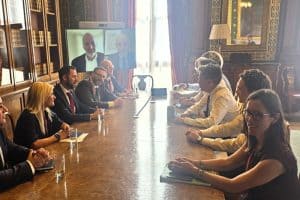
Now, after years of negotiating with the Institute of Jainology — which represents about 65,000 Jains in the UK — the Wellcome Collection has returned them during a ceremony in the Houses of Parliament.
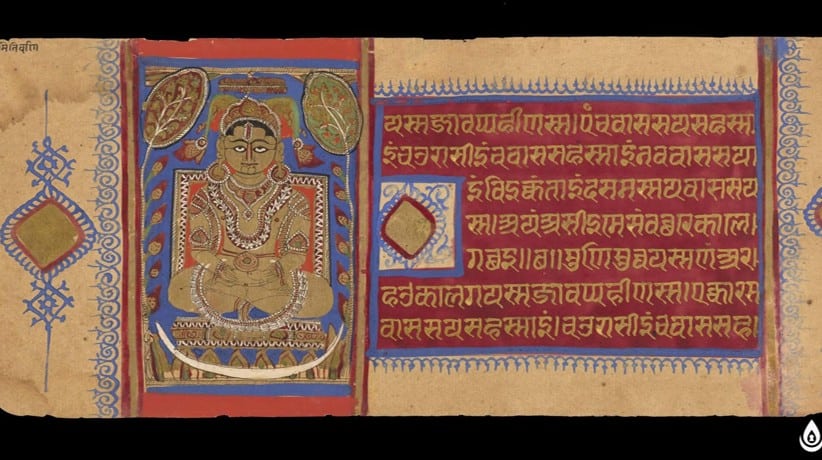
The Jain collection, which is believed to be the largest of its kind outside India, features many varied artefacts — from 15th-century illustrated manuscripts to unique texts from the 19th century, covering a broad range of topics including religion, medicine and culture in languages including Prakrit, Sanskrit, Gujerati, Rajasthani and early Hindi.
One of the most noteworthy is a text that heavily criticises the foundations of British rule in India. It lays out the ethical principles that Gandhi later drew on in his efforts to secure Indian independence.
Sir Henry Wellcome (1853-1936), who was a prominent figure in the growth of the modern pharmaceutical industry from the late 19th to early 20th century, travelled extensively as part of his work. During his lifetime, he aimed to advance knowledge of human health and disease and when he died his will set out terms for a trust to be set up in his name — and that would include his collection of historical medical items.
The Wellcome Collection, which opened in 2007, is a free library and museum in London that encompasses thousands of items related to health, medicine and “the human experience”; it and encompasses rare books, artworks, personal archives and a lot more.
Adrian Plau, Wellcome’s collections information lead, explained that Sir Henry employed numerous “agents” around the world to secure interesting “acquisitions”. Speaking to the Religion Media Centre before the ceremony hosted by the Jain All-Party Parliamentary Group, Dr Plau said the remit was “quite broad in terms of gathering material that would enlighten the history of medicine, health and science” and that what fell into this category could be considered as “quite flexible”.
The restituted collection comprises about 2,000 items — 1,200 of which came from the temple. “It was the entire holding of a Jain temple library,” he said, adding that there is much correspondence about the sale between London and the agent, who explained to his employer that he had “come across this opportunity to make an absolute bargain deal”.
Dr Plau added: “The feedback he gets from London is to try to get it cheaper still, and in the end he gets it at what appears to be the price of around five rupees for manuscripts, which was low even by the time.”
Another 800 or so documents in the collection were acquired from other sources, and yet hardly any of them have been on display since they arrived in Britain, Dr Plau said. They will now be moved to the Dharmanath Network in Jain Studies at Birmingham University, which will open the collection to those researchers and faith communities who are “best placed to read, interpret and translate their content for a global audience”, Wellcome says.
It comes as cultural organisations across the UK, and indeed globally, have been reckoning with the historical legacies of their collections. While other restitutions might be fuelled by a sense of righting the wrongs of the past, the Jain community has opted to look at things differently, according to Mehool Sanghrajka, managing trustee of the Institute of Jainology.
He told the RMC: “Although restitution and repatriation are very emotive subjects, we really don’t know what we don’t know. In other words, we really don’t know the circumstances under which this [the collection] was acquired.”
Also important to consider, he said, is the “huge amount of turmoil, loss of life and destruction” that occurred during partition which led to Indian independence in 1947.
“We look at that and think perhaps if Wellcome hadn’t acquired them, they may not actually be here any more,” he said, adding that Wellcome has “incredible” storage facilities which has meant the collection has been “treated with care and respect”.
“Now, rather than looking back and worrying about whether that was ethical, moral, legal and so on, we’re looking forward to saying ‘how can we make a real impact?’ Academics, researchers and the community [will now] have access to them and have them within the community, because that’s the place they belong.”
Mr Sanghrajka signed a memorandum of understanding on behalf of the Institute of Jainology in Westminster, alongside representatives of the Wellcome Trust and Birmingham University. A full legal agreement will be drawn up.
Dr Marie-Helene Gorisse, who is the Jain studies lead for the Dharmanath Network, said: “By working together, we will make sure that the return of the manuscripts by Wellcome Collection to the Jain community has maximum impact for students, researchers, members of the community, and for the general public. By securing access to this rich Jain heritage, we aim to raise awareness of Jain philosophy and culture, which can benefit the common project of living well in a diverse society.”