Council of Muslims and Jews announced at Religion Media Festival
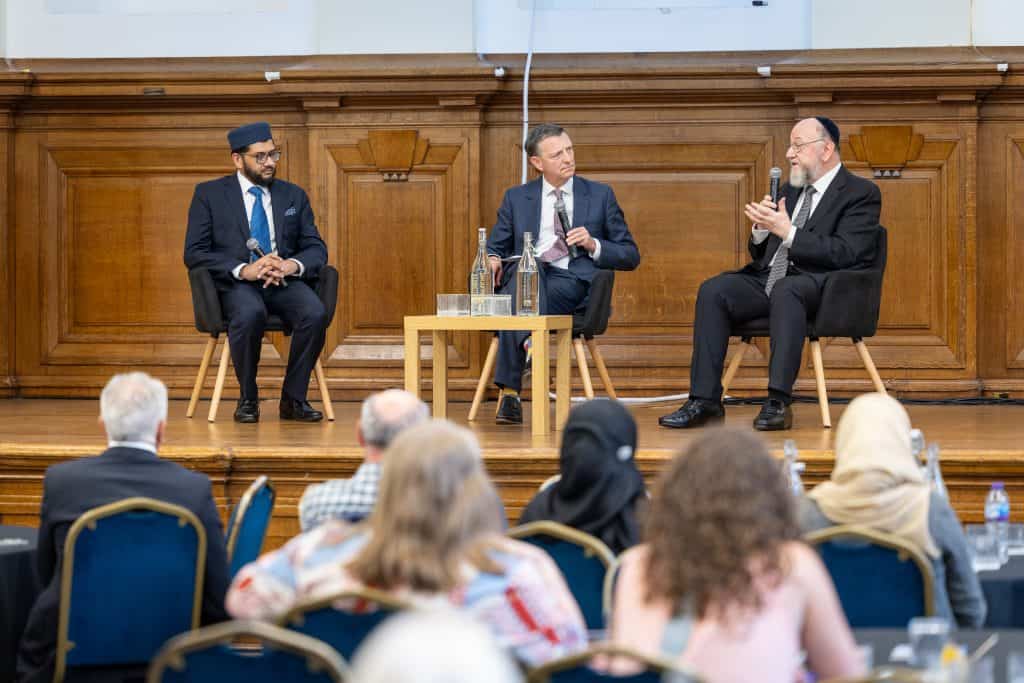
A council is being established to build bridges between Britain’s Muslim and Jewish communities and work towards improving social cohesion. Leading members of both communities will work side by side to tackle some of the biggest threats to inter-communal relations. The news emerged at the Religion Media Centre’s annual festival, in a conversation with the Chief Rabbi, Sir Ephraim Mirvis, and Imam Qari Asim, a senior imam at Makkah Mosque in Leeds. They were both signatories of the Drumlanrig Accords, where leaders of both faiths committed to the idea of a Muslim-Jewish Leadership Council, as well as four working committees covering education, civic engagement, charity work and religious freedom. Sir Ephraim said they were determined not to allow “a conflict thousands of miles away to disturb social cohesion on our streets”. Imam Qari Asim stressed that while he “may disagree on many things with the Chief Rabbi”, they could still work together to fight antisemitism and anti-Muslim hostility. Read Lianne Kolirin’s report of the session here.
Religion is ‘central to life’ and vital for rebuilding trust in media, says Archbishop of York
Religion is essential to understanding society and must be given greater prominence in the media if trust is to be rebuilt and communities held together, says the Archbishop of York, Stephen Cottrell. In his keynote speech at the Religion Media Festival, he argued that faith remained fundamental to public life and could not be treated as marginal or private. “Religious literacy is essential for community cohesion”, he said. In a panel discussion afterwards, Gareth Barr, ITV’s director of policy and regulation, pointed to uncertainty around the future of public service broadcasting, noting that “discussions are ongoing” and it remained unclear how religious content will feature in a more commercial system. Daisy Scalchi, BBC TV’s head of religion and ethics, highlighted strong audience demand for religious programming when it was done well, and said the under-25s are predominantly on YouTube and that “feels like an exciting opportunity.” Read Anna Averkiou’s article on the discussion here.
The Religion Media Festival was recorded and films will be published on our YouTube channel in the coming days.
King ‘protects faith within the multi-faith nation’
King Charles’ role as Defender of the Faith has been expanded in a definition outlined in the Sovereign Grant annual report for 2025-2026, which details how public funds have been spent. Outlining the King’s many public roles and responsibilities, the report says: “His Majesty is Supreme Governor of the Church of England and protects the space for Faith within the multi-faith nation”. It outlines the King’s role providing a “focus for national unity and identity” and says “His Majesty also has a special role in bringing communities and faiths together, engaging with them across the regions and nations of the UK”. In 1994, the then Prince Charles said in a TV programme: “I personally would rather see it as Defender of Faith, not Defender of the Faith.” In a 2015 Radio 2 interview, he clarified that he intended to retain the traditional title while acting as a protector of all faiths. In 2022, days after he acceded to the throne, he invited faith leaders to Buckingham Palace and told them “It is the duty to protect the diversity of our country, including by protecting the space for Faith itself and its practise through the religions, cultures, traditions and beliefs to which our hearts and minds direct us as individuals. This diversity is not just enshrined in the laws of our country, it is enjoined by my own faith.”
Pope Leo urges traditionalists to halt bishop consecrations
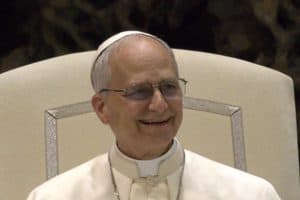
Pope Leo has made a final appeal to the Society of Saint Pius X, a traditionalist Catholic society of priests, not to go ahead with the consecration of four new bishops this morning, without his mandate, a move he regards as schism. The Society was founded in 1970 by Marcel Lefebvre in opposition to Vatican Two. It celebrates the Tridentine Mass and has its own network of seminaries, schools, priests and chapels. Pope Leo wrote to the Society’s Superior General of the Fraternity, Fr Davide Pagliarani, saying: “I urge you to consider carefully the spiritual good of the faithful, because the schismatic act you are about to undertake would deprive them of the licit and, in some cases, even valid reception of the Sacraments, which they love and seek for their sanctification.” He continued: “To tear the seamless garment of Christ is a sin of extreme gravity”. The consecration is due to take place today at 0800 BST at Écône, Switzerland.
Government scheme for mosque security ‘not fit for purpose’
Hyphen Online reports that mosques across the UK have had difficulty getting money from the government’s funds for mosque security and are dipping into their reserves to protect themselves at a time of heightened tension. Mosque leaders have told the reporter that the £40m Home Office fund for security at mosques is “not fit for purpose”. The report includes cases where mosques have been waiting for up to two years for applications to be processed. It quotes a spokesperson for Faith Associations, a company advising on security, saying the number of mosques approaching them for guidance had tripled since November 2025 and suggesting that funding should be allocated directly to the Muslim community rather than external contractors.
Japan’s decision to dissolve the Unification Church ‘dangerous precedent’
Human Rights Without Frontiers has warned that the dissolution of the Unification Church in Japan could set a dangerous precedent for religious freedom in democratic countries. Speaking at a press conference in Brussels, the organisation’s director, Willy Fautré, said the Japanese Supreme Court’s decision to dissolve the church amounted to an extreme interference with freedom of religion. Action followed the 2022 assassination of former Prime Minister Shinzo Abe, when the killer’s motive was associated with his mother’s funding of the church. But Fautré argued that less restrictive legal measures should have been considered. Speakers at the conference warned that other democracies could follow Japan’s example in seeking to dissolve unpopular religious groups.
Bishop ‘alarmed’ at maternity and neonatal care report
The Catholic bishop leading on healthcare, Bishop Paul Mason, says he is alarmed at the National Maternity and Neonatal Care report, which said women are not being “listened to, heard or believed”, and racism and discrimination are embedded in the system. He said there is a need for a culture of care, and the church believes that health and maternity services should promote respect for pregnant women as well as every human life from conception to natural death. He urged the government to ensure that parents and children are at the heart of all maternity care, saying that it is essential to listen to the needs of mothers and fathers and to respect their authority as parents in decisions concerning them and their children.
Northampton diocese under temporary governance after rape charge
Pope Leo has appointed the Archbishop of Westminster, Richard Moth, to be the “Apostolic Administrator” of the Diocese of Northampton, after the bishop there was charged with rape and has withdrawn from public ministry. This is a temporary role to ensure pastoral governance of the diocese. The Diocese of Northampton has issued a statement confirming that Bishop David Oakley “has been charged after an investigation into non-recent safeguarding allegations. We understand that this will be very distressing for all concerned but cannot comment further on an active legal process.”
Anglicans consider ending Canterbury’s unifying role
The Anglican Consultative Council is meeting in Belfast this week to consider changes which would remove the role of the Archbishop of Canterbury as a focus for unity. The move has arisen after disagreements over LGBT+ relationships and whether women can be ordained or be bishops, with traditionalists objecting while others have gone ahead. The issue is in sharp focus now, as Dame Sarah Mullally has been appointed as the Archbishop of Canterbury. Under the “Nairobi-Cairo” proposals, there would be a shared leadership model, with all provinces continuing to have relationships with each other, but acknowledging differences in belief. A decision is expected at the end of this week. Episcopal News Service report here