Nick Timothy’s ‘act of dominion’ charge is ‘megaphone dog whistle’
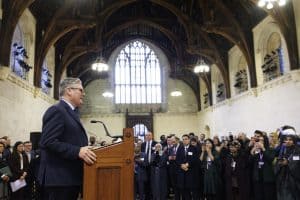
The shadow justice minister, Nick Timothy, has doubled down on his assertion that allowing Muslims to pray in a large group at an open iftar event in Trafalgar Square, was “an act of dominion”. In an article in The Telegraph, he quoted the ideology that the “total Islamisation of the public space – women in hijabs, Islamist posters and open prayers – is an expression of power and intimidation”. He said there is freedom to believe and practice religion in private in Britain, but “when such declarations are projected into shared civic spaces – including monuments of national history and identity such as Trafalgar Square – the line between freedom of religion and the imposition of religious rituals blurs”.
His party leader, Kemi Badenoch, has once more supported him saying there are ways of practising religion that are in accordance with British values and culture, but she regarded moving women to a segregated section to pray, as not being in alignment. She said religious festivals in this country are inclusive and everyone is welcome, but this was exclusive.
Nigel Farage said the prayer was “an open, deliberate, wilful attempt, not at the private observance of a different religion, but the attempt to overtake, intimidate and dominate our way of life”. This met a swift response from the former first minister and SNP MSP Humza Yousaf, who said: “Nigel Farage seems to have no issues with Christian prayer, Hannukah, Vaisakhi or Diwali all being celebrated in Trafalgar Square. He only has a problem with Muslims praying. There is a word for that, bigotry.”
Labour said Nick Timothy’s views were abhorrent. Keir Starmer denounced him and said Badenoch should sack him. The London mayor Sadiq Khan was pictures joining prayers at the event. He said the comments were a disgrace to the Conservative Party and a “megaphone dog whistle”. In an interview with La Repubblica, he said: “It’s Muslims today, who will it be tomorrow? Jewish people? Who the day after? Hindu people? This sort of mono-ethnic, mono-nationalistic view the Conservatives have is a carbon copy of President Trump. These guys are pound-shop President Trumps, they should be ashamed of themselves.”
The organisers of the open iftar, the Ramadan Tent Project, said all were welcome at the event. There were people of all faiths in the square, and after the call to prayer, hundreds walked up to the piazza by the National Gallery where prayer mats had been laid out facing Mecca.
Church of the Holy Sepulchre closed due to security concerns
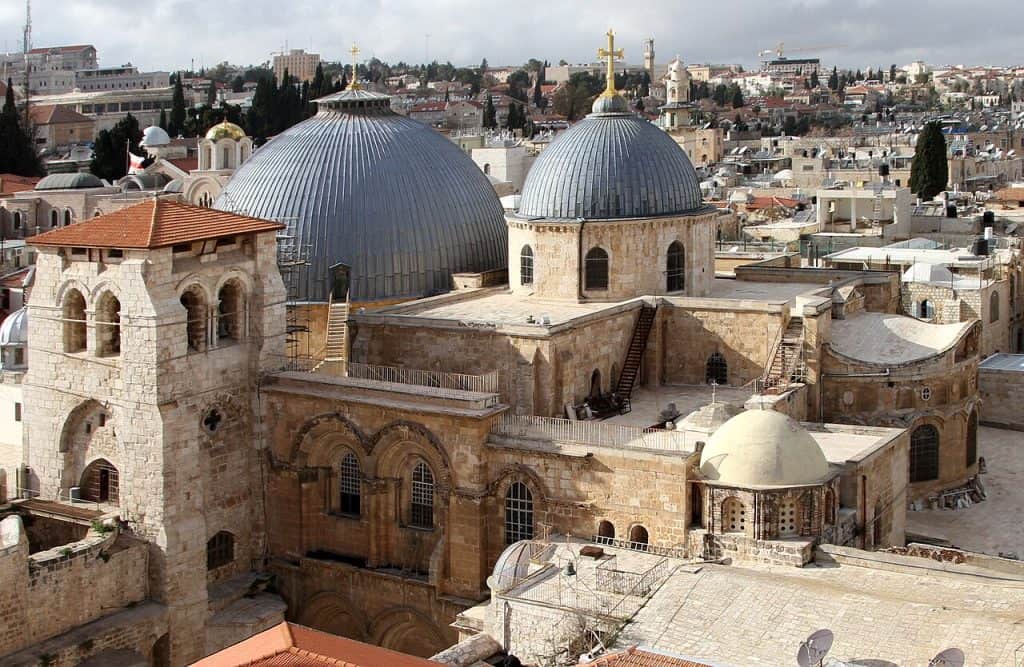
The Church of the Holy Sepulchre in Jerusalem has been closed since 28 February amid the conflict in the Middle East, and for the first time in living memory, worship has stopped for weeks in the crucial period of Lent and Easter. It was among several globally significant places of worship in Jerusalem to be shut, alongside the Western Wall and Al-Aqsa Mosque / Temple Mount, due to security concerns. The Church has shared custodians – the Greek Orthodox, Armenian Apostolic and Roman Catholic churches – and according to tradition, it is over the site where Jesus was crucified, and the location of his empty tomb. It is a highly significant and holy site, and the cycle of prayers during Lent and Easter, as well as the pilgrimage route on the Via Dolorosa, have been interrupted. Last Sunday, liturgy continued in a nearby church and the sermon was preached in the reception rooms. Only last Monday, debris from a missile landed on a rooftop close to the church, highlighting concerns and officials say the closure will remain in effect until security assessments determine it is safe to reopen. Western churches celebrate Easter Sunday on 5 April, but Eastern Orthodox use a different calendar and their Easter Sunday is 12 April. This means that in the church compound on 5 April, Palm Sunday and Easter Sunday will be marked on the same day.
Ramadan ends for most British Muslims today
Muslims in Britain were out watching the night sky last night for a sighting of the crescent moon, which would mark the end of the month of Ramadan, but it couldn’t be seen. Imad Ahmed, foundeJerusr of the New Crescent Society, announced on Facebook that people were looking from Scotland to Jersey, but there were no sightings. He said that Ramadan should therefore be observed for 30 days, ending on Saturday. He is leading a movement to validate UK sightings so everyone in the UK celebrates on the same day, but the campaign hasn’t won through yet. Most British Muslims follow sightings in different countries, principally Morocco or Saudi Arabia, and here the moon has been sighted, so most Muslims in Britain will celebrate the end of Ramadan today (Friday), with the festival of Eid ul Fitr, a time of rejoicing, partying and food.
Islamic Relief CEO urges ceasefire to honour Eid
The CEO of Islamic Relief, Iftikhar Shaheen is appealing to world leaders to embody the values of Eid and agree a ceasefire in the Middle East “so that people can celebrate without fear of bombs or starvation”. He cites people sleeping on the streets for safety in Lebanon, critically ill children and cancer patients in Gaza prevented from accessing treatment as crossings are shut, and the closure of the Strait of Hormuz, stopping food going to Sudan and Somalia, and says: “The world is spending an estimated $1 billion a day on this war, which could save and transform millions of lives if spent on aid rather than bombs.”
Two Iranian men charged with hostile surveillance of Jewish targets in London
Two Iranian men have appeared at Westminster Magistrates’ Court charged with carrying out hostile surveillance of Jewish targets in London on behalf of Iran’s intelligence service. Nematollah Shahsavani, 40, and Alireza Farasati, 22, are accused under the National Security Act of engaging in conduct likely to assist a foreign intelligence service. Prosecutors allege they conducted reconnaissance at locations including Britain’s oldest synagogue, a Jewish community centre, a school campus, a security organisation serving the Jewish community, and the Israeli embassy and consulate, between July and August 2025 and again in February 2026. Both men have been remanded in custody until their next court appearance on 17 April. Shahsavani holds British and Iranian nationality, while Farasati is an Iranian national who arrived in the UK in 2021. BBC report here.
Graves more than 100 years old could be re-used
The Law Commission has proposed that graves more than 100 years old could be reused across England and Wale, and some burial grounds closed under legislation going back 170 years, could be re-opened. Grave re-use is already permitted in London council cemeteries, Church of England churchyards, and others with their own specific laws. The proposals would extend re-use to other grounds, dependent on Government permission, local consultation and new safeguards. The report also recommends reforms to the way cemeteries and crematoria are run, giving instructions on burial depth, and offering bereaved families clearer rights. The report was written because there is a shortage of burial space. Guardian story here.
Free Speech Union says anti-Muslim hatred definition will have “chilling effect”
The Free Speech Union is launching a legal challenge against the Government over the new definition of anti-Muslim hostility, saying it will have a “chilling effect” on public debate. It says the definition is vague and subjective, and could restrict legitimate debate about Islam, Muslims, and Islamic beliefs, and inhibit women raising issues over honour killings and genital mutilation. It goes further, saying the definition could impede criticism of religion by atheists such as Richard Dawkins, and be used against Sikhs or Hindus where festivals honour anniversaries of historical figures who defended their faith against Islam. A government spokesperson told The Telegraph: “Our definition of anti-Muslim hostility gives a clear explanation of unacceptable prejudice, discrimination and hatred targeting Muslims so we can take action to stop it – while protecting our fundamental right to freedom of speech.” Telegraph article here.
Definition defended as a ‘tool to tackle rising hostility towards Muslims
Dominic Grieve, who chaired the working party which came up with the anti-Muslim hatred definition has defended the wording. He told The Times that with rising levels of abuse against Muslims, the state “should not be neutral” nor do nothing. He says the definition is a pragmatic tool to tackle rising hostility but without shielding Islam from criticism.
CAFOD criticises overseas aid cuts
The Foreign Secretary Yvette Cooper has confirmed that cuts to the UK overseas aid budget will go ahead as planned, with spending falling from 0.5 per cent of GDP to 0.3 per cent by 2028-2029. The government will now prioritise countries at war – Ukraine, Gaza and Sudan, but Pakistan and Mozambique will see significant reductions to their funding. The Director of Advocacy at CAFOD, Neil Thorns, said: “Today is not a good day for the UK’s global reputation, and it’s the wrong time for the government to be breaking its manifesto pledge to be a global climate leader. Peace and security in the world will be achieved through tackling poverty, reducing inequality and solving issues which cause destabilisation through diplomacy and dialogue, not through greater spending on defence”.
CofE re-organisation stopped by parliamentary committee
The Church Times reports that reform of the National Church Institutions, the organisations that govern the church including the Archbishops’ Council, has been stopped after the parliamentary Ecclesiastical Committee objected. The report says that criticism led by Danny Kruger, Reform MP, concerned the extent of power to be invested in a new structure with financial responsibilities, the need to establish new safeguarding structures and clarity over the church’s charitable purpose. The changes were designed to streamline administration and engender more trust, but now the church has been asked to come up with proposals which do not need legislation. Story is here
Pope’s 11 day whirlwind trip to four countries in Africa
The Vatican has released details of the Pope’s visit to Africa from 13 to 23 August. He will visit 11 cities in Algeria, Cameroon, Angola, and Equatorial Guinea, across 11 days, delivering 10 addresses and eight homilies. His trip will include a visit to the Great Mosque of Algiers, one of the biggest in the world, which can host up to 120,000 people, and the Basilica of Our Lady of Africa nearby. Other venues include the Japoma, Bata and Malabo football stadiums, hospitals, nursing homes, an orphanage, Community Houses, a cathedral, a school, universities and a memorial to 100 people killed at a military base. He will also meet the presidents of Algeria, Cameroon, Angola, and Equatorial Guinea.