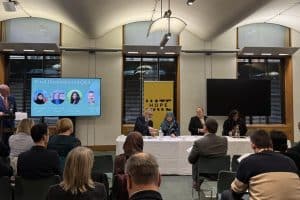
The Muslim Council of Britain has published a vision for 2050 which aims “to unite British Muslims for effective action, empower our communities with the tools to excel, and serve Muslims and our country so we may have a just, cohesive and successful British society”. The vision is based on evidence from Town Hall meetings organised last year and outlined in this report.
By Maira Butt
The Muslim community in Britain is in transition, according to a new report.
“Fifty per cent of British Muslims are now UK-born and 46 per cent are under the age of 24. This ‘demographic dividend’ offers immense potential for national prosperity yet is currently constrained by persistent inequalities, institutional Islamophobia, and a fragmented support ecosystem,” it says.
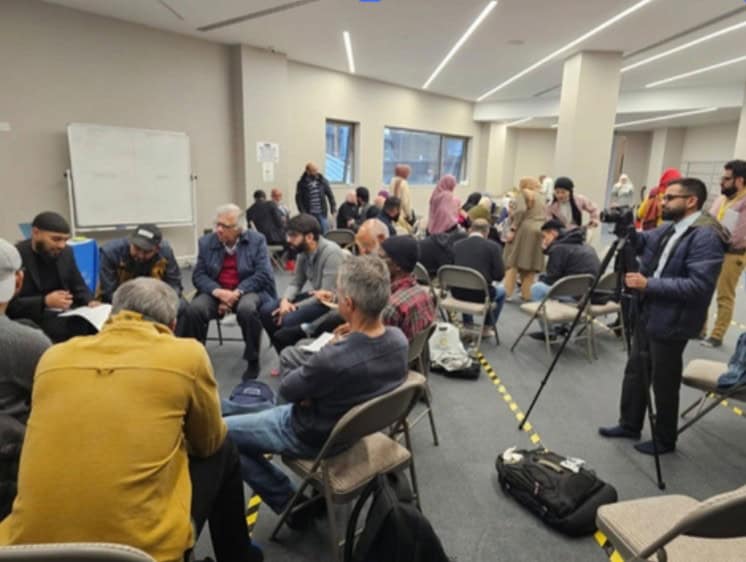
Regional Townhalls: What issues are facing the British Muslim Community? is based on a series of “town halls” conducted over six months last year in 30 towns and cities including London, Birmingham, Manchester, Nottingham, Bristol, Cardiff and Glasgow.
The report was commissioned by the Muslim Council of Britain (MCB), which is seeking to identify positive features and critical challenges and lay the groundwork to create a way forward for Muslim civil society.
It collates the findings from discussions with hundreds of people. Sri Lankan, Bosnian and Somali communities took part as well as converts, prisoners, mental health professionals, student Islamic societies and youth groups.
Five themes have emerged as priorities among grassroots groups: identity and integration; welfare, safeguarding and support; leadership, representation and advocacy; funding and resources; and Islamophobia and discrimination.
Identity and integration
The report highlights a “growing risk of identity dilution among youth” due to pressure from Islamophobia in schools and universities as well as feeling the need to “code-switch” — changing, for example, your accent depending on who you are talking to. It says this leads to young people hiding crucial parts of their identity. Lack of positive role models and surveillance cultures are identified as factors affecting their lives.
Converts report feeling marginalised and facing “marriage exploitation” as well as tokenism — the superficial inclusion of minority groups to simulate diversity — according to the report. Other groups reporting marginalisation include smaller ethnic groups from the Far East, and others from the Middle East and North Africa regions, who report disconnection from mainstream South Asian communities that make up the majority of the UK’s 4 million Muslims.
Refugees suffering post-traumatic stress disorder and poverty from experiences in war-torn countries report a feeling of “faith erosion” through feeling pressured by missionary activities from other faith groups as well as feeling neglected by Muslim communities already settled in the UK.
The MCB recommends creating specialist ethnic working groups connected to specific minority communities, establishing a prison reform taskforce, developing “convert care” frameworks, and establishing a national Muslim youth investment fund to support the 551,000 Muslim teenagers projected in 2031.
Welfare, safeguarding and support
Refugee poverty, prisoner welfare, mental health and loneliness were identified as key concerns among the regional meetings. Refugees were reported to be living on £8.95 per week and struggling with food insecurity and lack of access to verified halal food.
Muslims make up 18 per cent of the prison population, up by 10 percentage points from 2002, and the meetings said that ex-offenders struggled with reintegrating into society and facing stigma post-release.
Access to the National Health Service remains low for people struggling with their mental health, and stigma remains a barrier for Muslims. The report recommends a single point of access for mental health support.
It also suggests a national safeguarding framework to support with financial, logistical and moral support across all Muslim institutions and organisations to ensure streamlining.
Regional and local councils are also identified as a source of support for prisoners, enabling them to work on rehabilitation schemes and crime prevention, along with accredited chaplaincy and counselling services.
Disconnected leadership
Muslim leaders are reported as being disconnected from grassroots communities leading to “real anger out there” as well as “cynicism and frustration”. Young people, women and ethnic minorities feel particularly affected by the perception that meritocracy is a myth and that there is no clear “pipeline” into leadership that is not dependent on existing networks.
There was a feeling among the communities reached across the town halls that there are glass ceilings that are insurmountable. Under-represented groups such as those from the Middle East and North Africa, and the Far East, reported “no leadership representation without umbrella structures”.
The report recommends the creation of pipelines to ensure progression routes for a more diverse leadership across Muslim communities and organisations.
Funding and resources
Muslims donate more than £2.2 billion annually, making them the UK’s most generous givers, according to the think tank Equi. However, the town halls were uneasy about the way the donations were spent, with most of it going to projects abroad, or for the building of even more mosques in the UK, when grassroots organisations say they are working on “shoestring budgets”, especially with young people or converts. This places a strain on volunteers, the report says.
Muslims charities also reported being “de-banked” — their bank accounts being closed — and facing disproportionate scrutiny due to counter-terrorism laws.
The community struggles with disproportionate poverty levels, affected by the cost-of-living crisis, employment barriers, and more.
The MCB recommends more national zakat initiatives , which require adult Muslims to donate 2.5 per cent of their wealth annually to specific, needy recipients, as well as sustainability and support to be embedded across charitable organisations in the Muslim communities.
Islamophobia and discrimination
With government figures reporting that religiously motivated hate crimes are at a record high, and Muslims being the worst affected, the town halls identified Islamophobia intensifying over the period covered in the report.
It identified institutional bias, suggesting that Muslims are reported to the Prevent programme in the NHS at a rate eight times higher than others. Hyper-visibility or invisibility is also an issue with Muslims struggling to feel truly “seen”, and only when viewed through a security lens.
Muslim political participation is also identified as an issue with the Muslim Vote coalition of organisations being vilified as being “sectarian” or “undemocratic” rather than an exercise of democratic rights, the report says.
The report recommends changing the narrative using the media, social media, and grassroots groups to understand how to change the perception of Muslims. It also recommends a version of CAIR, the Council on American–Islamic Relations, as an advocacy group within the UK to serve the Muslim communities. It suggested that monitoring, reporting and acting bodies needed to be co-ordinated with data, marketing and funding.
The report goes on to unpack the individual needs of under-represented communities, including young people, converts, Turkish communities, professional networks, refugees, Far East Muslims, mental health communities and Middle East and North Africa communities.
The report concludes that this is “a community in transition” and Muslims must look past the idea of “saviours”.
“For a society to mature, for a civilisation to revive, for a people to succeed, they need to move towards building procedures, protocols and practices,” it says. “We need to speak to the people. We need to understand their fears, hopes and dreams, and then we need to work together to try to deal with them.”
The report is here