
By Catherine Pepinster
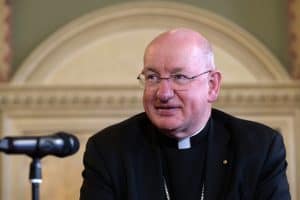
The retirement of Cardinal Vincent Nichols as Archbishop of Westminster marks the end of his 16 year leadership of the Roman Catholic Church in England and Wales, a period of rapid change in church and society.
Two notable historic events took place in these years: the first state visit of a Pope, when Benedict XVI visited Britain in 2010, and the 2023 coronation of King Charles III, when he became the first Roman Catholic cleric to participate in a coronation in this country since the Reformation.
His intervention in public affairs included
- A document on Catholic social teaching published just before Tony Blair won the landslide election victory.
- Efforts to use Catholic social teaching to improve business ethics following the global financial crisis of 2007-08.
- Raising the profile of human trafficking, through his membership of Pope Francis’s Santa Marta group, which brought together police chiefs and bishops to try to eradicate the problem.
- And strong criticism of the decision to close places of worship during the Covid lockdown.
His years, however, were marred by the sex abuse crisis in the Catholic church and the way in which he was singled out for criticism by the government inquiry into abuse, which led to calls for his resignation.
Early life
Vincent Nichols was a Catholic shaped by where he grew up. He was born in Crosby, Merseyside, where religion, like football, is tribal. He has been a lifelong fan of Liverpool FC.
At the age of 18, he studied for the priesthood at the English College in Rome, witnessing at first hand the turmoil of the Second Vatican Council which met throughout his time in the Eternal City.
After studying theology and philosophy in Rome, he then spent a year of postgraduate study at Manchester University, gaining an MA in theology and then went to Loyola University in Chicago for a masters of education degree.
Cardinal Nichols had been considered as a likely candidate for ecclesiastical high office by the laity, his fellow priests and senior church figures.
His ministry began in Wigan, then Toxteth, then as an auxiliary bishop in the Diocese of Westminster, Archbishop of Birmingham from 2000 to 2009 and finally, Archbishop of Westminster.
The Common Good
His first posting was as a parish priest in Wigan, and he later worked in Toxteth, an area of Liverpool that was marked at the time by severe deprivation. There he served under the Roman Catholic Archbishop of Liverpool, Derek Worlock, one of the first to pick out Nichols as someone destined for high ecclesiastical office and talked to him of the importance of being “Vatican-friendly”.
Perhaps it was that experience in Liverpool in a city that exemplified the post-industrial decline of the 1970s and 1980s, that saw him play a pivotal role in shaping The Common Good and the Catholic Church’s Social Teaching, a document published by the Catholic Bishops Conference in 1996 as guidance to Catholics when they came to vote in the forthcoming general election, which would be the landslide that brought Blair’s New Labour to power.
One of its key lines stood out: “Evangelisation also requires the transformation of an unjust social order; and one of its primary tasks is to oppose and denounce such injustices.”
The document merely stated and explained mainstream Catholic social teaching, but was viewed by some at the time as an endorsement if not of the Labour Party itself, then of the need for widespread change in British society.
For the most part, though, Nichols was cautious entering what could be interpreted as the political fray and he was not as comfortable among the London elite, as the well-connected Basil Hume, had been, nor did he have the easy charm and humour of his immediate predecessor, Cormac Murphy-O’Connor. Nichols was always more comfortable among his own tribe: Roman Catholics.
But he chose his interventions carefully and they were often about education, which was not only a particular academic interest but also an ecclesiastical one: he chaired the Catholic Education Service for many years, representing schools that make up 10 per cent of schools in the English and Welsh state system.
He also served as general secretary of the Catholic Bishops’ Conference of England and Wales from 1984 to 1992, which gave him invaluable insights into the workings of the church and its relations with the state and with Rome, before being appointed an auxiliary bishop in Westminster, under Hume. It was another indication that bishops thought him destined for high office.
Public issues
Nichols was heavily involved in encouraging business to rethink their values in the wake of the global financial crash of 2007-08, bringing together in 2012, 200 leading businesspeople for a conference on Blueprint for a Better Business, which in turn led to the setting up of an organisation of the same name, focused on improving business ethics.
Concerns about exploitation also led him to help Pope Francis create the Santa Marta Group which brings police chief, bishops and some politicians from around the world to try to tackle human trafficking. Nichols was aware of the potential for the church to lead on this issue because of the work done by religious sisters, working with trafficked women
But perhaps his most direct intervention in the political sphere came during the Covid lockdown, when he strongly criticised the decision to close places of worship, a measure intended to prevent the spread of the virus. Together with Archbishop Malcolm McMahon, the Catholic Archbishop of Liverpool, Nichols spoke of his “anguish” at the decision, saying:
“Whilst we understand the many difficult decisions facing the government, we have not yet seen any evidence whatsoever that would make the banning of communal worship, with all its human costs, a productive part of combating the virus.
“We ask the government to produce this evidence that justifies the cessation of acts of public worship.”
Earlier in the pandemic, in 2020, the Church of England had gone so far as to ban its clergy from entering their own churches – even alone – to pray privately or to enable the livestreaming of services, provoking an outcry from some of its own vicars. By November that year, during the second national lockdown, most of Britain’s religious leaders were singing from the same hymn sheet — and made their opposition to the closures clear.
LGBT issues
Archbishop Nichols was on perhaps more familiar theological ground when he spoke out in 2012 against plans to legislate for same-sex marriage. Having earlier likened gay relationships to what he called a “profound friendship”, he called the moves by David Cameron’s government “a shambles” because they had not been included in party manifestos before the 2010 election. George Orwell, author of Nineteen Eighty-Four, the archbishop said, would be “proud of that manoeuvre”.
Yet a few months later, the archbishop made a decision concerning gay Catholics that, while attracting criticism at the time, very probably helped to keep many members of that community within the church. Responding to sustained censure from conservative commentators and some parts of the media over so-called “gay masses” being held at a church in Soho, Nichols, with the agreement of the Society of Jesus, moved the base of activities of the group to the Church of the Immaculate Conception in Mayfair.
The church they had been using, Our Lady of the Assumption and St Gregory, was given over to the members of the new Personal Ordinariate of Our Lady of Walsingham, comprising a little over a thousand members of the Church of England who, unable to stomach women bishops, were allowed by Pope Benedict XVI to enter into full communion with the Catholic church, while retaining elements of their Protestant tradition.
There was a catch though; there were to be no more distinctive “gay masses” for the gay community. Instead, they would join the established parish services with other parishioners in Mayfair.
Yet with this compromise, Nichols was able to fulfil the demands of pastoral care for gay Catholics who often felt they were excluded from the full life of the church, while also satisfying the rule-policing tendencies of some parts of the Catholic commentariat.
Those battles over sexuality, poverty and lockdown pale into insignificance compared with what arguably became the cardinal’s most difficult challenge. It damaged the moral and institutional authority not just of the church, but of Nichols himself.
Sex abuse
During his time as auxiliary bishop in Westminster, when Basil Hume led the diocese, child sexual abuse was barely mentioned, although it later turned out that it was already a problem at Hume’s own Benedictine monastery of Ampleforth in North Yorkshire, when Hume was there in the 1970s.
By the time Cormac Murphy-O’Connor succeeded Basil Hume as Archbishop of Westminster in 2000, survivors of abuse were beginning to talk about it, as were journalists, and a scandal in Murphy-O’Connor’s previous diocese of Arundel and Brighton nearly derailed his time at Westminster.
But the scandal grew more and more evident during Nichol’s tenure as Archbishop of Westminster with more and more survivors coming forward to describe how the church in England and Wales had failed them with some of the most scandalous cases happening during Nichols’s time in Birmingham.
The government’s response to a growing deluge of abuse revelations that ran right through the country’s institutions, not least its schools, prompted it to establish an official inquiry, where the facts could be laid out and, if not a reckoning, the findings could be used to ensure that abusers never again had free rein over their victims, while those in power looked away.
The Independent Inquiry into Child Sexual Abuse (IICSA) investigated both the Catholic and Anglican churches, and Cardinal Nichols was called to give evidence before the panel over the course of two days.
What emerged was damaging to him, and the church, as he was forced to explain his response to claims of abuse when he was Archbishop of Birmingham, which were judged inadequate.
Nichols had to bear the brunt of the questioning about the overall role of the church alone because, despite a request from the inquiry, the Papal Nuncio refused to provide a statement on his office’s role in investigating abuse at Ealing Abbey and St Benedict’s school in west London.
The inquiry found that between 1970 and 2015 the Roman Catholic Church received more than 3,000 complaints of child sexual abuse against more than 900 individuals connected to the church.
It was “far from a solely historical issue”, the inquiry said in its November 2020 report, concluding that the cardinal, “did not always exercise the leadership expected of a senior member of the church, at times preferring to protect the reputation of the Roman Catholic Church in England and Wales and in Rome”.
He had shown “no acknowledgement of any personal responsibility to lead or influence change”. “Nor did he demonstrate compassion towards victims in the recent cases which we examined.” Cardinal Nichols apologised for the church’s actions when he gave evidence.
Despite calls for his resignation from survivors and others, Cardinal Nichols refused to budge. He also said that he had offered his resignation to the Pope — but that in fact was a formality which all bishops and archbishops undergo when they reach the age of 75.
In response, Cardinal Nichols said: “I’m not here to defend myself … I am here to say we accept this report, we are grateful to IICSA for bringing the light and giving public space to those who have been abused, we are deeply sorry this happened.”
Some survivors of abuse called on him to consider his position, but the archbishop made clear that he would not stand down.
His life as cardinal
While to most Catholics, Cardinal Nichols’s chief role appears to be leading the church in England and Wales, he has also played a notable role in the wider church through his membership of influential Vatican committees, or congregations, including the one responsible for recommending priests for promotion as bishops. This work took him frequently to Rome, leaving much of the work of running his diocese to his auxiliaries.
Since 2014, when he was appointed cardinal, joining what the church calls the College of Cardinals, he has been one of the elite band who are called on to elect a Pope.
He took part in the election of Pope Leo XIV in Rome on 8 May this year. Cardinals lose their right to vote on reaching 80, giving Cardinal Nichols only until his 80th birthday on 8 November 2025 to take part in a conclave.
His likely successor
The appointment of the next Archbishop of Westminster lies ultimately with the Pope. He will receive a report — known as a terna — from his nuncio, or ambassador, based in the UK, who will take soundings from other bishops and members of the laity here. The views of bishops in Scotland and Ireland may also be considered. So will those of notable English clerics in Rome, such as Cardinal Arthur Roche, who works in the Vatican as prefect of the Dicastery [department] of Divine Worship.
Westminster, considered the leading see of England and Wales, is always high profile and full of the risk for pitfalls and challenges, as well as triumphs, as Vincent Nichols discovered over many years.
Contacts:
Catherine Pepinster via the RMC [email protected]
Catholic Bishops Conference for England and Wales – communications: [email protected] 0207 901 4800
A number of other Catholic commentators are listed on our website here