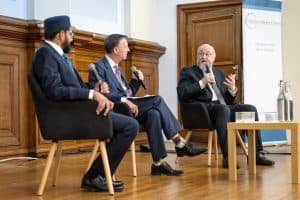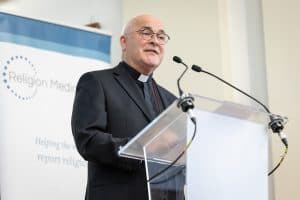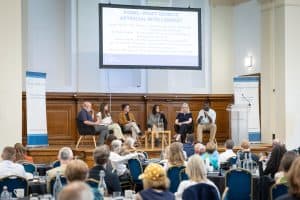
By Julia Bicknell & Ruth Peacock
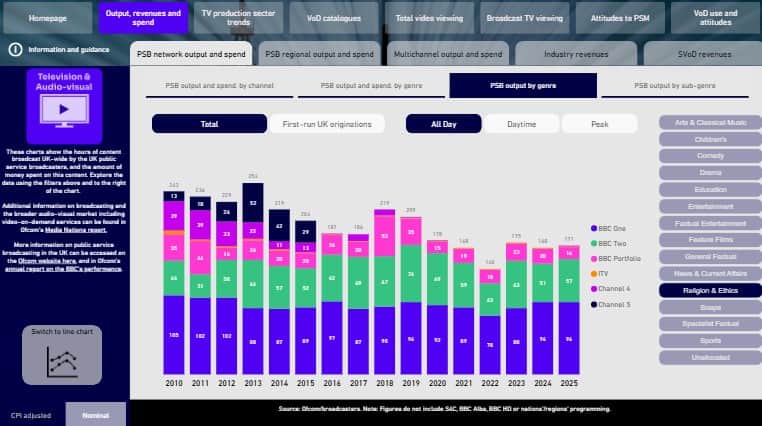
Latest Ofcom figures for “religion and ethics” TV and audiovisual output aired during 2025 by public service broadcasters, show an overall marginal increase of three hours on 2024, but the figure is much lower than the highpoint in 2013.
In that year, there were 254 hours of programming about religion including worship. In 2025, the figure was 171 hours (Diagram 1, below) – a drop of 33 per cent, mainly due to Channel 4 and Channel 5 withdrawing. In 2025, ITV and Channel 4 recorded one hour each, the rest came from the BBC.
Daisy Scalchi, BBC Head of Religion and Ethics, TV, said: “The BBC’s commitment to religion and ethics content is demonstrably strong. Audience habits have changed dramatically over the past 15 years, and we need to meet audiences where they are today – this includes programming in both peak and daytime TV but also programming that can gain a strong audience over time, and at their convenience, as viewers come to our content on iPlayer and other BBC platforms.
“The BBC provides almost 99 per cent of the UK’s broadcast religion programming across a wide variety of content, featuring documentaries, factual entertainment, worship, events and live debate, as well as titles in Children’s, Nations, BBC Bitesize and Education and a dedicated Religion Editor in News.
“Nor is religious representation limited solely to religion-specific programmes, as there are religious characters and storylines across entertainment and drama. There is no other UK media organisation consistently reflecting faith and belief across such a breadth of content and formats”
Ofcom’s findings are shown in the “Communications and Market Repeort 2026”, a series of graphs published on its website here. They show details of hours broadcast, category of programme, and time of day, divided into all day, daytime and peak. Diagram One, below, shows total hours of religion programming.
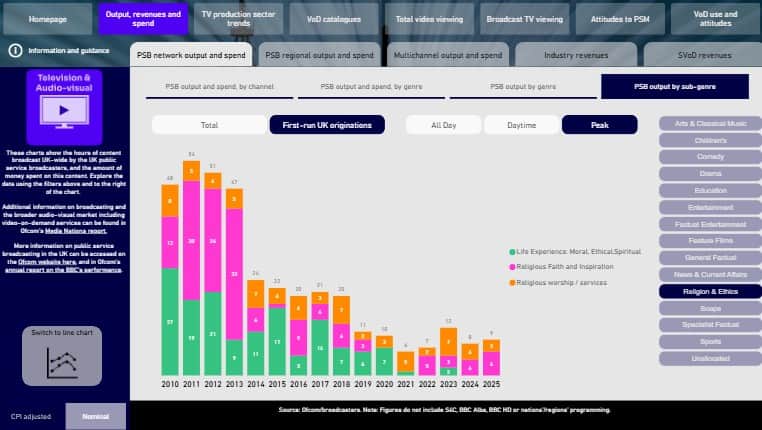
Original (first run) content in peak time 18.00-22.30
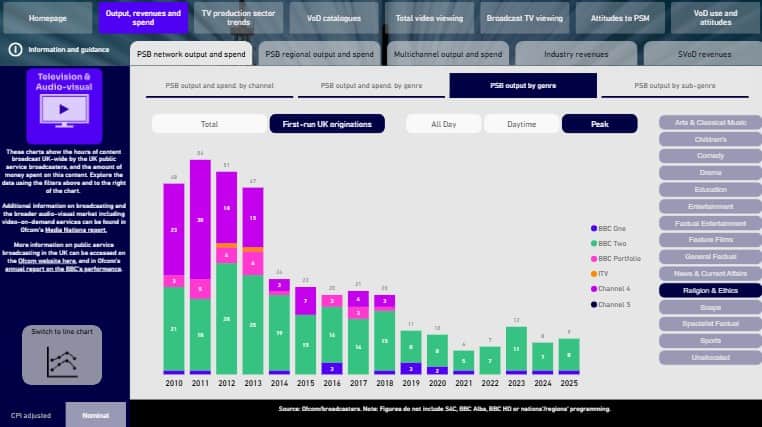
In 2011-13, (Diagram 2), peak-time TV viewers could see about 30 hours a year of original UK content featuring “Religious faith and inspiration” and 20 hours a year about “Religious life experience”, featuring moral, ethical and spiritual issues.
In 2025, these two last categories of output were combined. In peak-time, viewers got six hours in the whole year of first-run original content., and three hours of religious services/worship original content.
All-day and peak-time data
The total of daytime hours, including repeats, was marginally increased from 113 to 116 hours, the vast majority of it on BBC1 (graph not shown here).
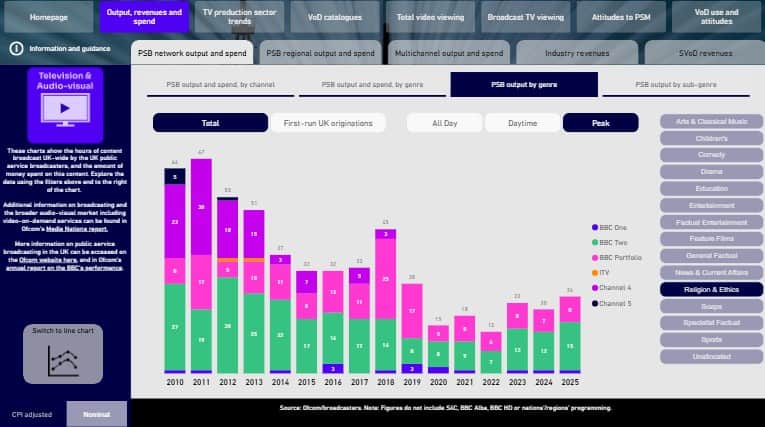
The total of peak-time (6pm to 10.30pm) religion and ethics output was up by 20 per cent from 2024 — rising from 20 to 24 hours, but down from 2011 when there were 67 hours (Diagram 3).
One hour was of this in 2025 was on BBC1 (the same as 2024), 15 hours were on BBC2 and eight hours were in “BBC Portfolio”. There was nothing on ITV, C4 or C5.
Original (first-run) content in peak hours
When it came to first-run content in peak hours (Diagram 4), there was an extra hour on BBC2, but the same number of hours as 2024 on BBC1.
However, first-run content in daytime hours (graph not shown) saw a slight increase from 71 hours to 75 hours on BBC1, presumably Songs of Praise. Original content for both daytime and peak hours has hugely declined from 2011-13, when there were about 50 hours of it — including on ITV and Channel 4 — in peak hours alone.