By Lianne Kolirin
A council is being established to build bridges between Britain’s Muslim and Jewish communities and work towards improving social cohesion.
Leading members of both communities will work side by side to tackle some of the biggest threats to inter-communal relations.
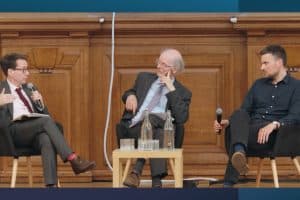
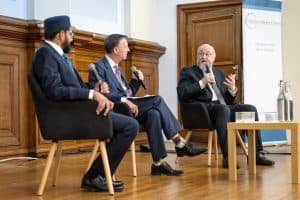
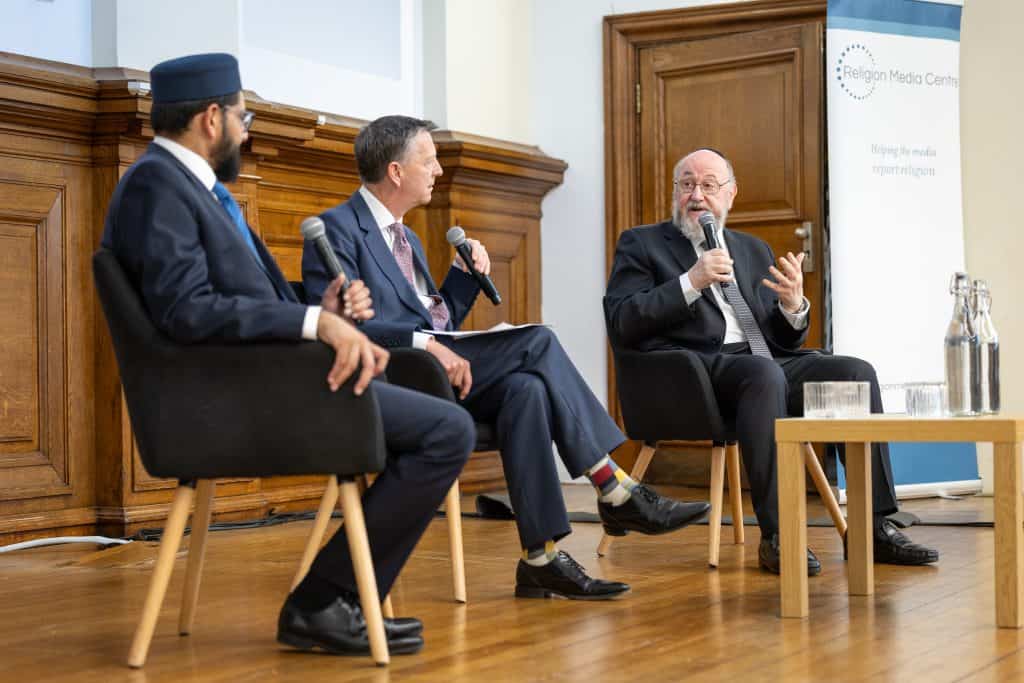
The news emerged at the Religion Media Centre’s annual festival on Monday in a conversation hosted by the former BBC home editor Mark Easton, who was interviewing the Chief Rabbi, Sir Ephraim Mirvis, and Imam Qari Asim, a senior imam at Makkah Mosque in Leeds.
Both men are signatories of the Drumlanrig Accords, an agreement aimed at strengthening relations between Muslim and Jewish communities in the UK. In early 2025 six Muslim leaders and six Jewish leaders met at Drumlanrig Castle in Scotland to sign the historic agreement — later presented to the King at Buckingham Palace — setting out a “framework of reconciliation, understanding and security”.
The idea was not to make a symbolic gesture, but a call to action committing both communities to working together “on practical initiatives that support the most vulnerable, tackling societal inequities such as discrimination, isolation, and poverty”.
Those who signed committed to the idea of a Muslim-Jewish Leadership Council, as well as four working committees covering education, civic engagement, charity work and religious freedom.
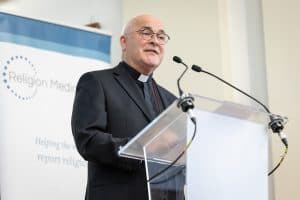
Sir Ephraim told the large gathering at Methodist Central Hall in Westminster that the council would be officially announced soon.
“We spent two days in seclusion in a castle in Scotland to show we get on well together,” he said. “We’re determined to carve out a common destiny, to not allow a conflict thousands of miles away to disturb social cohesion on our streets, and to guarantee that we will pledge to do our utmost to ensure that our communities can live in security and in peace together.”
Besides the historic document, he added, the signatories “now have a practical way forward, and we are delighted that we are nearly able to announce the creation of the Council of Muslims of Jews of Great Britain”, adding: “And that will be a direct consequence of Drumlanrig.”
Imam Asim said that the accords were concerned with “shared responsibility” and “about respectfully disagreeing with each other”.
He went on: “More importantly, it offers a practical framework on how we can work together to respond to some of the international events that are beyond our control. We can work together to ensure that hatred, dehumanisation and violence do not take place on our streets.”
Imam Asim stressed that while he “may disagree on many things with the Chief Rabbi” such as the policies of the Israeli government and the causes of the humanitarian crisis in Gaza, they could still work together to fight antisemitism and anti-Muslim hostility.
This would involve working to improve educational resources, poverty and other issues. “It will take time, because of the polarised environment, because at the moment we are trying to develop a common language to deal with some of the issues that are affecting our communities,” he said.
The discussion, the final one of a packed schedule of events for the one-day festival, followed a keynote speech delivered by the Chief Rabbi.
Sir Ephraim, leader of the United Hebrew Congregations of Great Britain and the Commonwealth, said the hard work of those involved in inter-faith work “nearly ground to a halt” after 7 October 2023 — when Hamas launched a murderous attack on Israel, triggering the bloody war in Gaza that left tens of thousands of Palestinians dead.
“Until the seventh of October, the slogan of all global interfaith was ‘let’s focus on all that brings us together and we will recognise that we have far more in common with others than that which separates us’ — and it worked beautifully.
“The trouble, however, was that on the seventh of October we weren’t tested on that which brought us together, we were tested on that which separated us and we were ill-prepared,” he said.
He said the approach taken by signatories at Drumlanrig was fundamentally different — and he was hopeful it would succeed.
“We have taken the elephant in the room and we’re placing it on the table,” he said. “We’re discussing Israel, its centrality to Jews, its centrality in Jewish faith, what it means to Muslims, what it means to Christians, and where we differ.
“We are honest about it and we’re discussing and raising our differences in a context of collegiality, of friendship, and of warmth. That’s how we can move forward together, so that next time round, if we are tested, we will be prepared, and the same, I believe, applies to social cohesion.”
The media, he said, had an enormous role to play in strengthening social cohesion by highlighting British values and reporting on the sensitive issue with caution.
He compared multicultural society to a symphony orchestra. “Each instrument has its own unique sound, and under the baton of the conductor the sounds blend together to produce perfect harmony,” he said. “That’s what we need to achieve in Britain today. We are different. We need to recognise our differences. We need to be proud of that which we live for and which sets us apart, and at the same time we need to respect others and give them the space to be themselves.
“Under the baton of human coexistence, we have the responsibility to create and to sustain harmony within our society.”
Mark Easton gave neither of the pair an easy ride, throwing them “curveball” questions, as he described them, on issues mainly centred on freedom of the press and expression. He questioned the imam on the wave of protests in 2021 over The Lady of Heaven, the film about the daughter of the Prophet Muhammad, and put the Chief Rabbi on the spot over claims of anti-Jewish bias at the BBC, as well as whether critical reporting of Israel constitutes antisemitism.
Circling back to the future council, however, he asked the imam how it might respond should a “terrible incident” take place tomorrow.
The imam replied that solidarity was already in evidence, with imams having reached out to the Jewish community after the Manchester synagogue attack on Yom Kippur in October last year.
“Similarly, very recently, when an attacker went around in Edinburgh attacking Muslims just because of their faith identity, the Chief Rabbi issued a statement to support the Muslim community,” he said.
Such statements went “a long way in diffusing tension between communities, but also encouraging people that yes, we can work together to tackle hatred and dehumanisation in this country,” Imam Asim added.
“One thing we have, I think, realised is that there have been deliberate attempts to stoke up antisemitism, anti-Muslim hate and increase community tensions, which have been orchestrated by foreign governments and political activists on their behalf.”
He warned of the danger of responding immediately, and said it was important to “stand together to root out all forms of hatred for the sake of a healthy society and for the sake of our home: Britain”.