
By Anna Averkiou
The controversy surrounding the so-called “Quiet Revival” has shaken many, but two leading researchers say it has left behind important lessons about how to interpret statistics on religion.
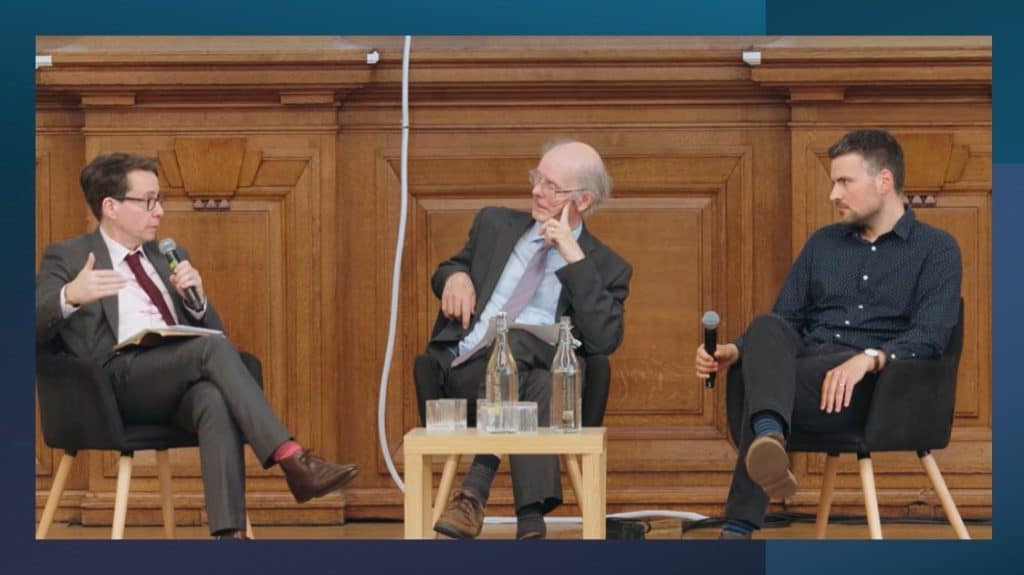
A panel discussion at this year’s Religion Media Centre Conference at Central Hall, Westminster, chaired by the journalist Tim Wyatt set out to move the conversation beyond the initial headlines, reflect on how data on religion was handled, and what can be learnt.
Bobby Duffy, from King’s College London, and Sir John Curtice, from the National Centre for Social Research and professor of politics at Strathclyde University, both urged greater caution, particularly when headline-grabbing findings appear to contradict long-term trends.
“If something surprises you that much, it’s probably wrong,” said Professor Duffy, describing it as a “rule of thumb” for pollsters. Rather than celebrating striking results, he added, researchers should first think: “Something’s gone wrong in this.”
The “Quiet Revival” was the title of a Bible Society report published in April 2025, which claimed monthly church attendance had spiked among members of Generation Z (those born between 1997 and 2012). However, the report was withdrawn after the polling data was found to be faulty.
The original study, which used YouGov polling, suggested that monthly church attendance in the UK had increased from 8 to 12 per cent between 2018 and 2024. Among the 18s to 24s the growth was from 4 per cent to 16 per cent. This surge was celebrated by church communities. However, sociologists and church leaders quickly questioned the findings, which contradicted other significant datasets including the official British Social Attitudes Survey.
One key lesson is the importance of long-term data. Both speakers pointed to decades of high-quality surveys showing gradual change rather than sudden shifts.
“You don’t … see those quick turnarounds in people’s behaviours or beliefs,” Professor Duffy said, noting that big changes in religious belief tended to change across generations; they were not dramatic turnarounds.
Professor Curtice agreed, highlighting the risk of focusing on exceptional claims instead of consistent evidence. “The exceptional gets noticed,” he said, while steady patterns such as long-term decline in Christian observance, with only partial recovery after the Covid-19 pandemic, often go under-reported.
The discussion also exposed the challenges of measuring religion accurately, especially when studying relatively rare behaviours such as regular church attendance. Small errors or unusual responses can quickly distort results when the underlying numbers are low.
“You only need a little bit of the wrong sort of data to really throw out your findings,” Professor Duffy warned.
This is particularly relevant for online panel surveys, where researchers cannot always be certain that respondents are who they claim to be. Professor Curtice noted that there can even be incentives to present oneself as a “rare” type of respondent, which can skew findings.
At the same time, the panel stressed that no method was perfect. Traditional random surveys are more robust but face falling response rates and rising costs. Online methods are faster and cheaper but require careful quality control.
“I think the answer … is that you should have a degree of scepticism about all survey work,” Professor Curtice said.
Professor Duffy warned of another lesson to be learnt from the role of human bias. “If something surprises you that much, it’s probably wrong — so double-check it’s not wrong!
“There is a lot of motivated reasoning in wanting something to be true,” he added, cautioning that both researchers and journalists could be drawn to narratives that felt significant or hopeful.
Finally, the panel suggested that eye-catching claims could distract from more meaningful trends. While the Quiet Revival focused attention on a supposed surge among young people, the underlying reality was more complex.
Churches may appear younger not because of a wave of new attendees, but because “older people … have broken the habit” of attending since the pandemic, Professor Curtice explained.
Both stressed that the episode underlined the need for patience and perspective when interpreting data. As Professor Curtice put it: “You cannot make a trend out of two time points.”
The Quiet Revival failed to hold up statistically, but the debate around it has sharpened understanding of how religious change is measured (and mismeasured) in modern Britain and offers a cautionary tale for both journalists and religious organisations: striking claims require rigorous scrutiny, especially when they challenge well-established trends.
Rather than signalling a sudden resurgence of faith, the episode reinforced a more complex picture of gradual change, shifting demographics and the enduring difficulty of measuring religion in modern Britain.